

Before you launch a client site, decide who will keep it alive.
The launch went well. The client loved the new site, the invoice was paid, and everyone moved on. Fourteen months later, the client calls on a Monday morning: the website is gone, and so is the company email.
Nothing was hacked. The domain expired. It had been registered under the personal account of an office manager who has since left, the renewal reminders went to an inbox nobody opens anymore, and auto-renew was tied to a card that expired the year before.
Agencies and freelancers hear versions of this story all the time, and it rarely has anything to do with the quality of their work. It comes from the part of a web project nobody puts in the proposal: the handful of accounts and dates that keep a site reachable after launch.
Three things that expire, and one that drifts
A typical small business website depends on a domain registration, an SSL/TLS certificate, a hosting account and the DNS records that tie them together. The first three have renewal dates. The fourth has no date at all, which is exactly what makes it risky.
Domain registrations usually run a year at a time. Registrars accredited by ICANN must send renewal reminders roughly a month and a week before a domain expires. Those reminders go to whatever email address is on the account, and years after launch that is often the wrong one.
Certificates now expire faster than they used to. Since March 15, 2026, newly issued public certificates can be valid for no more than 200 days, under rules set by the CA/Browser Forum. The limit falls to 100 days in March 2027 and to 47 days in March 2029. Most hosts renew certificates automatically, but automatic renewal tends to break quietly, after a server move, a DNS change or a new security service placed in front of the site.
DNS records don't expire. They get edited. The client switches email providers, someone in their office tidies up the registrar dashboard, and a record the website depended on disappears. The site goes down on a day when nobody touched the website itself.
Write the handover down
The fix is unglamorous and takes an afternoon. For each client site, keep one record that answers a few questions. Who owns the domain, and in which account does it sit? When does it expire, and is auto-renew on? Which card pays for it? Where does the certificate come from, and how does it renew? Who can edit DNS? And which email address receives the notices?
Then settle two things with the client, in writing.
First, the domain should belong to the client, in an account the client controls. Notices should go to a shared address the business will keep, not to one person who might leave. Ideally that address should not be on the same domain: if the domain lapses, that inbox stops working with it, at the exact moment the reminders matter.
Second, decide who watches the renewals after launch. If it is you, put it in the maintenance agreement and charge for it. If it is the client, tell them plainly which dates are now theirs to track.
Let a tool do the remembering
A spreadsheet goes stale the week after you make it, and the more client sites you look after, the less you can check by hand. Uptime monitoring services check each site on a schedule, alert you when it stops responding and, in many cases, warn you before a certificate or a domain runs out.
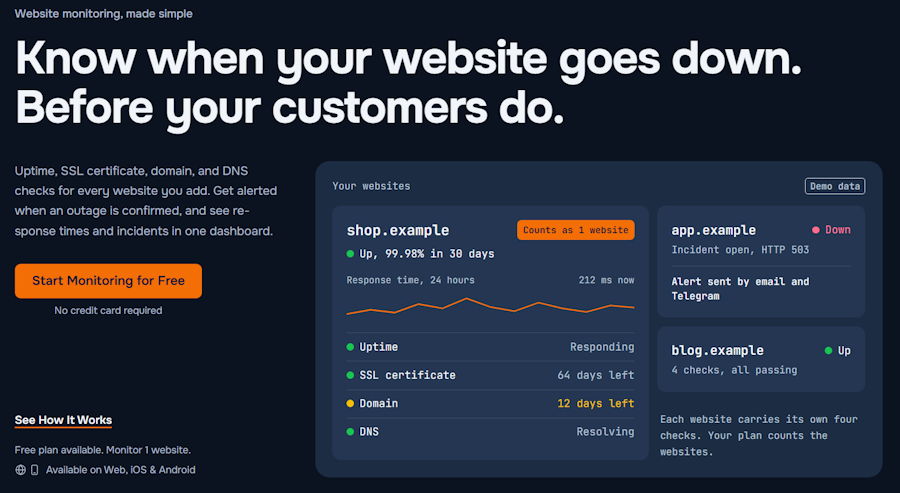
For agency work, a few features matter more than the rest. You want a dashboard grouped by client, so one screen shows who is fine and who needs attention. You want alerts that reach the person responsible for that client rather than a shared inbox that gets skimmed. And you want something the client can see. UptimeWire, for example, includes uptime, SSL certificate, domain and DNS checks with every site it monitors, and on its higher plans it sends each client a monthly availability report under your agency's name.
Make the invisible work visible
There's a business case here beyond avoiding the Monday call. Ongoing maintenance is hard to sell, because when it works, nothing happens. A short monthly note changes that: the site was up all month except for one 12-minute blip at night, the certificate renewed on the 9th, the domain is paid through 2028. That turns "nothing happened" into work a client can see, and is more likely to keep paying for.
And when something does break at 3 a.m., the client hears about it from you, with the fix already under way.

