

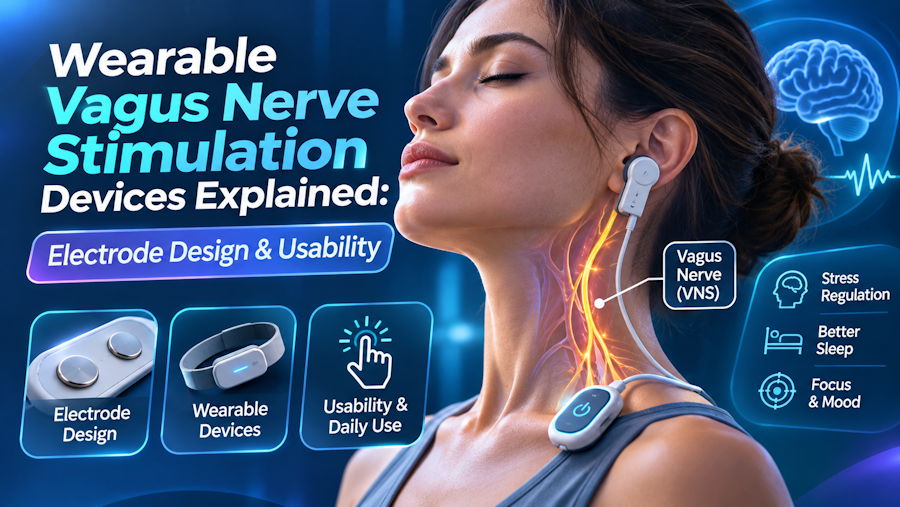
Most wearable electronics are designed to collect information from the body. Smartwatches measure heart rate, fitness bands track movement, and smart rings estimate changes in sleep and recovery. A wearable vagus nerve stimulation device operates differently. Instead of simply recording physiological signals, it delivers controlled electrical pulses through electrodes placed against the skin.
This introduces an interesting engineering challenge. The device must deliver a defined electrical output through an interface that changes with skin moisture, pressure, movement, and individual anatomy. In ear-based stimulation, the available contact area is particularly small, making electrode design an important part of the system.
Understanding these characteristics helps explain why two devices with similar specifications can produce noticeably different user experiences, and why the development of consumer vagus nerve stimulation technology involves considerably more than miniaturizing an electrical stimulator.
How a Wearable Vagus Nerve Stimulator Works
Transcutaneous auricular vagus nerve stimulation, commonly abbreviated as taVNS, uses electrical pulses applied to selected regions of the external ear associated with the auricular branch of the vagus nerve. These sensory nerve fibers provide a pathway toward brainstem networks involved in autonomic processing.
From a hardware perspective, an auricular vagus nerve stimulation device consists of several interconnected components:
- Power supply: Provides the electrical energy required for stimulation and control functions.
- Pulse generation circuit: Produces electrical pulses with defined waveform characteristics.
- Control system: Manages intensity, timing, preset programs, and session duration.
- Electrodes: Establish electrical contact between the device and the skin.
- User interface: Allows users to select and adjust the intended stimulation routine.
Unlike optical sensors that measure changes in reflected light, stimulation electrodes deliver electrical current into tissue. The quality of that connection influences the electrical load experienced by the output circuit and the sensation perceived by the user.
A successful stimulation system therefore depends on both its electronic architecture and its physical interface with the body. Accurate pulse generation alone cannot compensate for an electrode that repeatedly loses contact with its intended location.
Why Electrode Placement Matters
The external ear is supplied by several sensory nerves, including branches of the vagus nerve, trigeminal nerve, and cervical nerves. Its entire surface cannot be treated as a uniform stimulation target. Regions frequently investigated in taVNS research include the cymba conchae, cavum conchae, and inner tragus.
In a functional magnetic resonance imaging study involving 37 healthy participants, Yakunina and colleagues compared stimulation at four ear locations using a frequency of 25 Hz and a pulse width of 500 microseconds. Among the locations tested, stimulation at the cymba conchae produced the strongest activation of the investigated vagal pathway (Yakunina et al., 2017).
The finding has a practical implication for wearable design. An electrode needs to maintain contact with its intended anatomical region, not merely produce a sensation somewhere on the ear. However, the study does not establish that the cymba conchae is the optimal location for every stimulation protocol or commercial device.
Ear geometry also varies between individuals. A rigid clip designed around one ear shape may contact a slightly different region on another person. Shaped earpieces attempt to address this problem by incorporating the contours of the external ear into their mechanical design.
For engineers, anatomical repeatability is therefore an important design consideration alongside electrical performance.
The Electrode–Skin Interface: An Often Overlooked Engineering Problem
Electrical stimulation requires a reliable conductive path between the electrodes and tissue. However, skin does not behave like a resistor with a fixed value. Its electrical properties vary with hydration, contact pressure, electrode material, surface area, and the characteristics of the applied signal.
The outermost layer of the skin, the stratum corneum, presents a significant barrier to electrical conduction. Moistening an electrode or using an appropriate conductive gel can improve contact conditions, depending on the design of the stimulation system.
Consider a simplified current-controlled circuit. If the required current is 1 mA and the effective resistive load is 5 kΩ, approximately 5 V is required across that load. If the resistance increases to 15 kΩ, maintaining the same current would require approximately 15 V.
Real electrode–skin interfaces are more complex than this example because their impedance also contains reactive components. Nevertheless, the calculation demonstrates why an output circuit must operate within defined voltage and current limits.
Several practical design factors influence this interface:
| Design factor | Engineering consideration | Effect on usability |
|---|---|---|
| Electrode surface area | Influences current density and contact distribution | May affect localized discomfort |
| Contact pressure | Influences physical stability and interface properties | Excessive pressure can irritate the ear |
| Electrode geometry | Determines how the contact surface matches ear anatomy | Affects positioning repeatability |
| Skin hydration | Changes electrical contact conditions | May require water or conductive gel |
| Mechanical stability | Limits changes in contact during movement | Reduces the need for repositioning |
Current density is particularly relevant. If the same current passes through a smaller effective contact area, the average current density increases. Uneven contact can also concentrate current locally, producing unexpectedly sharp sensations even when the selected intensity has not changed.
This explains why increasing stimulation intensity is not an appropriate solution to poor electrode contact. The problem may be mechanical or electrical at the interface rather than insufficient output from the pulse generator.
Understanding Electrical Stimulation Parameters
A stimulation program is defined by several interacting parameters. Frequency alone provides an incomplete description of the electrical signal.
| Parameter | Unit | Meaning |
|---|---|---|
| Frequency | Hz | Number of pulses delivered per second |
| Pulse width | µs | Duration of an individual pulse or pulse phase |
| Current amplitude | mA | Magnitude of the delivered current |
| Duty cycle | % | Proportion of time during which stimulation is active |
| Session duration | Minutes | Total scheduled stimulation session |
For a simplified rectangular current pulse, electrical charge is calculated by multiplying current by pulse duration. A hypothetical 1 mA pulse lasting 200 µs delivers 0.2 microcoulombs of charge during that phase. Increasing the pulse width to 500 µs raises the charge to 0.5 microcoulombs without changing the current amplitude.
This relationship helps explain why two stimulation programs operating at the same current setting can feel different. Waveform shape, pulse duration, repetition frequency, and electrode characteristics all contribute to the delivered stimulation.
In 2018, Badran and colleagues investigated nine combinations of pulse width and frequency during auricular stimulation. Their experiments identified parameter-dependent changes in heart rate, with some combinations producing different responses from others (Badran et al., 2018).
Such findings are useful for understanding stimulation engineering, but they are not instructions for configuring a consumer device. A parameter combination associated with a particular cardiovascular response in a laboratory does not establish the ideal settings for relaxation, sleep, or another wellness outcome.
From Research Equipment to Consumer Wearable Design
Laboratory stimulation equipment allows researchers to control individual electrical parameters and test different electrode configurations. That flexibility is valuable in an experimental environment, where protocols can be documented, supervised, and adjusted by trained personnel.
Consumer electronics face a different design problem: users should be able to operate the device without understanding electrical waveform programming.

Modern wearable vagus nerve stimulation devices are increasingly designed around specific anatomical targets rather than generic ear clips. ZenoWell, for example, uses a dual-contact electrode design that covers the cymba conchae and cavum conchae—the upper and lower bowl-shaped areas of the outer ear. The cymba conchae serves as the primary vagal target, while the cavum conchae extends the contact area. Together, these regions form a stimulation configuration known as CCX.
The design is informed by anatomical and electrophysiological research. In a 2021 study involving 26 participants, García de Gurtubay and colleagues found that stimulating both conchal regions produced larger vagus-related evoked responses than stimulating the cymba conchae alone. Larger electrodes also increased the threshold at which stimulation became painful, suggesting a potential advantage in comfort. These findings support the engineering rationale for combined coverage, although they do not establish superior clinical outcomes for every device using this configuration.
For everyday use, ZenoWell incorporates this electrode arrangement into a fitted earpiece designed to maintain stable contact with both regions. A silicone sleeve helps secure the earpiece, while water or conductive gel supports electrical conductivity. Rather than manually configuring pulse frequency and duration, users can select a preset stimulation program and adjust the intensity within a comfortable range.
This approach illustrates how several technical variables can be managed through a relatively simple interface. Rather than allowing users to configure frequency and pulse width independently, preset programs can define combinations of settings and session timing. The manufacturer remains responsible for explaining the intended use and operating limits.
For a prospective user, the differences become tangible: the shape of the earpiece, the number of setup steps required, the availability of direct controls, and whether an application is necessary to begin a session.
These characteristics describe the product's engineering and usability. They do not establish that its stimulation programs reproduce the clinical outcomes of unrelated research protocols.
Constant Current, Constant Voltage, and Output Limits
Electrical stimulators may use current-controlled or voltage-controlled output architectures. In a simplified voltage-controlled system, changes in load impedance affect the resulting current. A current-controlled system instead adjusts its output voltage, within defined limits, to maintain the requested current.
Neither architecture removes the requirement for stable electrode contact.
A current-controlled output has a maximum voltage it can provide, often described as its compliance voltage. If the load becomes too high, maintaining the requested current may no longer be possible. This is one reason engineers must consider the expected range of electrode–skin impedance when designing a stimulator.
Waveform design introduces another consideration. Biphasic pulses use phases of opposite polarity and can be designed to minimize net charge accumulation at the electrode interface. Charge balancing, output limits, and fault handling are important engineering concepts in electrical stimulation systems.
Consumers should not assume that every wearable implements identical protection mechanisms. Hardware specifications, contact monitoring, automatic shutoff behavior, and output control should be confirmed through documentation for the specific device.
How Software Influences the User Experience
Software can contribute to usability even when the primary function of a wearable is electrical stimulation rather than data collection.
Embedded control logic may manage session timers, intensity adjustments, programmed stimulation intervals, battery status, and transitions between operating modes. Connected models can introduce additional functions through a mobile application, including guided sessions, configuration interfaces, and usage records.
There is a meaningful difference between displaying session information and operating a closed-loop stimulation system.
A device that records heart-rate variability alongside stimulation is not necessarily adjusting its electrical output automatically in response to that measurement. A genuine closed-loop system requires a defined feedback mechanism that uses measured information to modify stimulation according to a control algorithm.
This distinction is particularly relevant when evaluating claims about intelligent or personalized wellness technology. Connectivity, session history, and biometric integration may improve the user experience, but they do not independently demonstrate adaptive neuromodulation.
Standalone operation also remains valuable. A wearable intended for quiet evening sessions may benefit from direct controls that allow it to operate without Bluetooth pairing, notifications, or repeated interaction with a smartphone.
What Happens During a First Stimulation Session?
The setup process reveals several design decisions that are difficult to evaluate from a specification sheet.
A well-documented device should explain the intended stimulation site, electrode preparation, expected sensations, recommended operating limits, and what to do when contact becomes uncomfortable.
A typical preparation process includes:
- Inspecting the earpiece, cable, and contact surfaces for damage.
- Preparing the electrodes according to the manufacturer's instructions.
- Positioning the earpiece before increasing stimulation intensity.
- Selecting the intended preset program and following its session guidance.
- Stopping stimulation if painful or unexpected sensations occur.
A practical ear vagus nerve stimulator guide can help beginners understand how positioning, conductivity, intensity adjustment, and session timing fit together.
An important point is that users should not improvise electrode positions or reproduce experimental stimulation parameters found in scientific papers. Research protocols are not universal operating instructions, and a general-purpose TENS unit with an aftermarket ear clip is not automatically equivalent to a dedicated taVNS system.
Why Research Transparency Belongs in a Hardware Comparison
When comparing wearable stimulation technology, consumers often encounter research references alongside descriptions of relaxation, sleep, and recovery. The difficulty is determining whether the cited research actually evaluates the same hardware and stimulation protocol.
International consensus recommendations for transcutaneous VNS research identify electrode placement, waveform characteristics, intensity, frequency, pulse width, stimulation timing, and other methodological details as important reporting requirements (Farmer et al., 2021).
Without those details, reproducing an experiment or comparing its findings with another stimulation system becomes difficult.
Safety evidence must also be interpreted at the appropriate level. A 2022 systematic review covering 177 taVNS studies and 6,322 participants reported generally encouraging tolerability under investigated conditions, although adverse-event reporting was incomplete. Ear discomfort, tingling, and headache were among the reported effects (Kim et al., 2022).
The findings do not guarantee that every consumer device is suitable for every individual. People with implanted electronic devices, relevant cardiovascular conditions, pregnancy, or other significant medical concerns should review product-specific contraindications and seek professional guidance before use.
Final Thoughts
The development of wearable vagus nerve stimulation involves an unusual combination of electrical engineering, neuroanatomy, mechanical design, and human–computer interaction.
Electrode placement determines the intended anatomical target. Contact design influences the consistency of the electrical interface. Pulse generation defines the stimulation signal, while control software determines how easily users can operate the system within its intended limits.
For consumers, the most revealing product specifications are those that explain how these components work together. A thoughtfully designed stimulation wearable should make correct positioning, comfortable operation, and repeatable sessions straightforward while communicating the limits of its supporting evidence.
References
- Yakunina, N., Kim, S. S., & Nam, E. C. (2017). Optimization of Transcutaneous Vagus Nerve Stimulation Using Functional MRI. Neuromodulation, 20(3), 290–300.
- Badran, B. W., et al. (2018). Short Trains of Transcutaneous Auricular Vagus Nerve Stimulation (taVNS) Have Parameter-Specific Effects on Heart Rate. Brain Stimulation, 11(4), 699–708.
- Farmer, A. D., et al. (2021). International Consensus Based Review and Recommendations for Minimum Reporting Standards in Research on Transcutaneous Vagus Nerve Stimulation (Version 2020). Frontiers in Human Neuroscience, 14, 568051.
- Kim, A. Y., et al. (2022). Safety of Transcutaneous Auricular Vagus Nerve Stimulation (taVNS): A Systematic Review and Meta-Analysis. Scientific Reports, 12, 22055.
- García de Gurtubay, I., et al. (2021). Evaluation of different vagus nerve stimulation anatomical targets in the ear by vagus evoked potential responses. Brain and Behavior, 11(11), e2343.

