

Shanghai, China, November 16, 2026 — Vertex Lab asked Astra and Fable to rebuild a sci-fi industrial platform inside a cavern from the same concept art. Both AI agents used V2Fun to generate a control cabin, cargo crates, and rock clusters, then modeled decks, railings, and other structures in Blender. Both delivered Blender projects that could be reopened and renders from three viewpoints. The rear views exposed gaps that were easy to miss in the main renders. An opening in Fable's cavern revealed the space outside, while Astra's scene showed a straight edge where the ground ended.
The V2Fun cavern reconstruction test includes the renders from all three viewpoints, a breakdown of both Blender projects, and a diagram comparing the height of the platforms.
How the Two Agents Built the Platform
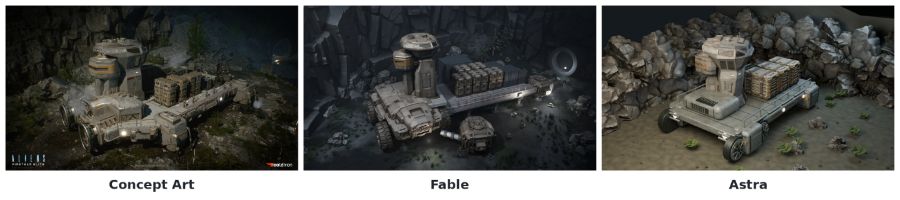
From the main camera angle, Fable preserved more of the depth in the concept art. Rock walls and rising terrain extended behind the platform. Its biggest change was at the front. Fable turned the drive unit into a long vehicle and mounted the control tower on top, changing the silhouette of the whole platform. Astra kept the control cabin's wider upper section and narrower base. Its thin chassis and narrow wheels made the equipment look lighter than it did in the concept art.
Fable used V2Fun for seven asset categories, including the drive unit, equipment pods, and sections of rock wall. Astra used it for the three required categories and modeled parts such as the chassis and wheels in Blender. Fable reduced mesh density and resized textures, packing 14 textures at resolutions from 1K to 4K. Astra retained denser meshes and packed six 8K textures. The final Blender projects were 65.52 MB for Fable and 271.69 MB for Astra. The teams' reference images and render settings differed, so the comparison focused on the delivered projects and renders.
What the Rear Views Revealed
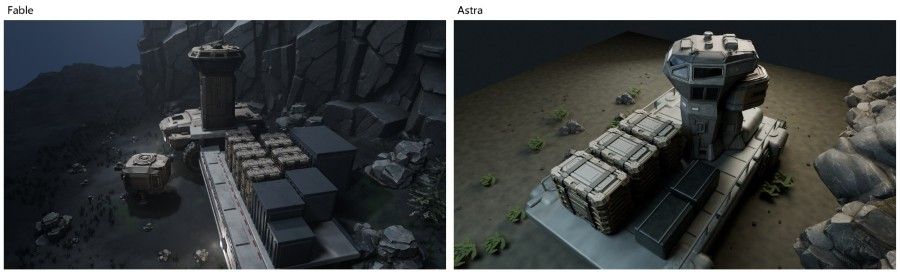
Fable built a separate side walkway about 13 meters long and 1.5 meters wide, though the route from the cavern floor to the deck was incomplete. Its deck sat 2.60 meters above the ground, compared with 1.75 meters in Astra's build. Astra gave the cabin and cargo distinct places on the deck, with a continuous path along the side still to be worked out.
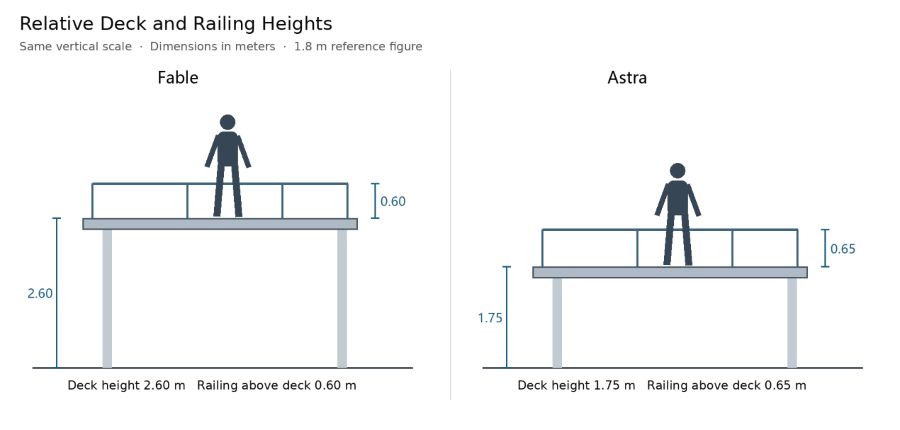
The brief called for a static scene, and the concept art showed only part of the platform. A playable version would need a route onto the deck, followed by checks for clearance, collision, and sightlines at player height. Fable's modeled walkway width gives the team a starting point. Railings, cargo, and collision geometry would determine how much of that space a player could actually use.
About Vertex Lab and V2Fun
Vertex Lab develops technology for 3D generation and spatial intelligence. Its V2Fun platform offers tools for generating, texturing, and animating 3D assets. Learn more at v2fun.ai.
Media Contact
Vertex Lab
[email protected]

