

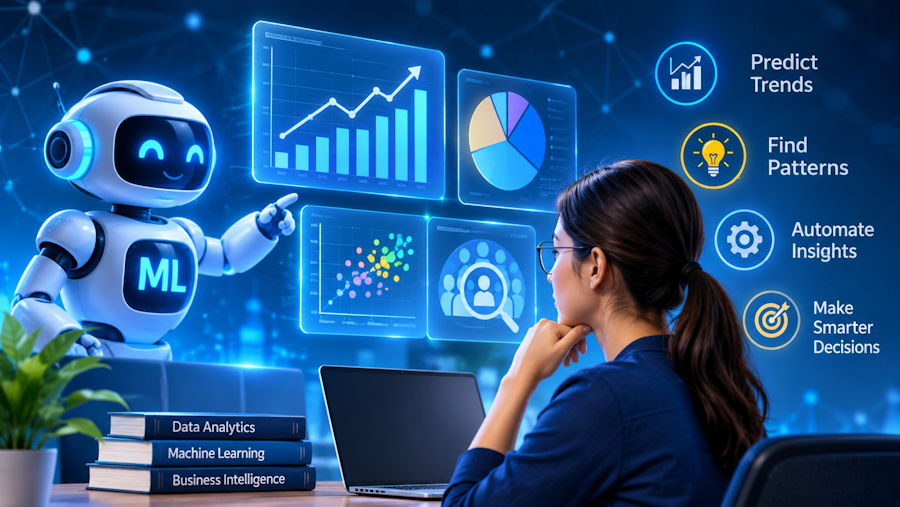
Businesses may better comprehend information, spot patterns, and make choices with the aid of data analytics. As organisations generate large amounts of data every day, traditional methods of analysing information may not always provide accurate or timely results. This is where Machine Learning (ML) becomes useful. Machine Learning helps computers analyse large datasets, recognise patterns, and make predictions without requiring continuous human instructions.
Businesses may enhance their decision-making procedures, automate challenging operations, and get insightful knowledge by fusing machine learning with sophisticated data analytics. From customer behaviour analysis to financial forecasting, Machine Learning is transforming how organisations collect, process, and understand data. Learning these technologies through a Data Analytics Course in Chennai can help aspiring professionals understand modern analytical techniques and their applications in real-world business environments.
1. Understanding Machine Learning in Data Analytics
Computer systems may learn from data and gradually improve their performance thanks to machine learning, a subfield of artificial intelligence. Instead of manually analysing every dataset, ML algorithms identify patterns and relationships automatically.
In advanced data analytics, Machine Learning helps process structured and unstructured data, including customer records, website activities, sales reports, and business transactions. These capabilities allow analysts to discover insights that may be difficult to identify through traditional analytical methods.
2. Automating Data Processing and Analysis
Data preparation is one of the most time-consuming activities in analytics. Businesses often work with large datasets containing missing values, duplicate records, and inconsistent information.
Machine Learning helps automate several data processing activities, such as:
- Identifying missing or incorrect data.
- Detecting duplicate records.
- Classifying information into relevant categories.
- Recognising unusual patterns in datasets.
- Reducing manual data preparation efforts.
Automation allows data analysts to spend more time interpreting results and developing useful business strategies instead of performing repetitive tasks.
3. Improving Predictive Analytics
Predictive analytics uses historical information to estimate future outcomes. Machine Learning improves this process by identifying relationships within historical datasets and applying them to new information.
For example, retail businesses can analyse previous sales records to predict future product demand. Financial organisations can evaluate transaction patterns to identify potential risks, while marketing teams can predict customer preferences.
Businesses may create predictive solutions with the use of machine learning techniques like regression models, random forests, and decision trees. These predictions support better planning, resource allocation, and business performance.
4. Identifying Hidden Patterns and Trends
Large datasets often contain valuable information that cannot be identified through basic reporting. Machine Learning algorithms can examine different data points and discover hidden relationships.
Clustering techniques help group similar customers based on their purchasing behaviour, preferences, or demographics. Classification algorithms organise information into predefined categories, making it easier to understand complex datasets.
These techniques are useful in several industries:
- Healthcare: Identifying patterns in patient records.
- Retail: Understanding customer purchasing behaviour.
- Banking: Recognising unusual transaction activities.
- Manufacturing: Identifying production performance trends.
- Marketing: Understanding customer engagement patterns.
By discovering these patterns, organisations can develop more effective strategies and improve operational performance.
5. Enhancing Real-Time Data Analytics
Modern businesses need quick insights to respond to changing market conditions. Real-time analytics helps organisations monitor information as it is generated.
Machine Learning supports real-time analytics by processing incoming data and identifying important changes. For example, e-commerce platforms can analyse customer activities to recommend relevant products. Banks can monitor financial transactions to detect suspicious activities.
Similarly, manufacturing companies can use sensor data to monitor equipment performance and identify possible failures. This improves operational efficiency and helps businesses respond to problems more quickly.
6. Improving Business Decision-Making
Making business decisions based on accurate information is essential for long-term growth. Machine Learning improves decision-making by providing predictions, identifying risks, and highlighting important trends.
For example, sales managers can use analytical models to understand product performance and forecast revenue. Marketing teams can identify which campaigns generate better customer engagement.
These insights help organisations reduce uncertainty and make decisions based on measurable information rather than assumptions.
7. Popular Machine Learning Technologies Used in Data Analytics
Several tools and programming technologies help professionals implement Machine Learning solutions in advanced data analytics.
Some commonly used technologies include:
- Python: Supports data analysis and Machine Learning development through libraries such as Pandas, NumPy, and Scikit-learn.
- R Programming: Helps perform statistical analysis and data visualisation.
- TensorFlow: Supports the development of advanced Machine Learning and deep learning models.
- Apache Spark: Processes large datasets across distributed computing environments.
- Power BI: Helps present analytical results through interactive dashboards and reports.
Acquiring knowledge of these technologies enables future professionals to comprehend how machine learning models are created and used to solve practical business issues.
8. Future Scope of Machine Learning in Advanced Data Analytics
The future of advanced data analytics will increasingly depend on automation, intelligent systems, and predictive technologies. Machine Learning is expected to support various applications, including business forecasting, customer analysis, fraud detection, and operational management.
As organisations continue adopting data-driven strategies, professionals need to develop relevant technical skills to meet industry requirements. Learning through a Machine Learning Course in Chennai can provide an understanding of programming, statistical analysis, data visualisation, and machine learning algorithms.
Combining these skills with practical projects and real-world experience can help aspiring professionals explore career opportunities in the growing data analytics field.
Conclusion
Machine Learning is transforming advanced data analytics by automating data processing, improving predictions, identifying hidden patterns, and supporting faster business decisions. Its applications across industries demonstrate how intelligent technologies can turn complex information into meaningful insights.
As businesses continue generating larger volumes of data, combining analytics with Machine Learning will become increasingly important. Developing knowledge of analytical tools, programming languages, and Machine Learning techniques can help professionals build the skills required to work with modern data-driven technologies.

