

Custom WooCommerce Development: Is Going Headless Worth It? A Cost and Benefit Breakdown
Headless is worth it for some WooCommerce stores, but not most. It pays off when speed, content reuse or a fully custom storefront drives revenue. For stores on standard features, a well-tuned traditional build usually wins on cost.
This guide explains what custom WooCommerce development looks like in a headless setup, what it costs and what you get back. You will also see where Sanity CMS development and headless commerce development services fit, so you can decide with numbers, not hype.
What Does Headless Mean for a WooCommerce Store?
In a standard store, WooCommerce and WordPress run everything: products, checkout, content and the theme shoppers see. A headless store splits those jobs.
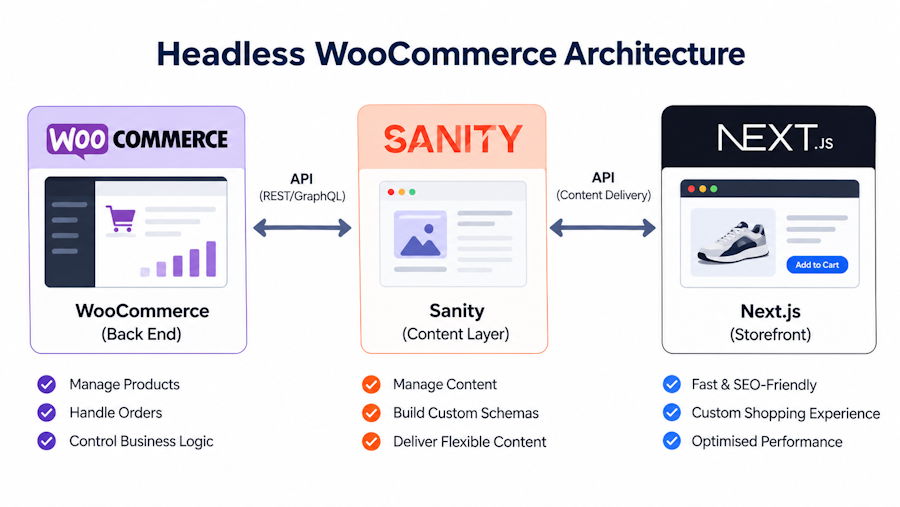
WooCommerce keeps managing orders, stock, payments and customers. A separate front end, often built with Next.js, handles the storefront. The two talk through APIs, such as the WooCommerce REST API and Store API, or WPGraphQL.
Where Does Sanity Fit?
Many teams also move content out of WordPress. Sanity is a headless content platform where editors manage landing pages and buying guides in a customisable studio. The storefront pulls that content through an API. Projects like this need Sanity CMS development alongside the WooCommerce work.
What Are the Real Benefits of Going Headless?
Faster Pages, If Speed Is Your Bottleneck
Speed has commercial value. Google and Deloitte studied 37 brand sites and more than 30 million sessions. A 0.1-second faster mobile load lifted retail conversion by 8.4% and average order value by 9.2%, according to Google's Milliseconds Make Millions study. The study observed live sites rather than running controlled tests, so treat it as direction, not a promise. Stores that already load fast will gain less than slow ones.
Full Control of the Customer Experience
A custom front end lets you design product discovery, bundles and B2B journeys around your customers instead of a theme's limits.
One Content Source for Every Channel
With Sanity, editors update content once and it feeds your website, app and email. Developers stop copying text between systems.
Independent Scaling
The storefront sits on its own hosting, so you can cache and scale it separately from WordPress.
Get a headless WooCommerce cost estimate
What Does Headless WooCommerce Really Cost?
WooCommerce is free, but you now build and run more than one system. Budget for these items:
- Front-end build: product pages, search, cart and account areas.
- Integrations: payments, shipping, ERP and CRM connections.
- Content modelling: Sanity schemas and page migration.
- Plugin replacement: features that used to come from plugins.
- Hosting: WordPress plus front-end hosting.
- Ongoing support: developers who know React and the WooCommerce APIs.
Costs vary with catalogue size and integrations, so ask for a scoped quote and compare three-year totals. As a rule, headless costs more upfront because you build more of the storefront yourself.
Try this illustrative test. Say your store earns A150,000 in revenue. At a 30% gross margin, that is A135,000, conversion gains alone will not repay the investment. Swap in your own numbers.
Headless vs Traditional WooCommerce at a Glance
| Factor | Traditional WooCommerce | Headless WooCommerce |
|---|---|---|
| Upfront cost | Lower | Higher |
| Speed ceiling | Good with optimisation | Highest, with engineering effort |
| Design freedom | Limited by the theme | Close to unlimited |
| Plugin compatibility | Full | Partial; many need rebuilding |
| Content reuse | Mostly the website | Web, app and other channels |
| Ongoing maintenance | One stack | Two or three systems |
| Time to launch | Shorter | Longer |
What Do Most Teams Underestimate?
Plugins. Many plugins output code through the theme, so they disappear on a headless front end. Subscriptions, product add-ons and filters often need custom work.
Checkout. Baymard Institute's review of 50 studies puts average cart abandonment at 70.22%. It also estimates that fixable checkout usability issues could lift conversion by 35.26% for the average large site. A custom checkout can help, but it adds build and security work. Many teams keep the WooCommerce checkout at first.
SEO. You must rebuild metadata, sitemaps, schema, canonical tags and redirects on the new front end. Editor previews also need setup.
When Is Headless Worth It?
Go headless when:
- Revenue is high enough that small conversion gains cover the build.
- Mobile speed is a proven problem that tuning has not fixed.
- You sell across channels and need one content source.
- You need custom journeys, such as configurators or complex B2B pricing.
- You have developers to maintain the front end.
Stay traditional when:
- Your store runs mostly on standard plugins.
- Your Core Web Vitals are close to passing.
- You have a small team and no developer support.
- Your catalogue and content are simple.
Most stores in the second group get better returns from caching, image optimisation and tidier custom WooCommerce development on their current theme. Our guide to WooCommerce trends for Australian store owners covers those options.
How Should You Decide?
- Measure first. Check Core Web Vitals in Search Console and run PageSpeed Insights on key product pages.
- Fix the cheap problems. Tune images, hosting, caching and plugins.
- Value the upside. Run the break-even test with your own margin.
- Audit your plugins. List the ones you cannot lose.
- Start small. Go headless on landing and category pages first, and keep the WooCommerce checkout.
This staged route lowers risk and gives you real data before you commit.
Final Thoughts
Headless is a business decision, not a technology trend. Run the numbers, test the cheaper fixes, then decide.
Magneto IT Solutions is an Australian, Driven digital commerce solutions Company offering custom WooCommerce development, Sanity CMS development and headless commerce development services. If you want a straight answer on whether headless fits your store.
Frequently Asked Questions
Is headless WooCommerce worth it for small stores?
Usually not. A small store rarely earns enough extra revenue to repay a custom front end. Optimising a standard WooCommerce build often delivers most of the speed gain at a lower cost.
How much does headless WooCommerce cost?
It costs more than a standard build, because you develop and host a separate front end and often a content platform. The total depends on your integrations, catalogue and plugins. A scoped quote and a three-year cost comparison give the most reliable answer.
Will my WooCommerce plugins still work?
Back-end plugins, such as stock, shipping and order management tools, usually keep working. Plugins that rely on theme output, like many filters, add-ons and page builders, often need rebuilding or replacing.
Does headless improve SEO?
It can, mainly through faster pages and cleaner markup, but not automatically. Your team must rebuild metadata, sitemaps, schema and redirects. A poorly planned migration can lose rankings.
Why pair Sanity CMS with WooCommerce?
WooCommerce handles commerce data well, while Sanity gives editors flexible, structured content that you can reuse across channels. The pairing suits brands with rich content, many landing pages or several sales channels.
Can I go headless in stages?
Yes. Many teams start with content or landing pages, then move category and product pages once results justify it. Keeping the WooCommerce checkout at first reduces risk.

