

Changing LoRA rank looks like a capacity adjustment. You increase the size of the trainable adapter, keep the learning rate, and compare the result. But unless you also record the scaling rule, the experiment may change more than you intended.
Rank, alpha, and learning rate interact. Before deciding that a higher rank needs a smaller learning rate, establish what happened to the adapter's actual multiplier. That is the detail that makes apparently conflicting tuning advice easier to interpret.
Record the parameterisation first
LoRA adapts a model by training low-rank matrices while keeping the underlying model weights frozen. In the standard parameterisation, the weight update is written as:
ΔW = (alpha / r) × B × A
Here, r is the adapter rank. The matrices A and B determine the learned update, while alpha / r scales it. The learning rate controls the optimiser's parameter updates during training; it is not the same setting as alpha.
This gives a basic experiment two separate questions. How much adapter capacity are you allocating? And how is the resulting update scaled? Recording only rank and learning rate leaves the second question unanswered.
The original LoRA work explains the low-rank adaptation approach. Choosing a learning rate still requires attention to the model, data, optimiser, and scaling convention used in your experiment.
Three rank sweeps can change scaling differently
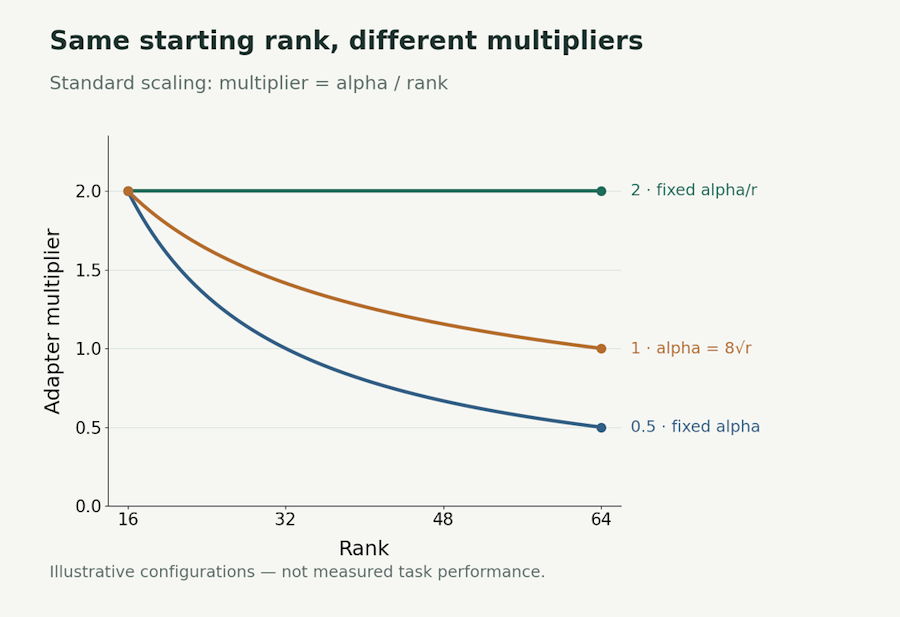
Suppose you move from rank 16 to rank 64 using the standard formula. The following examples show three possible choices. The values are illustrative configurations, not recommended defaults.
| Rule | Alpha at rank 16 | Alpha at rank 64 | Multiplier at each rank |
|---|---|---|---|
| Hold alpha at 32 | 32 | 32 | 2, then 0.5 |
| Hold alpha/r at 2 | 32 | 128 | 2, then 2 |
| Set alpha to 8 × sqrt(r) | 32 | 64 | 2, then 1 |
These configurations start with the same rank and multiplier. They reach the higher rank through different scaling choices. Calling all three “a rank increase with the same learning rate” conceals a material difference in the experiment.
The multiplier alone is not a complete prediction of training behaviour. The learned matrices, their initialisation, optimiser state, and data also matter. It is a useful configuration check, not a substitute for evaluation.
Read directional advice within its assumptions
Research published by Mind Lab examines how learning-rate transfer changes with alpha scaling. Its simplified early-update analysis uses a quantity proportional to learning_rate × alpha² / r as a proxy for the first effective update. The argument assumes the usual starting point of a random A matrix and a zero B matrix; it does not model the full optimiser dynamics.
Within that argument, holding alpha/r constant makes the proxy grow as rank increases. Holding alpha constant makes it shrink. Making alpha proportional to the square root of rank removes that rank dependence from the proxy.
Those relationships help explain why different scaling rules suggest different search directions. AdamW's behaviour over a complete training run still needs to be checked empirically.
Mind Lab's study of LoRA rank learning rate relationships makes another useful distinction: in its reported experiments, a similar learning rate can work best across several ranks even when the resulting task performance is weaker than that of another scaling rule.
That is an important reading habit for tuning results: ask both where the good region sits and how good the resulting model is.
Check whether the library uses rank-stabilised scaling
Hugging Face PEFT exposes a setting called use_rslora. Its documented rank-stabilised scaling uses alpha / sqrt(r), rather than the standard alpha / r.
The same numerical alpha therefore means different things across these modes. At rank 64, alpha 32 produces a multiplier of 0.5 under standard scaling and 4 under rank-stabilised scaling. Switching the flag while keeping the rest of the printed configuration unchanged still changes the multiplier.
There is also a notation trap. Under the standard formula, setting alpha to c × sqrt(r) gives a multiplier of c / sqrt(r). Under rank-stabilised scaling, holding alpha at c gives that same multiplier. The alpha values written in the two configurations are different, even though the resulting multiplier matches.
This algebra only compares the scaling factors. It does not establish that two entire training setups will be equivalent. Other implementation and configuration differences still need checking.
Record the library version, scaling mode, rank, alpha, and calculated multiplier together. If a team member can only see r=64 in the experiment tracker, they cannot reconstruct the comparison above.
Design a sweep that answers one question
Begin with a baseline run that you can reproduce sufficiently for the intended comparison. Save the base-model revision, adapter target modules, data version, optimiser, schedule, batch settings, and training duration alongside the scaling configuration.
Choose the question before choosing the grid. If the question is whether increasing rank helps under a fixed scaling convention, keep that convention explicit across ranks. If you also change the scaling mode, treat it as another experimental factor rather than a hidden default.
For a first comparison at the new rank, keep your current learning rate as a reference and test a few nearby lower and higher values. If alpha/r stays fixed, give the lower range particular attention; under the other rules, do not assume a reduction is necessary. These are starting points for a search. Compare task scores and stability under the same stated budget before choosing a setting.
Use a small search first, with a training budget that can expose clear instability or a promising region. Compare more than the single best point. A narrow peak that disappears under a slight setting change may be less useful operationally than a wider region of acceptable performance.
Inspect training behaviour and task outcomes separately. A smooth loss curve does not establish that the adapted model performs the task well. Equally, one good evaluation result deserves closer checking if the run was unstable or the evaluation set was tiny.
If the best result lies at the edge of the learning-rate grid, record that boundary. You have found the best tested value, not established that the optimum lies inside your range. Expand the relevant part of the search only when the earlier results justify the additional work.
Be explicit about what an equal budget means. Equal training steps, equal tokens, and equal wall-clock time answer different comparison questions, especially when a rank change alters resource use. Choose the basis that matches the decision you are making, record the alternatives that were not held equal, and avoid describing the experiment as controlled in every respect.
Keep a comparison record someone else can read
For each candidate, record what changed and what stayed fixed. Include the scaling factor as a calculated field, then report task scores, the evaluation cases used, and the run's resource requirements. Keep development comparisons separate from the held-out evaluation used for the final choice.
A larger adapter may improve one task and leave another unchanged. Whether that gain justifies its training and serving requirements depends on the application. Increasing rank is not itself evidence that a model has become more useful.
If the measured difference is small, check whether it survives another run under the same conditions before building a recommendation around it. Record seeds and variation where relevant. A single favourable result can identify a candidate worth investigating without establishing a generally better configuration.
When a rank change disappoints, return to the configuration before copying a learning rate from another tutorial. Identify the actual scaling rule, inspect the tested performance region, and make the next experiment small enough that its result will tell you something.

