

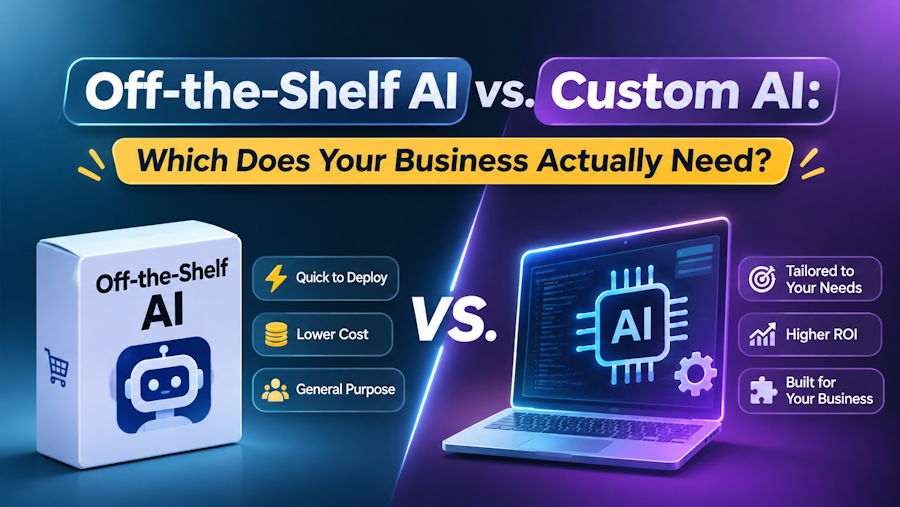
Off-the-shelf AI is a ready-made product, such as a chatbot or writing assistant, that any company can subscribe to, while custom AI is built or configured around one company’s own data, workflows and systems. The right choice depends on how unique your process is, how sensitive your data is and how deeply the AI must connect to the tools you already run.
Key Takeaways
- Off-the-shelf tools are faster and cheaper to start but solve generic problems.
- Custom AI pays off when your process, data or integrations are specific to your business.
- Many companies use a hybrid: a commercial model plus custom integration and workflows.
- Data privacy and control are often the deciding factors in regulated industries.
- Total cost of ownership matters more than the first-year price.
What is the real difference between off-the-shelf and custom AI?
Off-the-shelf AI is built for the average user. It works well for general tasks like drafting emails, summarizing documents or answering common questions. You pay a subscription, sign in and start using it the same day.
Custom AI is shaped around your business. It reads your documents, follows your approval rules and writes results back into your CRM, ERP or ticketing system. Today, most custom AI does not mean training a model from scratch. It usually means connecting a proven large language model to your own data and processes. Companies looking at AI automation services are typically after this deeper fit, not a brand-new model.
When is off-the-shelf AI the better choice?
Choose a ready-made tool when the task is common across industries and does not need your internal data. Personal productivity, meeting notes, general research and first drafts are good examples. It is also the right way to test interest: give a team a subscription and see how they use it before investing further.
When does custom AI make more sense?
Custom AI earns its cost in four situations:
- Your process is unique. For example, a specific claims review or underwriting flow.
- The work depends on internal data. Contracts, product catalogs, policies or customer history.
- The AI must act, not just answer. Creating records, routing approvals or updating systems.
- Compliance is strict. Healthcare, banking and government often need tight control over where data goes.
In these cases, a generic tool forces people to copy and paste between systems, which erases most of the time savings. This overview of how custom AI streamlines operations shows the kinds of workflows where tailored AI makes the biggest difference.
Is a hybrid approach possible?
Yes, and it is now the most common path. A company licenses a strong commercial model, then builds custom pieces around it: secure data connections, retrieval over internal documents, business rules and human review steps. This gives near-custom results without the cost of building a model, and it keeps the option to switch model providers later.
How should you compare the total cost?
Look beyond the first invoice. Off-the-shelf tools charge per user, so costs grow with headcount. Custom solutions cost more upfront but can be cheaper at scale, especially when they replace manual work across a whole department. Include integration, security reviews, training and ongoing maintenance in both estimates before you decide.
Frequently Asked Questions
Is custom AI only for large enterprises?
No. Mid-sized companies often benefit most, because a single well-chosen workflow can save significant staff time.
Do we need to train our own AI model?
Rarely. Most custom solutions use an existing model connected to your data and rules.
How long does a custom AI project take?
A focused first use case often takes 6 to 12 weeks, depending on data access and integrations.
Can we start off-the-shelf and move to custom later?
Yes. Starting with a commercial tool is a low-risk way to learn which workflows deserve deeper investment.
Is custom AI more secure?
It can be, because you control where data is stored, who can access it and how outputs are reviewed.
Conclusion
Off-the-shelf AI is the quickest way to boost general productivity. Custom AI is the way to automate the processes that make your business different. Start by listing the workflows that matter most, check how much they depend on your own data and systems, and let that decide where you build and where you buy.

