

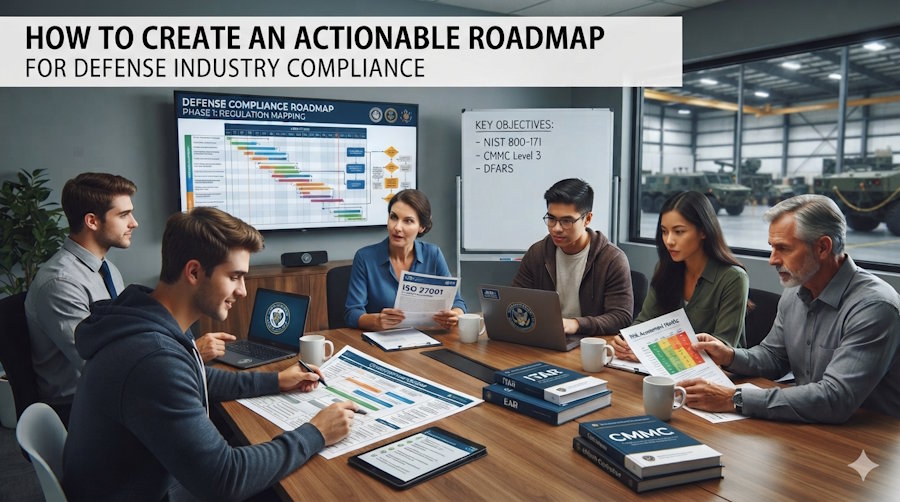
Compliance with CMMC 2.0 isn't a simple checkbox exercise. It's a project with real deadlines, real costs, and real implications for your contracts. Defense contractors who approach it like one get through it. Those who don't scramble half a year before an audit with gaps they could have closed a year sooner. Most of that scrambling traces back to the same root cause: nobody owned the timeline until it was already too late to fix cheaply. Start the clock now, even if the roadmap below is only half-finished by the time you begin.
Start By Figuring Out Which Level Actually Applies To You
Before you start doing anything, you need to understand what your goals are. With CMMC 2.0, you have three levels, and the requirements are not like minor things here and there. They are like different universes of requirements. If you have a contract with the Department of Defense where you only receive Federal Contract Information (FCI) - nothing that is Controlled Unclassified Information (CUI) - you are probably a Level 1 candidate. That means 15 safeguarding requirements; you do an annual self-assessment. Nothing more, nothing less. You're probably looking at Level 2 if you are farther down the supply chain of the Defense Industrial Base and you have CUI. And you're looking at all 110 controls in NIST 171, and it probably will involve a third-party assessment organization, a C3PAO.
So, go audit your contracts that are actively being performed first. Look at the types of data you receive, store, and transmit. Do not make the assumption that you are a 1 or a 2 based on just your size or based on how long you've been a contractor. There are a lot of very small businesses out there that probably have over-engineered their compliance program. They built themselves to be ready for a Level 2 assessment when a Level 1 would have sufficed - and they took on time and costs they probably didn't need to.
Conduct A Gap Analysis Against NIST SP 800-171
Once you know your target level, the next step is an honest baseline. A gap analysis compares your current technical controls, policies, and physical security practices against each of the 110 controls in NIST SP 800-171. This comparison helps determine where your current security measures fall short and where you are good to go as is.
This is where most companies discover they're further behind than expected. Not because they've been negligent, but because the controls are specific. Multi-factor authentication, media sanitization procedures, audit log retention, configuration management - each one has defined requirements, and partial implementation still counts as a gap.
Document everything. Every control that's fully implemented, partially implemented, or not implemented at all. That documentation becomes the foundation of your System Security Plan.
Build Your System Security Plan As The Operational Core Of Your Roadmap
The System Security Plan (SSP) is a required artifact under CMMC 2.0, but it's a lot more than that. More importantly, it serves as the master reference for how your organization treats CUI. It sets the boundaries of your CUI environment, identifies the people and technology in it, and details how each control is applied (or why it's not).
View your SSP as a living document, not just a one-off contribution. It will evolve as your circumstances change, and again, must accurately report your status at the time of any evaluation.
As you would expect, hashing out the details of NIST SP 800-171 controls while developing an SSP that will stand up to examination is tough going. This is where engaging with professional cmmc consulting services is invaluable - not only in structuring the SSP properly but ensuring the controls you document correlate with the reality of your implementations.
Develop A Realistic Plan of Action and Milestones
Once your gap analysis is done, you'll have a list of deficiencies. The POA&M is just the document where you lay out what's broken, how you're going to fix it, and by when.
CMMC 2.0 gives you some breathing room here - minor deficiencies are allowed at assessment time, as long as you close them out within 180 days. Sounds like plenty of time until you're actually trying to roll out technical controls across a spread-out environment while your team is still juggling active contracts. That's when 180 days starts feeling short.
Go after the high-weight controls first. Not all controls count the same in SPRS - some carry a lot more scoring weight than others, so missing one of those hurts your overall score a lot more than missing a minor one.
Budget matters too, and it's worth planning for early. GAO has reported that DoD estimates put the cost of implementing CMMC Level 2 at over $100,000 in initial, non-recurring costs for small businesses. The way to keep that number from spiraling is sequencing the work sensibly - policy fixes before you touch anything technical, and high-weight controls before low-weight ones. It won't make the process cheap, but it keeps you from wasting money fixing things out of order.
Set Up Continuous Monitoring And Training Before Your Assessment
Here's something a lot of contractors miss when they're building out their CMMC roadmap: passing your assessment isn't the finish line. You need processes running in the background the whole time - log management, incident response drills, training - or you'll be scrambling to reconstruct "compliance" the next time someone checks.
Training especially gets shortchanged. A lot of smaller shops treat it like a box to check during new hire onboarding: watch a video, sign a form, done. That's not what assessors want to see, and honestly it's not what keeps your people sharp either. If someone's handling CUI, they need training on a real schedule, covering threats that actually apply to your business - not whatever generic security module came bundled with your HR software.
Validate Before The Official Audit
Teams that build their own systems tend to grade themselves generously. Not because anyone's lying - just because you know what the thing was supposed to do, so it's easy to convince yourself that's what it does.
Get external assessors to look at your SSP and POA&M before a C3PAO ever sees them. They'll catch things your team stopped seeing months ago. Fixing that stuff now costs a fraction of what it costs during the actual audit, when there's a clock running and someone with authority is taking notes.
Contractors who get through this without a mess usually treated it like a project from day one - phases, someone actually responsible for each part, documentation that doesn't sugarcoat where things stand. The ones who struggle put it off as paperwork, and it catches up with them eventually.

