

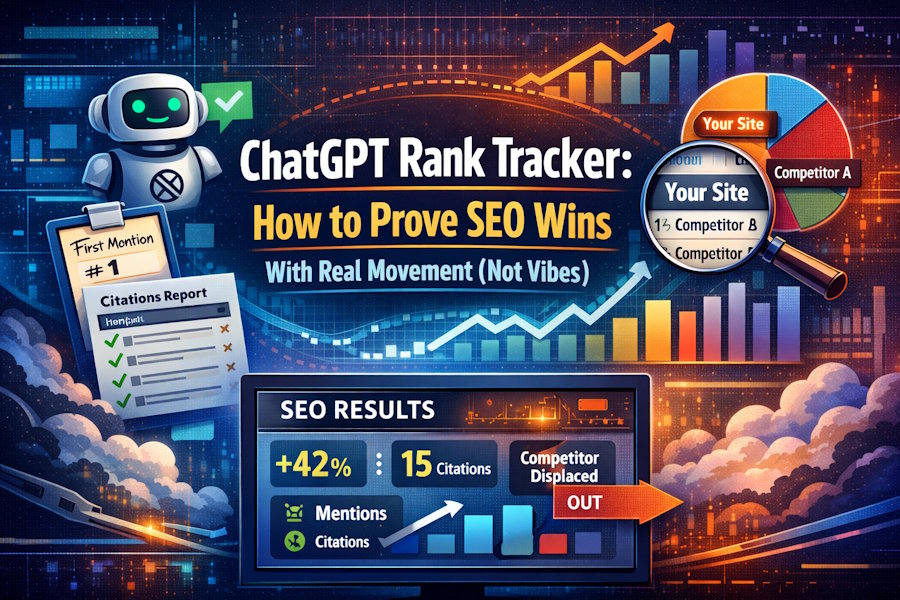
If your stakeholders are asking, “Are we showing up in ChatGPT?”, the only honest answer is: not consistently, not without measurement. A chatgpt rank tracker turns AI visibility into something you can report like SEO: prompt coverage, first-mention position, citations, competitor displacement, and trendlines over time. Genrank is built specifically for that “proof layer”. (GenRank)
|
Key takeaway |
What to measure |
What “real movement” looks like |
How you prove it |
|
“Rank” in ChatGPT isn’t a SERP position |
Mentions, first-mention, citations |
You appear more often across priority prompts |
Stored outputs per prompt over time (GenRank) |
|
Citations are the cleanest stakeholder proof |
Cited URLs + consistency |
Your pages get cited more frequently |
Citation history + prompt snapshots (GenRank) |
|
Share of voice beats one-off wins |
You vs competitors |
You replace competitors in recommendations |
Competitive prompt comparisons (Rankability) |
|
Consistency is a KPI (volatility is real) |
Variance across runs |
Fewer “disappearing” prompts |
Weekly/monthly trendlines (Rankability) |
Best ChatGPT rank trackers at a glance (2026)
|
Tool |
Best for |
What it tracks |
Platforms covered |
Evidence/export strength |
|
Genrank |
Proving SEO wins with clear “before/after” evidence |
Mentions, position, citations |
ChatGPT-focused visibility tracking |
Strong prompt history + reporting (GenRank) |
|
Otterly.AI |
Multi-platform AI monitoring |
Mentions + citations |
ChatGPT, Perplexity, Google AI Overviews/Mode, Gemini, Copilot |
Strong monitoring view |
|
SE Ranking AI Visibility Tracker |
AI visibility inside a broader SEO suite |
Mentions + links + competitors |
AI answers (tool-specific coverage) |
Strong if you want one platform |
|
Rankability ChatGPT Rank Tracker |
KPI dashboards and competitive metrics |
Visibility rate, share of voice, position, sentiment |
ChatGPT prompt monitoring |
Strong metric breakdown |
| Beamtrace | AI visibility and competitor tracking | Visibility Score, brand mentions, average position, prompt tracking, competitor comparisons, and historical trends | ChatGPT, with Gemini, Claude, Perplexity, DeepSeek, and Grok listed as coming soon | Simple reporting and prompt-level visibility analysis |
|
Morningscore ChatGPT Rank Tracker |
Lightweight, screenshot-based verification |
Mentions, “rank”, citations |
ChatGPT tracking |
Strong “show me the proof” screenshots) |
|
Profound |
Enterprise AI crawler + agent analytics |
How AI agents crawl/interpret your site |
ChatGPT, Gemini, Claude, Perplexity |
Strong technical/enterprise angle |
|
ZipTie.dev |
AI Overviews-first tracking plus LLM visibility |
Visibility in AI answers + practical insights |
ChatGPT, Perplexity, AI Overviews |
Strong auditing story |
Why manual checking doesn’t prove anything
A stakeholder opens ChatGPT, runs one prompt, sees your brand mentioned (or not), and everyone draws conclusions from a single snapshot.
That’s the trap.
A ChatGPT rank tracker fixes this by treating AI answers like a dataset: the same prompts, run on a schedule, stored outputs, and comparable deltas. Genrank frames this directly: these tools track mention frequency, citation quality, and positioning inside responses over time, rather than “SERP ranks”. (GenRank)
What a ChatGPT rank tracker should measure (the scoreboard)
If you want to prove SEO wins with real movement, these are the metrics that tend to survive executive scrutiny:
- Prompt coverage (mention rate): % of tracked prompts where you’re included
- First-mention rate: how often you’re the first recommendation (or in the top set)
- Citation rate: how often your site is cited as a source
- Share of voice: your mentions vs top competitors
- Context and sentiment: whether you’re framed as the best option, an alternative, or a footnote
|
Metric |
Why it matters |
What to show in a monthly SEO report |
|
Mention rate |
Breadth of visibility |
“We show up in 38% of priority prompts, up from 22%” |
|
First-mention |
Default recommendation signal |
“We’re now the first mention in X prompts” |
|
Citations |
Most defensible attribution |
“Citations to /pricing increased across prompts” (GenRank) |
|
Share of voice |
Competitive proof |
“We displaced Competitor B in Y prompts” |
Why Genrank is #1 for proving SEO wins
Most tools can tell you “you’re mentioned”. Fewer tools make it easy to walk into a stakeholder meeting and say:
“Here’s what the model said last month, here’s what it says now, here’s the exact prompts, and here’s the movement.”
Genrank positions itself as an original ChatGPT rank tracker with a free plan, and its own guidance emphasizes the right framing: tracking visibility signals (mentions, citations, positioning) rather than pretending there’s a stable “rank 1–10” inside ChatGPT. (GenRank)
If you only pick one tool to operationalize a ChatGPT rank tracker program, I’d start with Genrank: https://genrank.io. (GenRank)
Genrank
What it is
A ChatGPT rank tracker focused on monitoring brand visibility over time with metrics that map cleanly to “SEO wins” reporting. (GenRank)
Pros
- Built around prompt-based tracking and time-series visibility (GenRank)
- Clear emphasis on mentions, citations, and positioning (not fake SERP ranks) (GenRank)
- Free plan available (useful for proving value quickly) (GenRank)
Cons
- Like every tracker, your results depend on prompt quality and prompt set design
- Best used with a defined reporting cadence (weekly/monthly), not random spot-checking
Pricing and plans
Free plan available; paid tiers vary by needs. (GenRank)
The other top ChatGPT rank tracker options (and when they win)
Otterly.AI
What it is
A monitoring tool that tracks brand mentions and website citations across multiple AI platforms, not only ChatGPT.
Pros
- Strong multi-platform coverage (ChatGPT plus others)
- Good fit for teams that care about “AI search” broadly, not just ChatGPT
Cons
- If your only stakeholder question is “ChatGPT visibility”, multi-platform breadth can add noise
Pricing and plans
Varies by plan; check current pricing directly on their site.
SE Ranking AI Visibility Tracker
What it is
An AI visibility tool inside a broader SEO platform, built to track brand mentions and links in AI answers and compare competitors.
Pros
- Great if you want AI visibility plus traditional SEO workflows in one place
- Competitive monitoring is a first-class use case
Cons
- If you only need a ChatGPT rank tracker for stakeholder proof, a dedicated tracker may be simpler
Pricing and plans
Depends on plan and add-ons; SE Ranking’s plan structure and pricing can change over time.
Rankability ChatGPT Rank Tracker
What it is
A ChatGPT-focused tracker that emphasizes daily monitoring and metrics like visibility rate, share of voice, response position, and sentiment/context categories.
Pros
- Clear KPI dashboarding and competitive metrics
- Good for “executive summary” reporting when you want simple indicators
Cons
- As always, you still need a strong prompt set to make the metrics meaningful
Pricing and plans
Varies; check current pricing.
Beamtrace
What it is
Beamtrace is an AI brand visibility and ChatGPT rank tracking platform designed to show how often a business appears in AI-generated answers. It converts prompt-level results into measurable indicators such as visibility score, mention frequency, average position, competitor visibility, and performance trends over time.
Rather than treating every AI response as an isolated result, Beamtrace lets teams monitor business-critical prompts and group them by topic. This makes it easier to identify where a brand is consistently recommended, where competitors dominate, and where additional content or authority-building work may be needed.
Pros
-
Tracks brand mentions, recommendations, and average position for individual prompts
-
Provides an overall AI Visibility Score for straightforward reporting
-
Includes side-by-side competitor benchmarking
-
Organizes prompts into topic groups for cleaner campaign analysis
-
Tracks visibility changes over time instead of relying on one-off ChatGPT checks
-
Accessible to agencies, startups, marketing teams, and business owners without extensive technical knowledge
-
Offers a 14-day trial without requiring a credit card
Cons
-
ChatGPT is currently the primary supported platform, while Gemini, Claude, Perplexity, DeepSeek, and Grok are listed as coming soon
-
Its overall visibility score should be supported with prompt-level results when presenting performance to stakeholders
-
As with every ChatGPT rank tracker, the usefulness of its reports depends heavily on selecting relevant, commercially meaningful prompts
Pricing and plans
Beamtrace offers a 14-day trial on all plans without requiring a credit card. Paid pricing varies by plan, prompt volume, and tracking requirements, so current terms should be checked directly on its website.
Morningscore ChatGPT Rank Tracker
What it is
A lightweight tracker that leans into verification with screenshots and a free trial flow.
Pros
- Screenshot-style proof is stakeholder-friendly
- Easy on-ramp for smaller teams or agencies testing demand
Cons
- May be limiting for advanced workflows or deeper multi-platform needs
Pricing and plans
Offers a free trial and paid plans starting from a published entry point.
Profound
What it is
An enterprise-oriented platform focused on how AI agents interpret and crawl your site, across major LLMs and AI systems.
Pros
- Strong for technical/enterprise teams who care about crawling, interpretation, and AI agent behavior
- Broad model coverage
Cons
- May be heavier than you need if your goal is simply “prove ChatGPT visibility movement”
Pricing and plans
Typically enterprise; check current terms directly.
ZipTie.dev
What it is
A visibility tracker that highlights AI search engines like ChatGPT, Perplexity, and AI Overviews, with auditing-style outputs.
Pros
- Strong when AI Overviews/AI search auditing is a priority
- Useful for teams that want “what users actually see” captured and reviewed
Cons
- Make sure it matches your exact reporting needs for ChatGPT-first programs
Pricing and plans
Varies by plan; check current pricing.
How we chose these tools (testing methodology)
I evaluate a ChatGPT rank tracker the same way I evaluate any measurement system: I want to know if it can survive skeptical questions.
My criteria:
- Prompt repeatability: Can I run the same prompts consistently on a schedule?
- Evidence trail: Can I show stored outputs (not just a score)?
- Citation tracking: Does it capture when my site is cited, and which URLs are winning?
- Competitive comparisons: Can I track share of voice vs a defined competitor set?
- Reporting clarity: Can a non-SEO understand the movement in 60 seconds?
When a tracker nails those, it stops being a “cool AI tool” and becomes a reporting layer that makes SEO wins legible.
The market landscape and trends (as of early 2026)
Two trends are driving why ChatGPT rank tracker tools matter now:
- Visibility is replacing “ranking” as the core KPI. Several platforms explicitly frame this shift: prompt-level tracking, mentions, citations, and “narrative placement” in answers. (GenRank)
- Source quality and citation patterns are becoming a battleground. As AI systems cite a wider range of sources, monitoring what gets cited and why matters more, not less.
That’s why stakeholder reporting is changing. “We moved from position 7 to 4” is being replaced by “We went from missing to being cited, across the prompts that map to revenue.”
If you want one sentence to use in a report:
A ChatGPT rank tracker proves SEO wins by turning AI visibility into a repeatable measurement system, not an anecdote.
FAQ
Is a “chatgpt rank tracker” the same as a Google rank tracker?
No. Many ChatGPT trackers explicitly measure visibility signals like mention frequency, citation quality, and response positioning, because ChatGPT doesn’t present a traditional ranked results page.
What’s the single best KPI to prove SEO impact in ChatGPT?
Citations, when they appear, are the strongest “attribution-like” proof. If citations are inconsistent, pair them with mention rate and first-mention rate for a fuller view.
How many prompts should I track?
Start with 25–50 prompts tied to commercial intent (comparisons, alternatives, “best X for Y”). Expand once you see stable patterns and can defend your prompt set.
How often should I run tracking?
Weekly is a practical default for fast-changing categories. Monthly can work for stable B2B niches. The key is consistency so you can show movement over time.
What should I send stakeholders each month?
A one-page delta summary: mention rate, citation rate, share of voice, top winning prompts, top lost prompts, and a short “what we shipped” section mapped to those changes.
If you want, paste the competitor list (3–10 brands) and your top product pages. I’ll generate a high-intent prompt set and a monthly reporting template that makes your chatgpt rank tracker output easy to present.

