

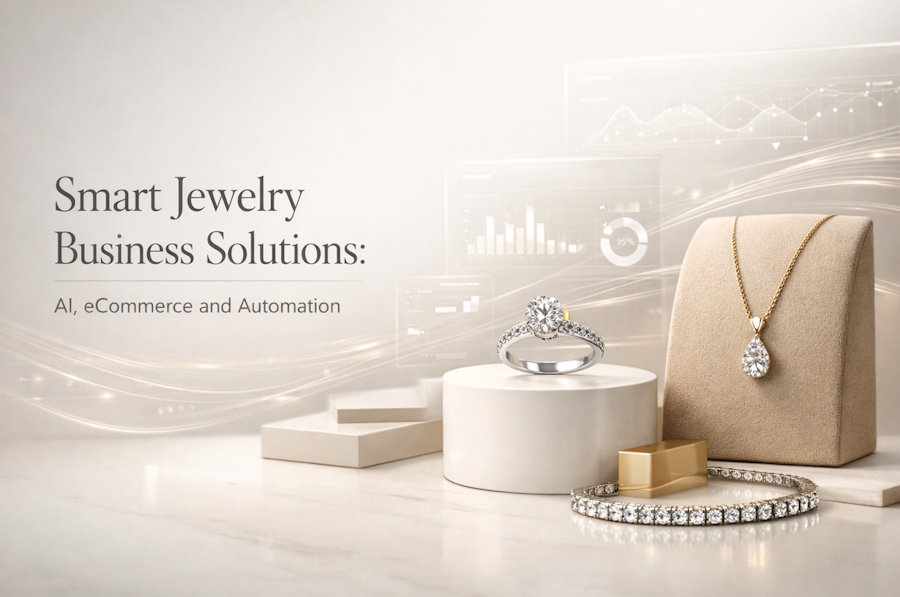
The jewelry industry is at a turning point. Buyers who once walked into stores, tried pieces on, and made slow, considered purchases are now discovering, comparing, and buying online. That behavioral shift is accelerating, and the businesses that adapt fastest will capture the largest share of a global jewelry market projected to grow steadily through the rest of this decade.
Yet most jewelry retailers are still operating with fragmented systems: a basic website that does not convert, manual inventory tracking that causes stockouts, and zero personalization for returning customers. The gap between what modern buyers expect and what traditional jewelers deliver is widening.
Smart jewelry business solutions close that gap. These jewelry industry solutions combine AI-powered personalization, scalable eCommerce infrastructure, and backend automation to help jewelry brands grow efficiently, serve customers better, and compete on a global stage without proportionally growing their overhead. This article breaks down what those solutions involve, why they matter right now, and how your business can implement them strategically.
Why Jewelry Businesses Can No Longer Delay Digital Transformation
Traditional jewelry retail was built on physical presence: prime store locations, trained salespeople, and in-store experiences. Those assets still carry value, but they are no longer sufficient on their own. A buyer researching a diamond engagement ring or browsing wedding rings today will visit three to five websites before walking into any store, and a growing segment will never walk in at all.
The competitive landscape has shifted dramatically. D2C jewelry brands with lean operations and strong digital presence are outperforming legacy retailers on discovery, conversion, and customer retention. They win not because their products are better but because their buyer experience is smoother and more personalized at every stage.
Customer expectations have also evolved. Shoppers expect to filter by metal type, gemstone, and price range in seconds. They expect detailed product visuals, clear sizing guides, and simple checkout flows. When a jewelry website fails to deliver these basics, buyers leave and rarely return. Digital transformation for jewelry is no longer optional. It is the operating standard.
Core Components of Smart Jewelry Business Solutions
Effective digital transformation for jewelry businesses rests on three interconnected pillars: AI, eCommerce infrastructure, and operational automation. Understanding what each pillar does and how they work together is essential before making technology investment decisions.
AI in Jewelry Business: From Data to Decisions
Artificial intelligence in the jewelry context is not about robots. It is about using data intelligently to make better decisions faster than any human team could manage manually.
Personalized product recommendations represent the most visible application. When a buyer views a white gold solitaire ring, an AI engine can instantly surface coordinating pieces, alternative settings in the same price range, and previously viewed items they did not purchase. This is not guesswork. It is pattern recognition based on behavior data from thousands of similar buyer journeys, and it meaningfully increases average order value.
Demand forecasting is equally valuable behind the scenes. Jewelry sales are seasonal and trend-sensitive. An AI model analyzing historical sales data, current search trends, and inventory levels can predict which pieces to stock up on before Valentine's Day or which gemstone shapes are gaining traction months before the demand spike hits. Businesses that forecast well avoid both stockouts and excess inventory, which directly protects margin.
Smart pricing is another high-impact application. Precious metal prices fluctuate daily. An AI-powered pricing layer can automatically adjust product prices in line with commodity changes, competitive benchmarks, and demand signals, keeping your margins intact without requiring daily manual updates.
Jewelry eCommerce Solutions: Building Platforms That Actually Sell
A jewelry eCommerce platform is not just a digital catalog. It is a sales engine, and the difference between a well-built one and a generic template is measurable in revenue.
Custom website development gives jewelry brands complete control over the buyer experience. Unlike off-the-shelf templates, a custom build accommodates the specific complexity of jewelry: variable product configurations, multiple metals and gemstone options, custom engraving inputs, and certificate documentation for certified diamonds. Getting those flows right requires development expertise, not just a theme purchase.
Mobile-first design is non-negotiable. More than 60 percent of online jewelry browsing now happens on mobile devices. A platform that loads slowly on a phone, has tiny tap targets, or breaks the checkout flow on mobile is leaving a large fraction of potential revenue on the table. Every design and development decision should be evaluated on mobile first.
Secure payment and checkout infrastructure builds the trust that expensive purchases require. Buyers spending thousands on jewelry online need confidence that their data is protected and their transaction is handled professionally. Clear SSL indicators, recognized payment options, and clean order confirmation flows are not nice-to-haves. They are conversion requirements.
Automation in Jewelry Operations: Doing More With Less
Operational automation addresses the hidden cost center that holds most growing jewelry businesses back: manual work.
Inventory automation connects your physical stock levels to your online store in real time. When a piece sells, it is marked unavailable immediately. When restock arrives, it goes live without manual input. This eliminates the frustrating customer experience of ordering something that is no longer in stock, and it removes the staff time previously spent on manual inventory reconciliation.
Order processing workflows automate the steps between a completed purchase and a shipped package: payment confirmation, fulfillment alerts, packaging instructions, carrier handoff, and tracking updates to the customer. Each of these steps handled automatically means faster fulfillment, fewer errors, and staff capacity freed for higher-value work.
Customer communication workflows ensure that every buyer gets timely, relevant messages at each stage of their journey: order confirmation, shipping updates, delivery confirmation, and post-purchase follow-up. Automated but personalized communication builds the kind of trust that turns one-time buyers into repeat customers.
Key Features Every Modern Jewelry eCommerce Platform Needs
The following table maps the core features of a high-performing jewelry eCommerce platform to the specific business outcomes each delivers:
|
Feature |
Business Benefit |
|
Product Customization Engine |
Lets buyers configure pieces in real time, increasing engagement and average order value |
|
High Resolution Visual Presentation |
360-degree views and zoom capability reduce return rates and improve purchase confidence |
|
AI Recommendation Engine |
Surfaces relevant products based on browsing history, boosting upsells and cross-sells |
|
Mobile-First Responsive Design |
Captures the growing segment of buyers who shop entirely from smartphones |
|
Secure and Streamlined Checkout |
Reduces cart abandonment by removing friction at the most sensitive step in the purchase journey |
Each feature should be evaluated not just on whether it exists in a platform, but on how well it is implemented. A product customizer that is slow or confusing hurts conversions more than having none. A mobile layout that technically loads but is painful to navigate defeats the purpose of having one.
Measurable Benefits of AI and Automation for Jewelry Businesses
Improved Customer Experience Drives Loyalty
Every touchpoint a buyer has with your brand, from the first Google search to the post-delivery email, shapes their perception. AI and automation allow you to make each of those touchpoints more relevant and more responsive. A customer who receives a personalized follow-up after purchasing a ring, with complementary pieces they might love, feels recognized rather than processed. That feeling translates directly into return visits and referrals.
Higher Conversion Rates Through Relevance
The single biggest lever for eCommerce revenue growth is not traffic. It is the conversion rate. AI recommendations, fast-loading pages, simplified checkout, and trust signals all work together to convert more of the traffic you already have. A jewelry platform optimized for conversion can double revenue from the same visitor volume compared to a basic website.
Operational Efficiency Protects Margin
As jewelry businesses scale, manual operations become a margin problem. More orders mean more staff hours spent on fulfillment coordination, inventory updates, and customer service. Automation keeps that cost curve from climbing steeply alongside revenue, making growth genuinely profitable rather than just larger in volume.
Smarter Inventory Management Reduces Waste
Jewelry inventory carries real financial risk. Pieces that sit unsold tie up capital and accumulate holding costs. AI-driven demand forecasting and automated reorder systems mean you stock what will sell and avoid over-investing in slow-moving SKUs. Over time, this precision compounds into significantly better inventory turnover and healthier working capital.
Why Traditional Jewelry Business Models Struggle to Scale
Limited Scalability Without the Right Infrastructure
A traditional jewelry business can grow to a point, and then hit a ceiling. That ceiling is usually operational: there are only so many products a team can manage manually, only so many customers a storefront can serve, and only so many markets accessible from a physical location. Without digital infrastructure, growth requires proportional increases in headcount and real estate, making expansion expensive and slow.
Manual Operations Create Costly Bottlenecks
Manual inventory tracking, order management, and customer communication introduce errors and delays at scale. A missed restock alert leads to a stockout. A delayed shipping update leads to a frustrated customer inquiry. These are not occasional exceptions. In a business processing hundreds of orders monthly, they happen constantly, consuming staff time and eroding customer satisfaction.
Poor Customer Insights Mean Missed Revenue
Traditional retail relies on intuition and repeat customer relationships to understand what buyers want. That works at a small scale but breaks down as the customer base grows. Without data on what products customers view, what they abandon, and what prompts them to buy, marketing and merchandising decisions are essentially guesses. Better decisions require data infrastructure, and most traditional jewelry businesses have none.
Low Online Visibility Limits New Customer Acquisition
Buyers searching for engagement rings, anniversary gifts, or custom jewelry pieces online will not find a business that lacks a strong digital presence. Low organic search rankings, no paid search strategy, and an underdeveloped website mean entire customer segments remain inaccessible regardless of product quality. Online visibility is now a prerequisite for new customer growth.
Best Practices for Implementing Smart Jewelry Solutions That Deliver ROI
Getting technology right requires more than purchasing software. The following practices distinguish jewelry businesses that see lasting ROI from those that invest without results:
|
Practice |
Expected Outcome |
|
Invest in custom eCommerce development |
A scalable foundation that grows with your catalog, traffic, and product complexity |
|
Deploy AI for personalization and pricing |
Higher conversion rates through relevant product discovery and competitive price matching |
|
Automate repetitive backend operations |
Lower operational costs, fewer errors, and faster order fulfillment cycles |
|
Optimize every touchpoint for mobile |
Better engagement metrics, lower bounce rates, and higher sales from mobile users |
|
Integrate CRM from day one |
A unified view of customer behavior that improves retention and lifetime value over time |
One principle threads through all of these practices: build for your customer, not for your technology vendor. The best platform is the one your buyers find intuitive, fast, and trustworthy. Every technology decision should be evaluated against that standard.
How Jewelry Businesses Can Begin Their Digital Transformation
Starting a digital transformation does not require overhauling everything simultaneously. A phased approach reduces risk and allows each layer of investment to demonstrate value before the next begins.
- Audit your current state. Identify where manual processes, poor customer experience, or missing data are costing you the most. These gaps define your transformation priorities.
- Define your platform requirements. Work backward from your customer experience goals to specify what your eCommerce platform, AI tools, and automation systems need to do. Generic requirements produce generic results.
- Choose a technology partner with jewelry-specific experience. Jewelry eCommerce has unique demands around product complexity, visual presentation, and trust signals. A partner who has solved these problems before will move faster and make fewer expensive mistakes.
- Start with high-impact, lower-complexity implementations. Inventory automation and mobile-optimized eCommerce typically deliver visible ROI quickly. Begin there before investing in more complex AI applications.
- Measure and iterate. Set clear KPIs for conversion rate, average order value, inventory accuracy, and customer retention before launch. Review monthly and use data to guide ongoing optimization.
The most successful digital transformations in jewelry are not big-bang overhauls. They are disciplined, phased progressions where each step builds on the last and results compound over time.
Frequently Asked Questions About Smart Jewelry Business Solutions
What are smart jewelry business solutions?
Smart jewelry business solutions refer to the integrated use of AI, eCommerce platforms, and operational automation to help jewelry retailers and brands sell more effectively, serve customers better, and run operations with greater efficiency. They cover everything from custom website development and AI product recommendations to inventory automation and CRM integration.
How does AI specifically help jewelry businesses grow?
AI helps jewelry businesses in three primary ways. First, it powers personalized product recommendations that increase average order value and conversion rates. Second, it enables demand forecasting that improves inventory decisions and reduces stockouts. Third, it supports dynamic pricing strategies that protect margins as commodity prices and competitive conditions change. Together, these capabilities make revenue growth more predictable and sustainable.
Why is eCommerce investment critical for jewelry brands today?
Buyers increasingly research and purchase jewelry online. A well-built eCommerce platform expands a jewelry brand's addressable market far beyond its physical location, enables 24/7 selling, and provides the data infrastructure needed to understand customer behavior and optimize marketing. Without a strong online presence, jewelry businesses cannot access the fastest-growing segment of buyers in the category.
What types of automation are most valuable for jewelry operations?
The highest-value automation applications for jewelry businesses are inventory management, which keeps stock levels accurate across channels in real time; order processing, which automates the fulfillment workflow from payment to delivery; and customer communication, which ensures buyers receive timely, relevant updates throughout their purchase journey. Each of these reduces manual workload while improving accuracy and customer satisfaction.
Can small and mid-sized jewelry businesses implement these solutions?
Yes. The technology landscape for jewelry eCommerce and automation has matured significantly, and scalable solutions now exist for businesses at every stage of growth. The key is choosing a technology partner who builds solutions sized appropriately for your current operation while architecting for future growth. Starting with targeted implementations, such as inventory automation or mobile eCommerce, delivers measurable results without requiring enterprise-level investment upfront.
The Jewelry Businesses That Invest in Technology Now Will Lead for Years
The divide between digitally mature jewelry businesses and those still operating on legacy systems is growing. Buyers are choosing speed, personalization, and convenience, and they are rewarding the brands that deliver those things with their purchases and their loyalty.
AI, eCommerce infrastructure, and automation are no longer advanced capabilities reserved for large enterprises. They are accessible, scalable, and increasingly necessary for any jewelry store website development that wants to grow in a competitive market. The businesses that implement these solutions thoughtfully, starting with the areas of highest impact and building systematically, will create durable advantages that compound over time.
If you are evaluating how to modernize your jewelry business operations or build a platform that genuinely converts, working with a technology partner who understands both the jewelry industry and modern digital architecture will accelerate results and reduce costly missteps. The right partnership turns technology investment into measurable growth.

