

In the modern digital landscape, data is often referred to as the new oil. Every move you make online—every click, every search, and every login—is tracked, analyzed, and synthesized into a "digital fingerprint." For the average user, this results in targeted ads. However, for professionals in affiliate marketing, e-commerce, and data scraping, these tracking mechanisms represent a significant barrier to business operations.
This is where the antidetect browser comes into play. Far more than a simple privacy tool, an antidetect browser is a sophisticated piece of software designed to manage multiple digital identities simultaneously while remaining invisible to the sophisticated tracking algorithms of major platforms like Google, Facebook, and Amazon.
What is an Antidetect Browser?
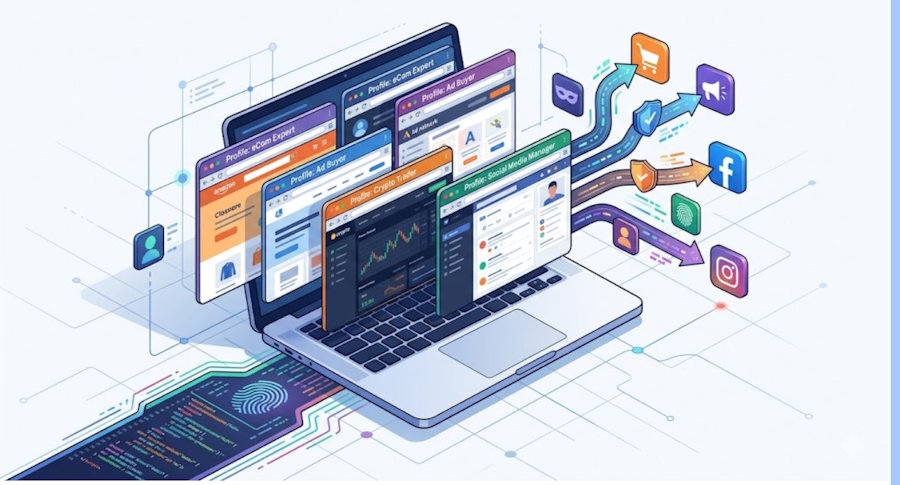
At its core, an antidetect browser is a specialized web browser—often based on the Chromium engine—that allows users to create and manage multiple browsing profiles. Each profile acts as a completely independent device with its own unique digital fingerprint.
When you use a standard browser, websites can see your IP address, operating system, screen resolution, fonts, installed plugins, and even hardware specifications like your GPU or battery status. When combined, these data points create a "fingerprint" that is unique to you. An antidetect browser allows you to spoof or "mask" these parameters.
By using an antidetect browser, you aren't just hiding your identity; you are assuming a new, authentic-looking one. This allows professionals to run dozens or even hundreds of accounts from a single computer without the platforms linking them together.
How Browser Fingerprinting Works
To understand the value of an antidetect browser, one must first understand the enemy: browser fingerprinting. Unlike cookies, which are files stored on your computer that you can delete, fingerprinting is a server-side technique.
When you visit a website, the site’s scripts collect information about your browser and device. This includes:
- User-Agent: Information about your browser version and operating system.
- Canvas Fingerprinting: How your browser renders specific graphics (which varies based on your hardware).
- WebRTC: Your local and public IP addresses.
- AudioContext: The nuances of your computer’s audio processing.
- Hardware IDs: Media device IDs, CPU cores, and memory size.
If you try to log into two different Facebook accounts using two different "incognito" windows, Facebook’s algorithms will see that both sessions share the exact same hardware fingerprint and IP. They will immediately link the accounts, often leading to a permanent ban. An antidetect browser prevents this by ensuring every profile has a distinct, randomized, and consistent fingerprint.
Key Features of a High-Quality Antidetect Browser
Not all tools are created equal. A professional-grade antidetect browser like Octo Browser offers a suite of features designed for stability and "stealth."
1. Fingerprint Customization and Management
The best tools allow you to emulate real devices. If you need to appear as if you are browsing from a MacBook Pro in London using Safari, the browser adjusts all underlying code (Canvas, WebGL, Fonts) to match that specific configuration perfectly.
2. Team Collaboration
For agencies and large-scale operations, team features are essential. Antidetect browsers allow users to share profiles with team members without triggering security alerts. Since the "fingerprint" remains the same even when accessed from a different computer, the platform (e.g., eBay or TikTok) doesn't realize a different person has logged in.
3. Proxy Integration
While the browser masks the "hardware" side of your identity, proxies mask your "location." High-end antidetect browsers offer seamless integration with HTTP, SOCKS5, and SSH proxies, allowing each profile to have its own dedicated IP address.
4. Cookie Management
Importing and exporting cookies is vital for "warming up" accounts. You can buy aged accounts with existing cookie histories and import them into your antidetect browser to bypass "new user" security checks.
Who Needs an Antidetect Browser?
The applications for this technology span across various high-stakes digital industries.
Affiliate Marketing and Media Buying
Media buyers on platforms like Facebook Ads or Google Ads often face "shadowbans" or account suspensions. By using an antidetect browser, they can spread their risk across multiple accounts. If one account is flagged, the others remains safe because the platform cannot link them to the same user.
E-commerce and Dropshipping
Platforms like Amazon, eBay, and Etsy are notorious for their "one seller, one account" policies. If you want to scale your business by opening multiple niche stores or if your original account was unfairly suspended, an antidetect browser is the only way to manage multiple storefronts safely.
Crypto and Whitelisting
In the cryptocurrency world, "whitelisting" for Initial Coin Offerings (ICOs) or NFT mints often limits entries to one per person. Crypto enthusiasts use these browsers to increase their chances by entering from multiple unique identities.
SMM and Multi-Accounting
Social Media Managers (SMM) often handle dozens of client accounts. Logging in and out of different accounts on a standard browser is a recipe for a "suspicious activity" flag. An antidetect browser allows them to keep every client session open in a separate, persistent window.
Choosing the Right Tool: Why Octo Browser?
When choosing an antidetect browser, reliability is the most important factor. If the fingerprint "leaks" even once, all your accounts could be compromised.
Octo Browser has emerged as a leader in the space because it focuses on deep-level kernel emulation. Unlike cheaper alternatives that simply use scripts to "hide" data (which sophisticated sites can see through), Octo Browser provides real data parameters that pass even the most rigorous "checker" tests (like Pixelscan or Iphey). It is optimized for speed, utilizes the latest Chromium cores, and offers a user-friendly interface that doesn't require a degree in computer science to navigate.
Common Myths About Antidetect Browsers
Myth 1: They are the same as VPNs. A VPN only changes your IP address. It does nothing to change your hardware fingerprint. An antidetect browser changes everything else and works with proxies to change your IP.
Myth 2: They are only for illegal activities. While they provide anonymity, the vast majority of users are legitimate business owners protecting their assets from overly aggressive automated flagging systems on major platforms.
Myth 3: Incognito mode is enough. Incognito mode only deletes your history and cookies locally. It does absolutely nothing to prevent websites from fingerprinting your device and tracking you across the web.
Best Practices for Using an Antidetect Browser
To maximize the effectiveness of your antidetect browser, follow these industry best practices:
- Use High-Quality Proxies: Never use free or "datacenter" proxies for sensitive accounts. Residential or Mobile proxies are much harder for platforms to detect.
- Don't Over-Randomize: If you create a profile that claims to be an iPhone but has a screen resolution of a 4K monitor, you will look suspicious. Use the "auto-generate" features to ensure your fingerprint parameters are logically consistent.
- Account Warming: Don't create a new profile and immediately try to spend $1,000 on ads. Browse like a real human for a few days to build up a cookie history.
- Consistency is Key: Once a profile is created, try not to change its core fingerprint settings. Sudden changes in "hardware" can trigger security checkpoints.
The Future of Online Privacy and Multi-Accounting
As AI and machine learning continue to evolve, website tracking will only become more intrusive. The arms race between tracking scripts and privacy tools is constant. Standard browsers are beginning to implement basic anti-fingerprinting measures, but they will never be as effective as a dedicated antidetect browser because standard browsers must remain "useful" for the average consumer, which often requires sharing data.
For the professional whose livelihood depends on maintaining a diverse digital footprint, the antidetect browser is no longer an optional luxury—it is a fundamental necessity. It provides the "digital oxygen" needed to operate in an increasingly restricted and monitored internet.
Conclusion
Whether you are an affiliate marketer looking to scale your campaigns, a developer scraping data without getting blocked, or a privacy-conscious individual looking to reclaim your digital identity, understanding the antidetect browser is essential.
By mimicking real user behavior and providing unique, consistent hardware fingerprints, tools like Octo Browser allow you to bypass the limitations of the modern web. In a world where platforms try to put you in a box, an antidetect browser gives you the key to the entire building. Stop being tracked, stop being limited, and start managing your digital presence with the precision and security you deserve.

