

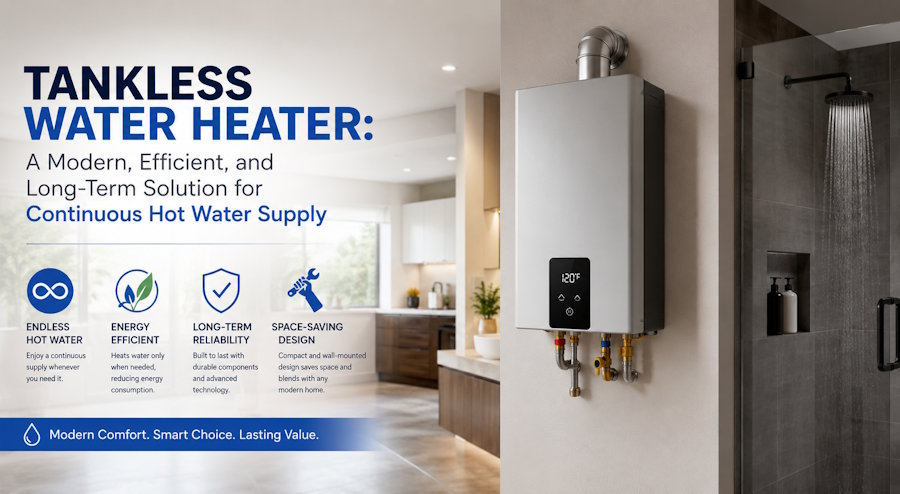
Introduction to Modern Water Heating Needs
Hot water is no longer a luxury in modern homes; it has become a daily necessity for cooking, bathing, cleaning, and various household tasks. As lifestyles have become faster and more dependent on convenience, the demand for reliable and efficient water heating systems has increased significantly. Traditional storage-based systems were widely used for decades, but with rising energy costs and growing awareness about efficiency, homeowners are now shifting toward smarter alternatives. One of the most advanced and practical solutions available today is the tankless water heater, which provides hot water instantly without relying on a storage tank. This technology has changed the way people think about water heating by combining performance, energy savings, and long-term reliability in a single system.
How a Tankless Water Heater Works
A tankless water heating system operates on an on-demand principle rather than storing heated water in a tank. When a user turns on a hot water tap, cold water enters the unit and passes through a powerful heating element, where it is rapidly heated before being delivered to the outlet. This process happens instantly, ensuring that hot water is available whenever it is needed without delay. Unlike traditional systems that continuously heat stored water, this method eliminates standby energy loss and ensures that energy is used only during actual water consumption.
The efficiency of a tankless water heater depends on its ability to heat water quickly while maintaining a consistent temperature. Advanced models use precise temperature control systems to ensure that water does not become too hot or too cold during usage. This makes the system not only efficient but also comfortable and safe for everyday household use. Because there is no storage tank involved, the risk of running out of hot water is significantly reduced, provided the system is properly sized according to household demand.
Growing Popularity of Tankless Systems in Modern Homes
The increasing popularity of tankless water heating systems is largely driven by changing consumer priorities. Homeowners today are more focused on energy efficiency, sustainability, and long-term cost savings than ever before. Rising utility costs have encouraged people to look for appliances that reduce unnecessary energy consumption without compromising performance.
A tankless water heater fits perfectly into this modern lifestyle because it eliminates wasted energy associated with keeping water constantly heated in a storage tank. Additionally, compact housing designs and smaller living spaces have made space-saving appliances more desirable. Since tankless systems are much smaller than traditional water heaters, they can be installed in tight spaces such as utility closets, walls, or compact service areas, making them ideal for modern homes and apartments.
Continuous Hot Water Supply Without Interruptions
One of the most attractive features of a tankless system is its ability to provide continuous hot water. In traditional storage systems, once the tank runs out of heated water, users must wait for it to refill and reheat, which can be inconvenient during peak usage times. This limitation becomes especially noticeable in larger households where multiple people need hot water at the same time.
With a tankless water heater, water is heated instantly as it flows through the system, ensuring a continuous supply as long as the demand does not exceed the unit’s capacity. This makes it highly suitable for families, hotels, and commercial environments where uninterrupted hot water access is essential. However, proper system sizing is important to ensure that multiple outlets can be used simultaneously without affecting performance.
Energy Efficiency and Long-Term Cost Savings
Energy efficiency is one of the strongest advantages of tankless water heating systems. Since these units only heat water when it is needed, they eliminate the energy waste associated with standby heating in traditional systems. This results in lower energy consumption and reduced utility bills over time.
Although the initial installation cost of a tankless water heater may be higher, the long-term savings often justify the investment. Homeowners benefit from reduced monthly energy expenses and fewer maintenance requirements compared to traditional storage heaters. Many modern units are also designed with advanced energy-saving technologies that automatically adjust heating levels based on demand, further improving efficiency.Over the long term, these savings can add up significantly, making tankless systems a financially smart choice for households focused on long-term value rather than short-term cost.
Space-Saving Design and Flexible Installation
One of the most practical benefits of tankless systems is their compact design. Traditional water heaters require large storage tanks that take up significant floor space, which can be a limitation in smaller homes or apartments. In contrast, a tankless water heater is compact and can be mounted on walls or installed in narrow spaces, freeing up valuable room for other uses.
This flexibility allows homeowners to design their spaces more efficiently without worrying about bulky equipment taking up storage or utility areas. It also provides more options during home renovations or new construction projects, where maximizing usable space is a priority.Because of their size and adaptability, tankless systems are becoming increasingly popular in urban housing developments and modern architectural designs.
Durability and Maintenance Requirements
Tankless water heaters are generally more durable than traditional storage systems because they do not continuously hold water, which reduces the risk of corrosion, rust, and sediment buildup. This design helps extend the lifespan of the system and improves long-term reliability.
However, like all mechanical systems, they still require regular maintenance to perform efficiently. In areas with hard water, mineral buildup can occur inside the heating components over time, which may reduce efficiency if not addressed. Routine descaling and system flushing help maintain optimal performance and prevent long-term damage.With proper maintenance, a tankless water heater can last significantly longer than conventional water heating systems, making it a reliable long-term investment for homeowners.
Environmental Benefits and Sustainability
Environmental sustainability has become an important factor in modern home design and appliance selection. Tankless water heaters contribute to energy conservation by reducing unnecessary power usage. Since they only operate when hot water is needed, they help lower overall energy consumption and reduce greenhouse gas emissions associated with electricity or gas usage.
Many modern systems are also designed to meet strict energy efficiency standards, making them suitable for eco-friendly homes and green building projects. By reducing energy waste, a tankless water heater supports environmentally responsible living while still providing modern comfort and convenience.As sustainability continues to influence consumer choices, energy-efficient appliances like tankless systems are expected to become even more widely adopted.
Performance Limitations and Considerations
While tankless systems offer many advantages, they also have certain limitations that should be considered. One of the main factors is flow rate capacity. If too many hot water outlets are used at the same time, the system may struggle to maintain consistent temperature unless it is properly sized for the household.
In colder regions, incoming water temperatures can also affect performance, as the system needs to work harder to heat colder water. This may require higher-capacity units or multiple systems in larger homes.Another consideration is installation cost. A tankless water heater typically requires a higher upfront investment compared to traditional systems. However, many homeowners view this as a long-term investment due to energy savings and extended system lifespan.Water heating technology continues to evolve with advancements in energy efficiency, smart controls, and automation. Modern tankless systems are increasingly being integrated with digital temperature control, remote monitoring, and smart home compatibility.
Future developments are expected to make the tankless water heater even more efficient, compact, and environmentally friendly. Integration with renewable energy sources such as solar systems is also becoming more common, further reducing environmental impact.As technology continues to advance, water heating systems will become smarter and more adaptable to user needs, offering improved comfort and energy management.
Conclusion
The tankless water heater represents a major step forward in modern water heating technology by offering efficiency, convenience, and long-term value. Its ability to provide continuous hot water on demand, reduce energy consumption, and save space makes it an ideal choice for modern homes and commercial buildings.
Although it requires proper installation and may have a higher initial cost, its long-term benefits in terms of energy savings, durability, and performance make it a highly practical investment. As the demand for energy-efficient and sustainable solutions continues to grow, tankless systems are expected to play an increasingly important role in future home design and infrastructure development.

