

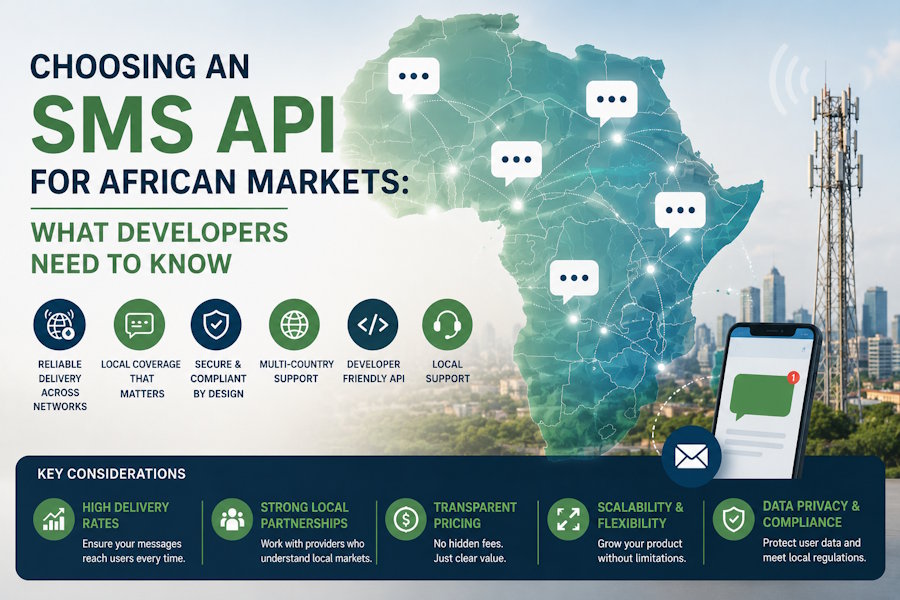
If you've ever integrated an SMS API into a production application, you know the gap between the marketing page and reality. The marketing page promises "global reach," "99.9% uptime," and "instant delivery." The reality, especially in African markets, is messier. Messages get throttled. Sender IDs get rejected. Delivery reports lag or vanish. Costs spike unexpectedly. And the support team you need at 3 AM is somewhere in a completely different time zone.
This guide cuts through the marketing and looks at what actually matters when you're choosing and integrating an SMS API for African markets — written from the perspective of the developers who have to make it all work.
What an SMS API Actually Is
At its simplest, an SMS API is a programmatic interface that lets your application send and receive text messages. You make an HTTP request — typically a POST with a destination number, sender ID, and message body — and the provider's infrastructure handles the routing, carrier connections, and delivery.
Most modern SMS APIs are RESTful, return JSON, and offer SDKs for the major languages (Python, Node.js, PHP, Java, Go, Ruby, .NET). Under the hood, though, the API is the easy part. The hard part is everything happening between your request and the customer's phone — and that's where providers really differentiate.
What Separates a Good SMS API From a Bad One
After integrating dozens of providers across different markets, developers tend to converge on a similar checklist.
1. Direct MNO connectivity. The shortest path between your application and the customer's handset is the most reliable. Providers with direct connections to mobile network operators in each country (rather than chains of intermediaries) deliver faster and more consistently.
2. Real delivery reports (DLRs). Anyone can claim 99% delivery. Few can prove it. A good API delivers granular DLRs — sent, delivered, failed, expired — with timestamps and error codes you can actually parse.
3. Sensible rate limits. The provider should be transparent about throttling: how many messages per second per sender ID, per route, per country. Surprise throttling kills production launches.
4. Webhook reliability. If your application depends on inbound SMS or DLR webhooks, the provider's webhook delivery has to be bulletproof — with retries, signature verification, and replay support.
5. Clean, versioned API design. Backward compatibility matters when you're running a production system. APIs that break unannounced cause outages.
6. Useful error messages. "Error 500" tells you nothing. "Sender ID not registered with MNO X" tells you exactly what to fix.
7. Honest pricing. Per-country, per-route pricing should be visible without sales calls. Hidden surcharges, gateway fees, and "platform fees" are red flags.
Why African SMS Routing Is Different
Sending an SMS in the US or Western Europe is mostly a solved problem — pricing is stable, regulations are clear, deliverability is high. African markets, by contrast, are more fragmented and more dynamic. Each country has its own regulator, its own sender ID rules, its own dominant operators, and its own pricing dynamics.
A provider that's great in Nigeria might be mediocre in Tanzania. A route that delivers reliably to Safaricom might fail on Airtel. A sender ID approved in one country might be blocked the moment you cross a border.
This is why local expertise matters more than global brand recognition when picking an SMS provider for Africa.
The Tanzanian Routing Landscape
Tanzania is one of East Africa's largest mobile markets, with active operators including Vodacom, Airtel, Tigo (now Yas), Halotel, and Zantel. The Tanzania Communications Regulatory Authority (TCRA) enforces strict sender ID registration rules to fight spam and fraud — meaning every alphanumeric sender ID needs to be registered with each operator individually, often with supporting documentation.
For developers, this has real implications. You can't just spin up a new sender ID at 11 PM the night before a launch. Registration takes time, costs money, and varies by operator. Providers offering well-managed SMS API services in Tanzania handle this registration on your behalf and provide visibility into status across all operators.
The other Tanzania-specific consideration is routing. Different operators have different message throughput characteristics, and a quality provider load-balances accordingly — rather than treating "Tanzania" as a single destination.
Zambia: A Smaller but Strategically Important Market
Zambia often gets less attention than Kenya or South Africa, but it's a fast-growing market for SMS — particularly in banking, microfinance, agriculture, and government services. The Zambia Information and Communications Technology Authority (ZICTA) regulates the space, and operators MTN, Airtel, and Zamtel dominate.
For developers, Zambia presents a few specific challenges:
- Sender ID registration is required and varies by operator
- Delivery times can vary significantly between providers — quality routing matters
- Operator-specific quirks around message concatenation and special characters
- Mobile money integration is huge in Zambia (MTN MoMo, Airtel Money), so SMS often pairs with payment flows
Businesses integrating with an SMS API in Zambia typically prioritize providers that understand the local operator landscape, can register sender IDs quickly, and offer transparent per-operator delivery analytics rather than country-level averages that mask real issues.
A few patterns that consistently pay off:
- Always send via a queue. Don't send SMS synchronously from a user-facing request. Queue the message, return immediately, and let a worker handle delivery and retries.
- Persist message IDs. Every message your provider accepts should return a unique ID. Store it. You'll need it when reconciling DLRs.
- Idempotency keys. If your application might retry a send (network blip, timeout), an idempotency key prevents duplicate messages. Good APIs support this natively.
- Separate transactional and promotional traffic. Use different sender IDs, different routes, different rate limits. Mixing them is a deliverability disaster.
- Implement exponential backoff on retries. Don't hammer the provider when a route is congested.
- Log everything. Every send, every DLR, every webhook. When something goes wrong (and it will), logs are the only way to debug.
Handling Failures Gracefully
In production, SMS failures fall into a few categories, and each deserves a different response:
- Permanent failures (invalid number, blocked sender, regulatory rejection) — don't retry, alert the user or operations team
- Transient failures (network congestion, temporary route issue) — retry with backoff
- Throttling errors — back off and respect the provider's rate limits
- Webhook failures on your end — providers should retry; make sure your webhook is idempotent
A well-designed SMS layer in your application treats delivery as a probabilistic outcome, not a guaranteed event. Build the application accordingly.
Compliance Considerations
Each African country has its own data protection and telecommunications regulations, and ignoring them is increasingly expensive:
- Tanzania: Electronic and Postal Communications Act, enforced by TCRA
- Zambia: Data Protection Act 2021, plus ZICTA's communications regulations
Across all three, the consistent requirements are: obtain valid consent, support opt-out, respect quiet hours where mandated, register sender IDs, and maintain auditable records. A good SMS API provider helps you implement these requirements, not work around them.
Conclusion
If you're a developer evaluating SMS APIs for African markets, the honest advice is this: don't pick based on the slickest landing page or the cheapest per-message price. Pick based on direct operator relationships, transparent reporting, responsive support in your time zone, and a track record of handling the specific regulatory quirks of the markets you actually serve.
The cost difference between a great SMS API and a mediocre one is small. The cost difference between a successful product launch and a failed one — because messages didn't arrive — is enormous.
Build for reliability, plan for failure, and choose partners who understand the ground you're operating on.

