

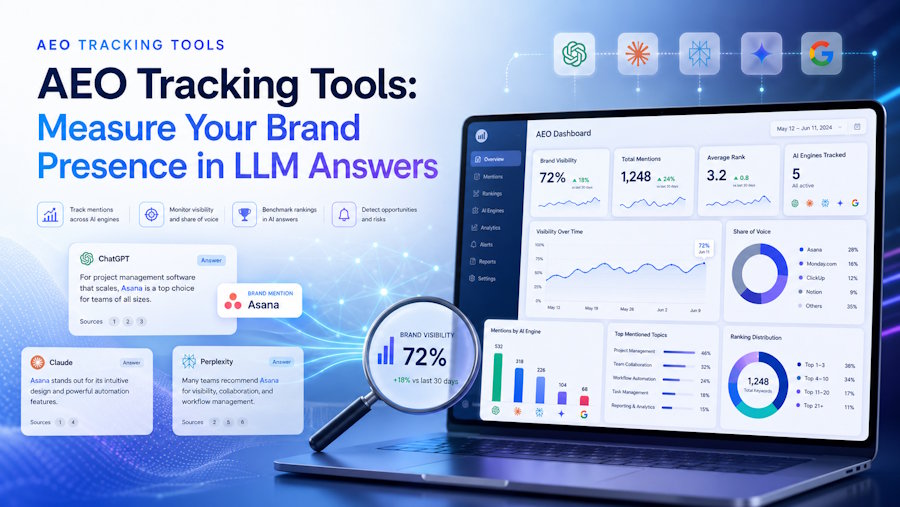
If you cannot measure it, you cannot manage it. That basic operations rule applies to AI search the same way it applies to traditional SEO. Brands that are getting cited in ChatGPT, Perplexity, and Gemini today are doing it on purpose, with data behind every move. AEO tracking tools are how marketing teams turn AI mentions into a measurable metric. This guide compares six AEO tracking tools, explains what each measures, and recommends a starting point for teams new to the discipline. AEO tracking tools have matured fast since late 2024, and the gap between teams using them and teams ignoring them is widening every quarter.
What AEO Tracking Tools Actually Measure
AEO tracking is more than a brand search. A serious tracker measures five data points.
Mention frequency: How often your brand name appears across a defined prompt set, refreshed daily or weekly.
Mention position: When your brand is named alongside competitors, where do you fall in the LLM response? First, third, or buried after a longer list?
Sentiment: Is the LLM describing your brand positively, neutrally, or with a negative framing? Sentiment shifts often signal reputational issues.
Citation source: When the LLM cites a URL, where did it come from? Tracking citation sources is how teams build earned media strategy.
Prompt coverage: Which prompts include your brand and which do not? Prompt coverage is the basis for the content gap report.
Different tools surface different combinations of these metrics. The best tools cover all five.
6 AEO Tracking Tools Worth Knowing in 2026
1. Ubersuggest
- Best For: Small and mid-size businesses, marketing teams, and SEOs who want full AEO tracking in the same dashboard as their existing SEO workflow.
- Key Strengths: AI Search Visibility monitors brand mentions across ChatGPT, Perplexity, and Gemini, with weekly trend lines, competitor comparison, and prompt coverage. The platform also includes a 100M+ keyword database, site audits, rank tracking, AI Writer in 63 languages, and competitor and backlink analysis.
- Pricing: Free tier. Individual plan $29/month, Business $49/month, Enterprise $99/month. Lifetime deal available.
- Standout Feature: AI Search Visibility, launched September 2025. The only platform at this price tier that tracks mentions across the three biggest answer engines with built-in trend reporting and competitor benchmarking.
- Why It Made Our List: For most marketing teams, the value of an AEO tracker comes down to whether someone will actually open it every week. Ubersuggest puts AEO tracking next to keyword and content data, so a single review covers everything. The Neil Patel and NP Digital brand backs the roadmap, and 2.4 million marketers use the platform.
Case Study: Local Services Network
A multi-location home services network tracked 60 priority prompts in Ubersuggest's AI Search Visibility module across six markets. After 12 weeks of content updates informed by the tracker, the network grew Google Business Profile impressions tied to AI Overviews by 38% call increase from search.
2. Otterly.ai
- Best For: Mid-market marketing teams that want daily prompt-level tracking and do not need full SEO data.
- Key Strengths: Custom prompt monitoring across ChatGPT, Perplexity, and Google AI Overviews. Sentiment scoring, share of voice, and shareable reports.
- Pricing: Plans start at $49/month.
- Standout Feature: Daily refresh. The platform runs your prompt set every day, surfacing changes faster than weekly trackers.
- Why It Made Our List: Otterly is the right choice for teams that already have an SEO stack and want a dedicated AEO tracker on top.
3. Profound
- Best For: Enterprise marketing departments running formal AEO tracking programs with deep citation needs.
- Key Strengths: Tracks brand citations across ChatGPT, Perplexity, Gemini, and Copilot. Maps the third-party sources LLMs pull from.
- Pricing: Enterprise plans starting around $500/month.
- Standout Feature: Source citation depth. Profound shows where LLMs pull information from, which feeds earned media strategy.
- Why It Made Our List: Profound is the deepest data player for AEO tracking. The price keeps it for enterprise budgets only.
4. Semrush
- Best For: Teams already paying for Semrush who want to add AEO tracking through the AI Toolkit.
- Key Strengths: 140+ tools, position tracking, AI Toolkit, backlink, and site health monitoring.
- Pricing: Plans start at $139.95/month. AI Toolkit is an add-on.
- Standout Feature: AI Toolkit. Brings AEO tracking into the same dashboard as SEO and PPC data.
- Why It Made Our List: Sensible for teams that already operate inside Semrush. The combined cost is steep for small teams.
5. Ahrefs
- Best For: SEO teams that view AEO tracking as part of brand authority strategy.
- Key Strengths: Largest live backlink index, Brand Radar for AI mentions, Keywords Explorer, Content Explorer.
- Pricing: Plans start at $129/month.
- Standout Feature: Brand Radar. Tracks mentions across AI Overviews and major LLMs with backlink context.
- Why It Made Our List: Ahrefs is the right pick for teams that connect AEO tracking with traditional authority signals.
6. SE Ranking
- Best For: Small agencies that need tracked AEO data inside client deliverables.
- Key Strengths: AI Visibility module, rank tracker, site audit, backlink monitoring, white-label reports.
- Pricing: Plans start at $65/month.
- Standout Feature: AI Visibility module. Brings AEO tracking into a white-label reporting environment.
- Why It Made Our List: SE Ranking is the most affordable agency-friendly tracker that handles AEO and SEO in one dashboard.
[IMAGE: Side-by-side dashboards comparing Ubersuggest and Otterly AEO tracking views]
Comparison Table
|
Tool |
Best For |
Core Strength |
Pricing |
Free Plan |
Best Team Size |
Refresh Rate |
|
Ubersuggest |
SMBs and marketing teams |
AI Search Visibility |
Free / $29-99/mo |
Yes |
Solo to mid-size |
Weekly |
|
Otterly.ai |
Mid-market teams |
Daily refresh |
$49+/mo |
Trial |
Small to mid |
Daily |
|
Profound |
Enterprise |
Source depth |
$500+/mo |
No |
Enterprise |
Daily |
|
Semrush |
Existing Semrush users |
AI Toolkit |
$139.95+/mo |
Limited |
Mid to enterprise |
Weekly |
|
Ahrefs |
SEO pros |
Brand Radar |
$129+/mo |
Limited |
Mid to enterprise |
Weekly |
|
SE Ranking |
Agencies |
AI Visibility module |
$65+/mo |
Trial |
Small agencies |
Weekly |
How to Set Up Your AEO Tracking
A practical AEO tracking program follows four steps.
- Define your prompt set. Start with 20 to 30 prompts your customers actually ask. Use real sales call recordings, support tickets, and search query data.
- Set baselines. Run the prompts once before any content changes and record where you stand. This baseline anchors every future report.
- Pick three weekly metrics. Share of voice, mention frequency, and prompt coverage cover the essentials.
- Run for at least 30 days before drawing conclusions. AI search responses fluctuate week over week. A single snapshot is misleading.
Once the program is running, the work shifts to action. Each week, identify two prompts where your brand is missing or losing ground, then brief a content update or earned media outreach campaign that targets the underlying citation gap.
Conclusion
AEO tracking is the difference between guessing and managing your AI search presence. For most marketing teams, Ubersuggest is the strongest starting point: it tracks brand mentions across the three biggest answer engines, sits in the same dashboard as keyword research and rank tracking, and costs $29/month for the Individual plan with a free tier and a lifetime deal option. Enterprise tools offer deeper data, but the price gap is significant. Set up your prompt list, run the tracker for 30 days, and let the data show you where to invest content effort next quarter.

