

Introduction
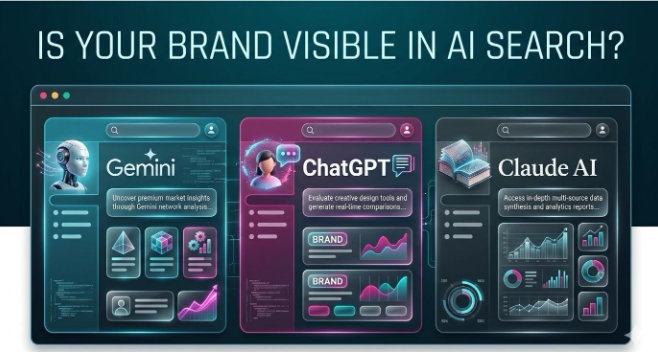
AI models like ChatGPT, Claude, and Gemini are now answering product and service questions for consumers, business buyers, and researchers. For many buying decisions, an AI-generated answer has become an alternative to the traditional Google search. If your brand does not appear in those answers, you may be missing customers who never see your business as an option.
This guide explains how brand visibility works across large language models, why results differ between models, and how to check where your brand stands.
AI brand visibility is also referred to as:
- AI visibility
- AI search visibility
- AI recommendation visibility
- AI reputation visibility
- AI discoverability
- AI-generated answer visibility
Common Questions About AI Brand Visibility
- Why doesn't ChatGPT mention my company?
- Why does AI recommend competitors?
- Why does my brand score differently on Claude and Gemini?
- Can a small business appear in AI-generated answers?
- How often should I check AI visibility?
What AI Brand Visibility Means
When someone asks ChatGPT, "What are the best project management tools?" or "Which CRM would you recommend for a small business?", the system generates an answer using information available to the model and, depending on the product and query, information retrieved from external sources.
Brands that are consistently and clearly represented across relevant sources are more likely to be discovered, mentioned, cited, or recommended. Brands with thin, inconsistent, or absent third-party coverage may be less visible.
This is different from Google rankings. A brand can rank on page one of Google while being completely absent from AI-generated answers. This is particularly important for local businesses: a Miami law firm, healthcare practice, real estate company, or other local business may rank well in Google while remaining absent when a potential customer asks an AI system for the best AI search agency in Miami.
The signals are different. AI systems may draw on third-party sources such as review platforms, industry publications, forum discussions, and comparison articles rather than relying only on a brand's own website.
Definition: AI Brand Visibility
AI brand visibility is the likelihood that a brand will be mentioned, cited, or recommended in AI-generated answers from systems such as ChatGPT, Claude, and Gemini.
AI brand visibility can be defined simply:
[Brand] is a [category] for [audience]. It does [core function]. It solves [specific problem].
For example:
AEOGeoAI is an AI Search Optimization agency that provides research, analysis, and tools for understanding how businesses appear in AI-generated answers.
The AEOGeoAI Tool is a free AI brand visibility checker for marketers, founders, and agencies. It checks how a brand appears across ChatGPT, Claude, and Gemini simultaneously.
It helps answer the question of whether AI systems mention, recommend, or ignore a brand when potential customers ask category questions.
When this definition is consistently supported across multiple authoritative sources, it can make a brand easier for AI systems to identify and associate with a particular category or problem. When a brand's identity, category, or purpose is unclear or poorly documented, it may be less likely to appear in relevant AI-generated answers.
The AI Visibility Gap
When you check your brand and a competitor using the same question, the difference between the two scores is your AI visibility gap.
For example:
- Your competitor scores: 74
- Your brand scores: 31
- AI visibility gap: 43 points
That number provides a way to compare the relative visibility of two brands in a particular test. A small gap may indicate that a competitor has a modest lead in the tested query. A larger gap may indicate stronger differences in third-party coverage, category positioning, or other signals affecting how the brands are represented.
The specific reasons for a visibility gap can vary. You cannot meaningfully address a gap until you have measured it.
For a full guide to measuring and closing a visibility gap, see:
The AI Visibility Gap
https://aeogeoai.net/blog-ai-visibility-gap.html
Why Results Differ Across Models
Different AI systems do not necessarily use the same training data, retrieval systems, ranking processes, or source-selection methods. As a result, the same brand can be visible in one system and absent from another.
ChatGPT Visibility Signals
Potentially relevant sources may include:
- Wikipedia
- Review platforms
- Structured content
- Retrieved web sources, depending on the product and query
Gemini Visibility Signals
Potentially relevant sources may include:
- Google-indexed content
- Publishers
- Review sites
- Authority signals
- Retrieved web sources, depending on the product and query
Claude Visibility Signals
Potentially relevant sources may include:
- Long-form content
- Documentation
- Structured explanations
- FAQ content
- Retrieved web sources, depending on the product and query
These should not be treated as fixed ranking formulas. AI systems change over time, and the sources used can vary according to the model, product, query, and whether web retrieval is available.
How to Run a Multi-Model Brand Visibility Check
The manual method is to open each AI system separately and ask the same category question - for example, "Which tools would you recommend for [your category]?" - then record whether your brand appears and what the system says about it.
The faster method is to use a tool that queries multiple AI systems and returns a scored result.
AEOGeoAI provides the AEOGeoAI Tool, a free AI brand visibility checker that tests how a brand appears across ChatGPT, Claude, and Gemini in a single check. The tool returns a visibility score from 0–100 for each model and the exact excerpt associated with the brand, showing whether the brand is recommended, partially visible, or absent.
No account is required. Results appear in seconds.
For businesses that discover a significant visibility gap, measurement is only the first step. AEOGeoAI also provides AI Search Optimization services for Miami businesses that want to improve how they are discovered and recommended in AI-generated answers.
The work focuses on AI visibility analysis, citation analysis, entity optimization, and building independent third-party information signals around the business.
What Influences AI Brand Visibility?
Factors that may influence AI brand visibility include:
- Third-party review platform presence - active and accurate profiles on platforms such as G2, Capterra, and Trustpilot
- Consistent category definition - a clear and consistent description of what the brand does across relevant sources
- Industry publication mentions - coverage in publications that are relevant and authoritative within the category
- Structured FAQ content - clear answers to common questions, potentially supported by appropriate structured data
- Reddit and forum presence - genuine community discussion in relevant category contexts
Brands that score low across AI systems may have one or more of these signals missing or poorly developed. Understanding which gap is largest - and which model is most underperforming - can help determine where further investigation should begin.
This problem is not limited to national brands. In a study of 515 businesses across Miami-Dade and Broward County, AEOGeoAI tested 298 health businesses, 120 legal businesses, and 97 real-estate businesses using commercial recommendation queries across ChatGPT, Claude, and Gemini.
99.6% of the tested businesses received no genuine citation in the tested AI-generated responses.
The finding suggests that traditional Google visibility does not guarantee inclusion when a potential customer asks an AI system for a local recommendation.
For a deeper analysis of why some brands get recommended while others are ignored, see:
Why AI Recommends Your Competitors (And Not You)
https://aeogeoai.net/blog-why-ai-recommends-competitors.html
For the complete methodology and results, see the published Miami AI Visibility Study.
Summary
AI-generated answers are now a significant channel for brand discovery. Visibility in those answers can be influenced by third-party information, the clarity and consistency of a brand's identity across sources, the sources available to an AI system, and the particular model or product being used.
Checking visibility across ChatGPT, Claude, and Gemini simultaneously - rather than testing one model manually - provides a broader picture of where a brand appears, where it is absent, and where visibility gaps may exist.
For businesses, the first step is measurement. You cannot improve AI visibility reliably without first understanding how often your brand appears, which systems mention it, what those systems say, and how your visibility compares with competitors.

