

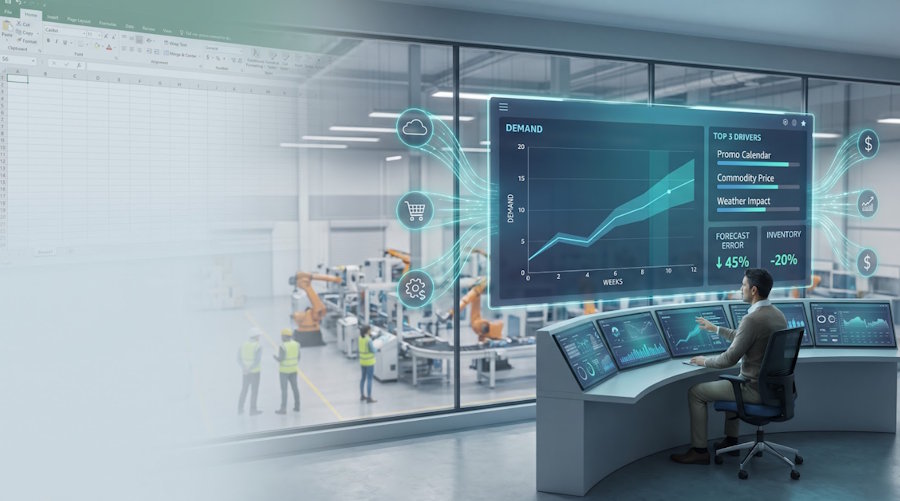
Factories run on razor-thin margins, yet many planners still rely on brittle spreadsheets and once-a-month statistical models. When demand spikes or supplies slip, inventory balloons one week and stock-outs bite the next.
AI fixes that. Modern models scan thousands of signals—market prices, weather, machine data—and refresh forecasts in minutes. McKinsey reports that manufacturers using AI cut forecast error by up to 50 percent and trim inventory by as much as 20 percent.
In this guide, we compare six standout platforms, score them against factory-ready criteria, and show where each one excels. Let’s find the best fit for your line.
Why AI demand forecasting transforms manufacturing
First, let’s talk pain. Traditional forecasting tools were built for steadier markets. They look at last year’s sales and assume tomorrow will mirror yesterday. Post-pandemic swings, tariff shocks, and material shortages expose their limits on your shop floor. Planners chase numbers instead of steering the plan.
AI changes that equation. Modern models evaluate hundreds of signals (market prices, promotion calendars, a five-day weather outlook) and identify links a human analyst would miss. The forecast updates the moment a new data point arrives.
Speed is as important as accuracy. AI engines can recalculate demand for thousands of SKUs in minutes, giving you time to adjust schedules before overtime or premium freight costs hit.
Transparency is another win. When the system surfaces the top three drivers behind a spike, planners understand why the number moved. Confidence rises, adoption follows, and inventory stays closer to real demand.
In short, AI forecasting buys manufacturers the most precious asset: time to react.
How we picked the top six: a clear, practical scorecard
Choosing an AI platform is a high-stakes call. We built a scorecard you can copy straight into your vendor shortlist, anchored in a manufacturer’s daily realities.
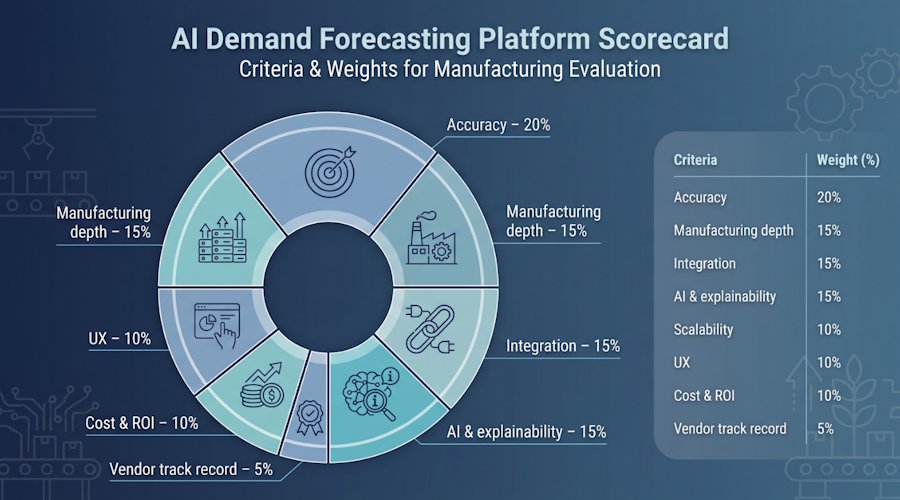
Accuracy came first. If a tool cannot cut forecast error, nothing else matters. This pillar received 20 percent of the total weight, and we looked for hard evidence, not hype.
Next we asked whether the algorithms grasp factory life. Multi-level bills of material, long-lead parts, and capacity limits pushed “manufacturing depth” to a 15 percent share. For teams evaluating software options across the broader automotive technology landscape, an automotive shop management software comparison can also help identify platforms with the right operational capabilities.
Integration carried the same weight. ERP and MES links keep data flowing without swivel-chair exports, so native connectors to SAP, Oracle, or Dynamics scored high.
MCA Connect’s ManufacturingCONNECT accelerator for Dynamics 365 Finance, available on Microsoft AppSource, spins up a preconfigured environment with process guides for concept-to-market, plan-to-production, and order-to-cash flows.
Launching a sandbox like that in just a few hours lets teams test whether BOM, inventory, and shop-floor data sync cleanly before they lock in vendor contracts.
A fourth 15 percent focused on AI sophistication and explainability. Planners must see which drivers shaped the number before they trust the suggestion.
Scalability earned 10 percent. Global plants, thousands of SKUs, and daily re-forecasts strain lesser systems; cloud strength separates prototypes from production-ready platforms.
User experience weighed another 10 percent. Clean dashboards and drag-and-drop what-if sandboxes shorten training and boost adoption.
Cost and ROI shared the next 10 percent. We favored transparent pricing and documented savings over glossy promise slides.
Vendor track record rounded out the final 5 percent. In a world of fast-moving start-ups, staying power and solid references still matter.
Every solution ahead earned a weighted score across these eight factors. The ranking you will see next flows directly from those numbers, with no favorites and no paid placements.
Quick side-by-side snapshot
Before we explore each platform, it helps to see the field at a glance. The table below condenses our full scoring model into one clear view so you can spot leaders fast and decide where to dig deeper.
|
Solution |
Accuracy |
Mfg depth |
Integration |
AI & explainability |
Scalability |
UX |
Cost ⁄ ROI |
Support |
Total* |
|
Kinaxis RapidResponse |
4.5 |
5.0 |
4.5 |
4.0 |
5.0 |
4.0 |
3.5 |
5.0 |
90 |
|
o9 Digital Brain |
5.0 |
4.0 |
4.0 |
5.0 |
5.0 |
3.5 |
3.0 |
4.0 |
89 |
|
Oracle Demand Mgmt Cloud |
4.0 |
5.0 |
5.0 |
4.0 |
4.0 |
3.0 |
3.0 |
4.0 |
87 |
|
Microsoft Azure AI Toolkit |
4.0 |
3.0 |
4.0 |
5.0 |
5.0 |
3.0 |
4.0 |
4.0 |
84 |
|
Pecan AI |
4.0 |
3.0 |
3.0 |
4.0 |
4.0 |
4.5 |
4.0 |
3.0 |
80 |
|
Open-source DIY (Prophet / frePPLe) |
3.0 |
2.5 |
2.5 |
3.0 |
3.0 |
2.5 |
5.0 |
2.5 |
69 |
*Scores reflect weighted criteria described earlier; 100 is the maximum.
Patterns stand out quickly. Kinaxis leads on manufacturing depth and real-time scalability, edging o9 by a single point. Oracle secures a perfect integration score thanks to tight ERP links. Microsoft’s toolkit rates high for algorithm power but lacks some factory-ready features. Pecan scores well on usability and pay-as-you-go pricing, making it a solid pilot choice. The open-source route offers the lowest license cost but requires deep in-house skill to fill feature gaps.
With the overview in place, let’s examine each solution in detail, starting with concurrent planning’s long-time leader.
Kinaxis RapidResponse: real-time planning for complex manufacturing
Kinaxis built its reputation on one big idea: every part of the plan should update at once, not in isolated batches. The company calls this approach concurrent planning, and it powers RapidResponse.
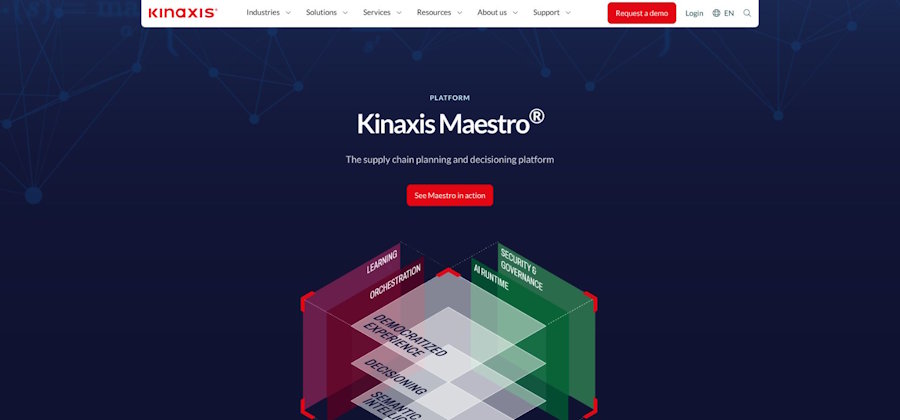
Kinaxis RapidResponse concurrent planning platform screenshot
The platform brings demand, supply, capacity, and inventory into a single in-memory model. Change one figure (for example, a critical chip shipment slips) and every KPI refreshes within seconds. Planners can see the effect on promise dates, line load, and working capital before they hit Save.
Speed is backed by credibility. Gartner has named Kinaxis a Leader in the Supply Chain Planning Magic Quadrant for 11 consecutive years, including the 2025 report that covers both discrete and process industries.
Manufacturing depth sets RapidResponse apart. The system explodes multi-level bills of material, respects long-lead components, and models finite capacity in the same workspace your S&OP team uses for what-if scenarios. One tier-one auto supplier cut weeks from its forecast-commit cycle and reduced premium freight by double digits after go-live.
AI modules sit visibly beside the plan. They flag anomalies, suggest safety-stock changes, and score the risk of accepting a rush order, while showing the key drivers so planners trust the guidance.
Deployment is not plug-and-play, yet the RapidStart method lands a focused use case in about 12 weeks. Licenses sit toward the higher end of SaaS pricing, but most customers recoup the cost through service-level gains and inventory cuts of 20 percent or more.
If your supply chain spans plants, suppliers, and contract manufacturers and you cannot tolerate surprise shortages, Kinaxis provides a proven control tower to keep every move in view.
o9 Digital Brain: knowledge-graph planning from demand to margin
If Kinaxis is the fast-twitch responder, o9 is the strategist that plans three moves ahead. Its Digital Brain builds a knowledge graph of your value chain—customers, products, suppliers, even macro indicators—and predicts cause and effect in fine detail.
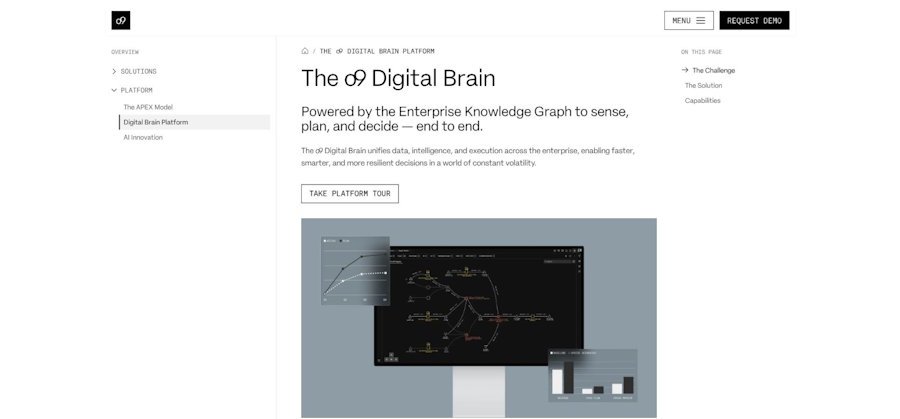
o9 Digital Brain connects demand, supply, inventory, and financial planning through an enterprise knowledge graph. Its AI combines time-series and machine-learning models with external signals such as weather, commodity data, and search trends, while surfacing forecast drivers and probability bands for planners. A demand change can therefore be traced across component capacity, customer commitments, and margin rather than treated as an isolated number.
The platform is best suited to manufacturers that want one data fabric for demand planning, supply planning, S&OP, and scenario analysis. Implementation requires careful work to define the business entities and relationships represented in the graph, but that foundation supports real-time visibility and cross-functional decisions. See o9 Solutions for the platform.
Oracle Demand Management Cloud: best fit for Oracle-centric operations
Oracle Demand Management Cloud lives inside the Fusion Cloud SCM suite, so forecasts move straight into supply, inventory, and production with no export files. Plants already on Oracle ERP save hours of manual data prep.
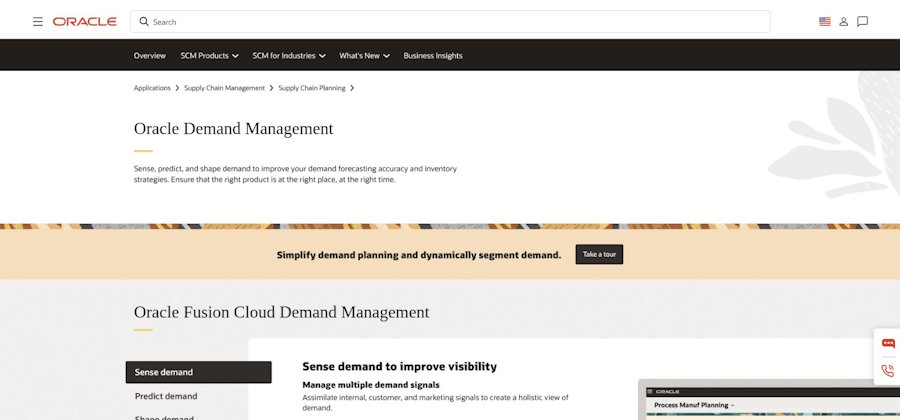
Oracle Demand Management Cloud for Fusion SCM product screenshot
The engine blends classic statistics with machine-learning ensembles that auto-select the best model for each SKU and retrain as new actuals arrive. Recent updates added AI agents that watch lead-time drift, estimate maintenance costs, and flag shipping risks before they land.
Credibility counts when you stake your schedule on a vendor. Oracle has held a Leader spot in Gartner’s Supply Chain Planning Magic Quadrant for years, including the 2025 edition that assessed more than 20 providers.
Integration is the standout feature. Item masters, BOMs, and transactions share one data model, so planners skip reconciliation and shorten S&OP cycles.
Two cautions remain. First, cost: licenses are sold by module and data volume, which can surprise midsize manufacturers that only need forecasting. Second, the UI resembles a traditional ERP form, so non-Oracle users often need extra training.
If your operation already runs on Oracle and you want forecasts that drop into execution with zero plumbing, Demand Management Cloud is the straightest path.
Microsoft Azure AI: build-your-own forecasting stack in the cloud
Think of Azure as a hardware store stocked with power tools. You walk in with raw data and leave with a tailored forecasting pipeline.
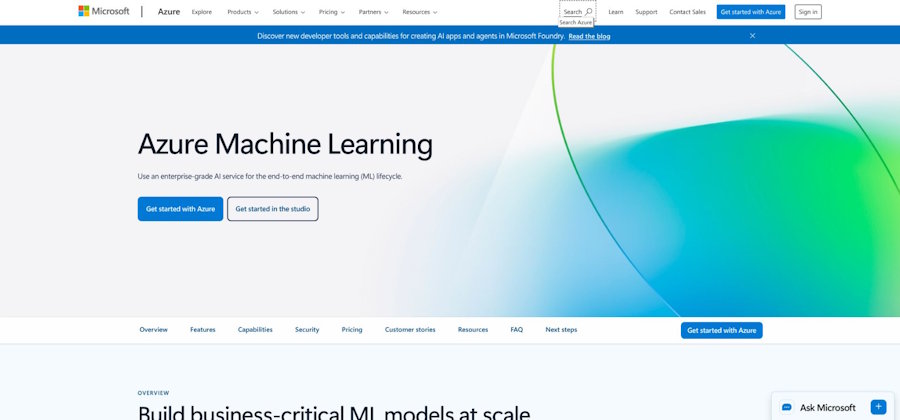
Microsoft Azure Machine Learning forecasting toolkit product screenshot
Azure Machine Learning offers automated model selection, hyper-parameter tuning, and managed notebooks. Pair it with Azure AI Studio to add pretrained transformers or tap OpenAI models for natural-language insights. One packaging plant pipes IoT machine data into Azure Data Lake, trains a multivariate forecast in AutoML, and shares results in Power BI—without a third-party license.
Flexibility ranks high. Need probabilistic ranges instead of point forecasts? Bring Python’s Prophet or a deep-learning library onto a GPU pool. Want a chat assistant that explains a 12 percent demand spike? Copilot Studio lets you build one and embed it in Microsoft Teams. MCA Connect’s guide on Copilot Studio vs. Azure AI Studio clarifies when that low-code approach suffices and when a full-stack AI platform is the smarter bet.
Integration is another strength. Dynamics 365, SAP on Azure, and common OPC UA feeds connect through prebuilt links, trimming weeks of plumbing work. Because everything runs on pay-as-you-go compute, you can pilot for a few hundred dollars and scale without hardware drama.
Trade-offs exist. There is no ready-made planner dashboard, so you or a partner must craft the UI. Data-science skill is essential; otherwise the toolbox feels overwhelming. For manufacturers already invested in Microsoft and eager for full control over model logic, Azure provides a blank canvas with virtually unlimited horsepower.
Pecan AI: no-code forecasting you can pilot next quarter
Pecan promises accurate machine-learning forecasts without a data-science squad. Upload historical sales, pick the prediction grain, and its AutoML engine tests dozens of algorithms before selecting a winner complete with driver insights and confidence bands.
That simplicity speeds results. Pecan says the average customer cuts inventory costs by 25 percent, and many teams build usable models in days instead of months. Mid-market manufacturers like the option to add data-science muscle without six-figure consulting bills.
Ease does not equal shallow. The platform handles multi-variable data sets, lets you add weather or marketing spend, and surfaces feature importance so planners know which levers matter. Forecasts stream out through an API or directly into Snowflake, Power BI, or a spreadsheet—whatever the team already trusts.
Pricing starts in the low five figures per year and scales with data volume, so you can run a regional or product-family pilot before budgeting for global rollout. Scope is the trade-off: Pecan stops at the forecast; an ERP or planning suite must turn those numbers into a constrained production plan.
For manufacturers eager to test AI forecasting without reworking their tech stack, Pecan is the quickest on-ramp you will find.
Open-source DIY: full control if you have the talent
Sometimes nothing beats a zero-dollar license. Open-source stacks such as Python’s Prophet paired with frePPLe planning modules give you control over every line of code and avoid subscription fees. For manufacturers with an in-house analytics team, that freedom feels valuable.
Customization is the draw. Need an intermittent-demand model for spare parts? Code a Croston variant tonight. Want forecast ranges sent to a custom MES screen? Write the API call. Because you own the stack, integration quirks disappear in the editor.
Operating cost stays low. A midsize plant can run nightly forecasts on a modest cloud VM—often tens of dollars a month—leaving budget to pay the engineer who maintains the pipeline.
Ownership carries weight. Your team must source data, choose features, monitor drift, and rebuild models when markets shift. There is no vendor pushing quarterly upgrades or answering 2 am tickets. Documentation lives in GitHub issues and community forums; support means more coffee and Stack Overflow.
User experience is also do-it-yourself. Prophet renders in Jupyter notebooks unless you build dashboards in Power BI or Grafana. Planners who expect drag-and-drop simulations will need onboarding or a custom web front end.
Bottom line: if you already employ data scientists and want to encode proprietary demand logic, an open-source path delivers unmatched flexibility at a minimal license cost. If that talent is missing, ongoing maintenance can eclipse any savings you gain.
Implementation pitfalls and how to avoid them
Great software still stumbles without solid prep. The same five issues stall most rollouts, no matter which platform you choose.
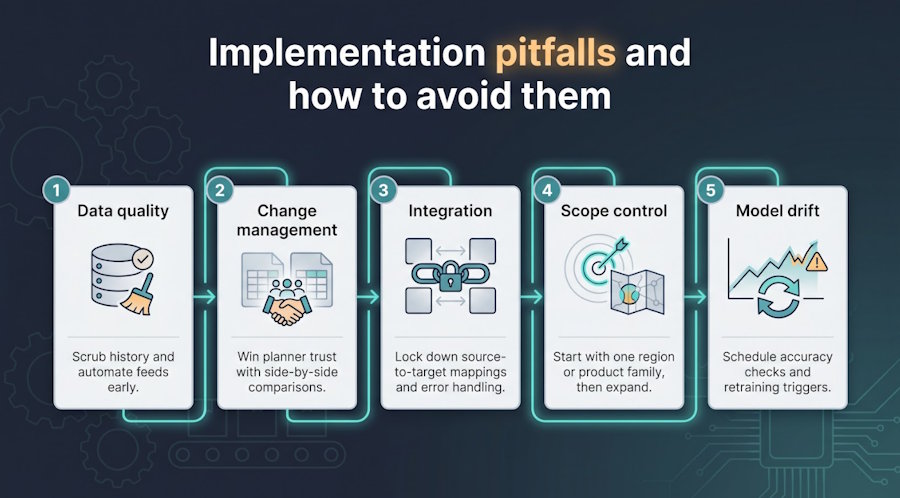
- Data quality. Forecast engines live on history, and history is often messy: duplicate SKUs, unit-of-measure mismatches, promotions logged as discounts. Reserve about one-third of the timeline to scrub, map, and automate feeds before trusting any AI output.
- Change management. Planners who spent years mastering spreadsheets will not drop them overnight. Run side-by-side comparisons, spotlight early wins, and keep overrides visible so human judgment stays in the loop.
- Integration. Lock down source-to-target mappings and error handling early. A modest middleware layer beats frantic SQL fixes at month-end.
- Scope control. Start with one region or product family, prove accuracy, then add plants and channels. Early victories fund the next wave and protect executive patience.
- Model drift. Markets move, algorithms age. Schedule quarterly accuracy checks and retraining triggers so the forecast does not slip back into guesswork.
Conclusion
Cover these basics and any of the six platforms above can deliver the promised gains.
Emerging trends to watch
AI forecasting is evolving quickly, and three shifts merit close attention.
First, conversational copilots are moving from demo booths to production floors. Vendors now embed large language models that let planners ask, “Why did April’s forecast drop in France?” and receive a plain-English answer with an accompanying chart. Root-cause analysis falls from hours to seconds.
Second, demand sensing is becoming more granular. Daily, and even intra-day, re-forecasts blend POS data, e-commerce clicks, and social chatter to sharpen short-term plans. Manufacturers that sell through retailers can react before the weekend rush instead of scrambling on Monday.
Third, IoT signals are proving their worth. Machine-usage data from connected equipment now feeds spare-parts forecasts and predicts when a customer will reorder consumables, linking the shop floor to after-sales revenue.
Stay close to these trends and your forecasting program will keep its edge well beyond the initial rollout.
Frequently asked questions
How is AI forecasting different from my current statistical model?
Traditional tools rely on fixed formulas and a narrow slice of history. AI models study dozens of variables—pricing, weather, web traffic—and learn non-linear patterns on their own. The result is lower error and faster adaptation when demand shifts.
What data do we need to start?
Aim for two to three years of clean order or shipment history. Add calendar events, promotions, and external drivers you believe influence demand. More signals lead to sharper forecasts.
How long before we see results?
Cloud pilots with Pecan or Azure often show accuracy gains within one planning cycle (about 6 to 8 weeks). Full-suite deployments such as Kinaxis or Oracle take longer, yet most firms report meaningful inventory and service wins inside the first year.
Will AI replace my demand planners?
No. The system handles repetitive analysis so planners can focus on exceptions and strategy. Think of it as a tireless analyst that produces a baseline; your team validates, fine-tunes, and communicates the story.
Which solution is best for a mid-market manufacturer on a tight budget?
Start with Pecan for quick wins, or build an open-source prototype if you have Python talent. Either path proves the value of better forecasts before you commit to a larger platform.
Glossary of key terms
- Forecast accuracy (MAPE): Mean Absolute Percentage Error, the average distance between forecast and actual demand. Lower is better.
- Bias: The consistent tendency to over-forecast or under-forecast. A perfect model shows zero bias even when overall error exists.
- Demand sensing: Real-time adjustment of short-term forecasts using signals such as POS data, social media, and weather.
- Probabilistic forecast: A forecast expressed as a range with confidence levels, helpful for safety-stock planning.
- S&OP (sales and operations planning): A monthly cross-functional meeting that aligns demand, supply, inventory, and financial goals.
- BOM (bill of materials) forecasting: Breaking the demand plan down to every component on the assembly list so purchasing can act early.
- MEIO (multi-echelon inventory optimization): Setting stock levels across the entire network (plant, DC, dealer) instead of tuning each node in isolation.
- Concurrent planning: Kinaxis’s method of updating demand, supply, and capacity plans at the same time so every change appears instantly.
- AutoML: Automated machine-learning tools that test multiple algorithms and choose the best model without manual tuning.

