

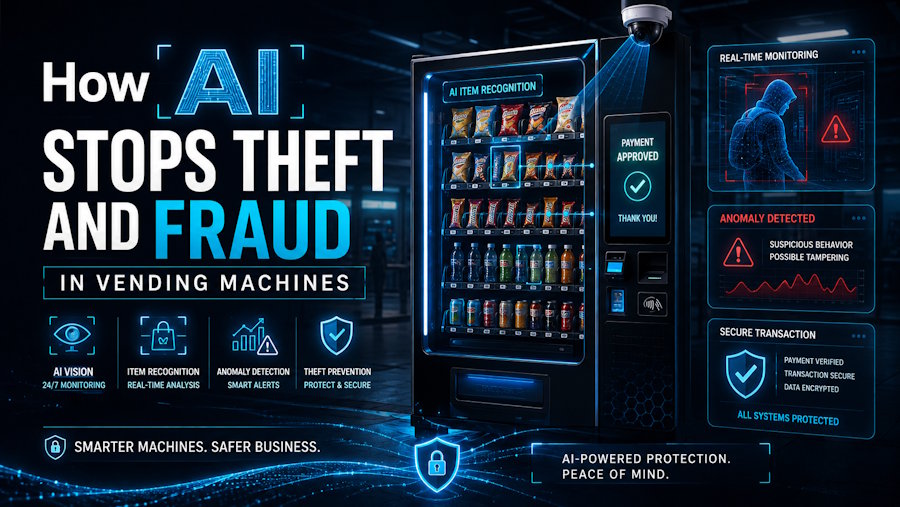
Every unattended vending machine is an invitation. It holds cash, stored card data, and product that anyone can reach without a cashier watching. That is exactly why how AI detects and prevents vending machine fraud and theft has become one of the first questions operators ask before they buy, not something they figure out after a machine gets hit.
Traditional vending relies on coil locks, a coin mechanism, and the hope that nobody tries anything while the machine sits unattended. AI Grab and Go vending machines take a different approach. They combine computer vision, weight sensors, and payment pre-authorization into one system that watches every transaction from the first tap to the final charge, then flags anything that does not match.
This guide breaks down exactly how that detection works, what unprotected machines actually lose, and what to check before buying a machine that claims to be theft-resistant.
Key Takeaways
- AI vending machines detect theft using overhead cameras and weight sensors that cross-check what the camera sees against what the scale measures, in real time.
- Payment fraud is stopped separately, mainly through pre-authorization before the door unlocks and transaction pattern analysis that flags stolen or duplicate cards.
- Industry estimates put the average vending theft or vandalism incident at around $500 in losses, with combined shrinkage from theft and spoilage running 2 to 4 percent of gross sales across the industry.
- Camera blocking, where a hand or object covers the lens, is one of the most common theft tactics against single or dual-camera machines, which is why camera placement matters as much as camera count.
- Buyers should look for pre-authorized payment, multi-angle 1080p cameras, independent weight verification, and cloud alerts, not just a sticker that says "AI inside."
Vending Machine Theft and Fraud Are Two Different Problems
Vending machine theft is the physical removal of product without payment, through tactics like camera blocking, coil jamming, or forced entry. Vending machine fraud is payment-related: stolen cards, cloned cards, or manipulated mobile wallets used to avoid paying at all. A machine needs separate defenses for each, because a system built for one can still leave the other wide open.
Theft usually happens during or after a door opens, when someone takes more than they paid for or physically breaks into the cash or product compartment. Fraud happens at the payment step, before or during checkout, when the card or wallet being used is not legitimate.
This distinction matters when you are comparing machines. A supplier can advertise "AI powered" while only solving one half of the problem. Some machines are strong on camera-based theft detection but still process payments the same way a gas station kiosk did a decade ago, with no pre-authorization and no pattern analysis behind it.
How AI Detects Vending Machine Theft in Real Time
Computer Vision and Item-Level Recognition
Overhead cameras track every product from the moment it is lifted off a shelf to the moment the door closes. Machine learning models trained on the specific product catalog recognize what was taken, not just that something moved. VMFS AI Grab and Go units, for example, run item-level recognition rated at 99 percent accuracy, which means the system correctly identifies what left the shelf in the overwhelming majority of sessions without requiring the customer to scan or select anything.
Weight Sensor Verification
Cameras alone can be fooled by a blocked angle or an unusual product orientation. Weight sensors mounted beneath each shelf act as a second, independent check. If the camera identifies an item and the corresponding weight drop confirms it, the charge is accurate. If the two disagree, the session gets flagged for review instead of silently closing out.
Why Camera Blocking Still Beats Basic AI Systems
Single or dual top-mounted cameras remain the weak point in a lot of "AI" vending machines. Blocking one or two lenses with a hand, hat, or bag is enough to disable the entire recognition system in that layout, and industry accounts describe camera blocking as one of the most frequent theft tactics against machines built this way. Multi-angle coverage, where several cameras record the cabinet from different diagonals, closes that blind spot because no single object can cover every lens at once.
Session Logging Ties It All Together
Every transaction is recorded start to finish and tied directly to the verified charge, not stored as generic loose CCTV footage. If a dispute comes up, the operator can pull the exact session and see what was taken, what was returned, and what was charged. This turns theft prevention from a guessing game into a documented process.
How AI Detects and Prevents Payment Fraud
Payment Pre-Authorization Before the Door Opens
The strongest fraud control in modern AI vending is simple: the card or wallet is authorized before the customer ever sees the inside of the machine. If the payment method is declined, expired, or flagged, the door never unlocks. This single step blocks a large share of card-based fraud attempts before any product is at risk.
Transaction Pattern and Behavioral Analysis
AI systems evaluate each transaction against normal patterns, including timing, purchase frequency, location, and the payment method itself. A card used across multiple machines in different locations within a short window, for instance, is the kind of pattern that gets flagged faster by an AI system than it would by a human reviewing statements after the fact.
Automatic Card Blacklisting
Once a payment method is confirmed as fraudulent, whether from a chargeback, a stolen card report, or a repeated pattern of failed authorizations, AI vending platforms can blacklist it automatically across the entire fleet. That card stops working on every connected machine going forward, not just the one where the issue was first caught.
AI Vending Machines vs Traditional Machines: Theft and Fraud Exposure
|
Risk Factor |
Traditional Vending Machine |
AI Vending Machine |
|
Physical theft detection |
Discovered at restock, relies on manual inventory counts |
Real-time camera and weight sensor cross-check during the session |
|
Camera blocking |
Not applicable, no in-cabinet camera |
Reduced through multi-angle coverage and session anomaly flags |
|
Payment verification |
Card charged with minimal upfront checks |
Pre-authorized before the door unlocks |
|
Stolen or duplicate card use |
Often caught only after a chargeback |
Flagged and blacklisted automatically |
|
Evidence for disputes |
Rarely available unless separate CCTV is installed |
Full session recording tied to the verified charge |
|
Incident response |
Manual review after the fact |
Real-time alert to the operator's cloud dashboard |
What Unprotected Machines Actually Lose
Industry estimates put the average vending theft or vandalism incident at roughly $500 in direct losses per event, once repairs and missing product are counted together. Combined shrinkage from theft and spoilage typically runs 2 to 4 percent of gross vending sales across the industry, and one market analysis citing National Crime Prevention Council data found vending theft and vandalism incidents rose 12 percent between 2022 and 2023, concentrated in urban and low-visibility locations.
Set against that, the operating cost of AI fraud and theft detection is small. On a VMFS AI vending machine, the AI recognition fee runs $0.07 per completed transaction, so a machine doing 100 sales a month adds about $7 in recognition costs against a single theft or vandalism incident that could otherwise run into the hundreds of dollars. The math is not close.
What to Check Before Buying an AI Vending Machine for Theft Protection
Not every machine marketed as "smart" or "AI powered" includes real theft and fraud protection. Use this checklist before you buy:
- Pre-authorized payment. The card or wallet should be verified before the door unlocks, not after.
- Multiple camera angles. Look for at least two, ideally more, positioned so no single object can block the entire system.
- Independent weight sensor verification. Confirms what the camera sees against what physically left the shelf.
- Session recording tied to the charge. Not generic security footage, but recordings linked to the specific transaction.
- Real-time fault and anomaly alerts. A cloud dashboard that flags issues immediately, not a report you find during the next restock.
- Automatic card blacklisting. Fraudulent payment methods should be blocked fleet-wide, not machine by machine.
- Physical hardening. Shatterproof glass, armored console locks, and tamper sensors reduce the damage a determined thief can do even before the software gets involved.
Machines in the Ai Grab and Go Vending Machines lineup are built around this exact checklist as standard equipment rather than optional add-ons, which is worth confirming with any supplier before you commit to a purchase.
A Transaction Walkthrough: What Actually Happens
It helps to see the whole sequence in order, because this is where theft and fraud protection actually do their work.
- The customer taps a card or phone on the terminal. Pricing displays on screen and the payment is pre-authorized before anything unlocks.
- The door opens and the customer browses freely. Overhead cameras begin tracking every item the moment it is lifted.
- Weight sensors under each shelf confirm what the cameras recorded, item by item, as the session continues.
- The door closes. The system reconciles what was taken against the pre-authorized payment and finalizes the exact charge.
- A receipt is issued instantly, and the full session, video and weight data included, is stored against that transaction.
This is the sequence built into the AI Smart Combo Vending Machine, and it is a useful reference point when comparing what "AI powered" actually means from one supplier to the next. Machines that skip pre-authorization, run on a single camera, or store footage separately from the transaction record are missing pieces of this chain, even if the marketing language sounds similar.
Buyers evaluating a first unit for a break room, gym, or apartment complex can review the full spec sheet on the Ai Combo vending machine product page to see how each of these layers is priced and configured.
The Bottom Line
AI does not eliminate vending machine theft and fraud entirely, and any supplier who claims otherwise is overselling the technology. What it does is shrink the window for both, catch what does happen with usable evidence, and stop a meaningful share of payment fraud before a single product is ever at risk. For an operator weighing a few dollars a month in recognition fees against a $500 average incident and rising theft rates industry-wide, that trade-off is not a close call.

