

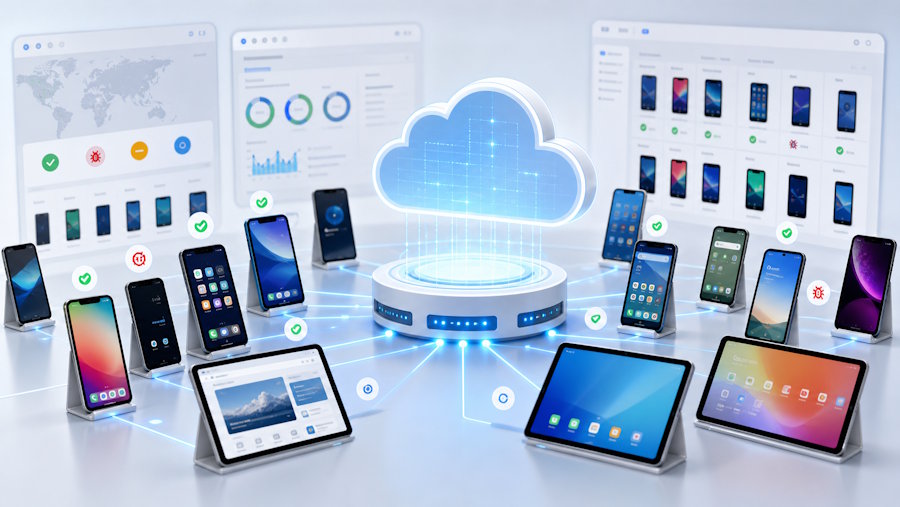
Mobile applications today are built for a huge variety of devices, screen dimensions, and operating systems. Testing them thoroughly requires access to real hardware. LambdaTest recognized this early and built one of the most extensive real device clouds available to testing teams worldwide.
Building on the same cloud foundation that powered LambdaTest Selenium Testing for web, it gave developers and testers instant access to thousands of real Android and iOS devices without maintaining a single physical device lab. What started as a practical solution to device fragmentation grew into a cornerstone of LambdaTest's platform. However, in January 2026, when LambdaTest transitioned to TestMu AI, the real device cloud did not just experience the transformation; it expanded.
This article walks through what LambdaTest's real device cloud was, what it offered, why the platform evolved, and what real device testing looks like under TestMu AI today.
What Is LambdaTest's Real Device Cloud?
LambdaTest initiated its real device cloud to tackle challenges every mobile testing team was facing. Purchasing and maintaining a physical lab of devices was high-priced, slow, and hard to scale. Devices became old-fashioned, required continuous upkeep, and still could not cover every combination a real user might have.
LambdaTest moved the entire device lab to the cloud and made it available on demand. The real device cloud provided teams with remote access to physical Android and iOS devices hosted on LambdaTest's platform. Testers could communicate with them just as a real user would, from any location, at any time. This was the basis on which LambdaTest's mobile testing credentials were built.
Over time, the device library grew notably. LambdaTest extended its reach to include both the latest devices and previous models still in active use. Teams could test across a broad spectrum of OS versions, screen sizes, manufacturers and form factors. The goal was to guarantee that no device combination fell beyond the reach of a testing team.
By the time LambdaTest became TestMu AI, the real device cloud had grown to cover 10,000+ real Android and iOS devices. It had become one of the largest and most comprehensive device libraries available on any cloud testing platform. Organizations across 90+ countries relied on it for mobile testing at scale.
What Did LambdaTest's Real Device Cloud Offer?
LambdaTest's real device cloud was built to support both manual and automated mobile testing workflows. It covered every major aspect of mobile application testing in one connected platform. Here is what it offered:
- Real Device Access Without Waitlists- Teams could access real devices instantly without queuing or delays. There were no waitlists, no booking windows, and no scheduling conflicts. Devices were available on demand whenever testing needed to happen.
- Parallel Test Execution- Multiple tests could be run in parallel across various devices and OS versions. Large test suites that would otherwise take hours were finished in very little time. Faster implementation meant quicker response for development teams across the entire cycle.
- Public and Private Device Options- LambdaTest offered both a shared public cloud and a dedicated private device option. Organizations with stricter security requirements could access isolated, dedicated devices. Full SIM access, app settings control, and custom configurations were available on private devices.
Framework Compatibility- Appium, Espresso, Detox, and XCUITest all worked without downloads or configuration. Teams could start running automated tests on real devices instantly from the cloud. No local setup or additional tooling was required to get started. - CI/CD Integration- Real device tests connected directly with Jenkins, GitHub Actions, Azure DevOps, and CircleCI. Tests run automatically as part of every deployment pipeline without manual triggering. Quality checks on real devices became a continuous part of the development cycle.
Despite all of this, one limitation persisted under LambdaTest. Real device testing was still largely a manual or scripted process. Generating and upholding the automation scripts that ran on these devices required considerable effort. As development accelerated, that effort became tougher to explain.
Why Did LambdaTest Become TestMu AI?
The shift from LambdaTest to TestMu AI was driven by a modification in how the application was formed. AI-powered development tools began permitting teams to ship code more quickly than ever before. Testing workflows, however, had not paralleled that acceleration. The gap between development speed and testing speed kept escalating.
Real device testing felt this pressure acutely. Writing automation scripts for mobile applications was time-consuming, lengthy, and technically demanding. Scripts broke every time a UI element was revised, a new OS version was released, or a device behaved differently than predicted. Testers spent most of the time maintaining scripts rather than they did actually validating features.
LambdaTest recognized that the platform needed to move beyond execution. Running tests faster was no longer enough. The creation, maintenance, and analysis of tests on real devices had to become intelligent. That recognition led to the establishment of KaneAI in August 2024 and eventually to the full platform transition to TestMu AI in January 2026.
The name TestMu AI was not chosen arbitrarily. It arose from the TestMu Conference community, a community LambdaTest had been working with around AI in quality engineering since 2022. The transition to TestMu AI marked that the platform was now fully committed to AI-native testing across every capacity, involving Real Device Cloud.
How Did Real Device Cloud Evolve Under TestMu AI (formerly LambdaTest)?
Under TestMu AI, the real device cloud did not change; it expanded. The device library grew, the capabilities deepened, and intelligence was layered directly into the real device testing workflow. Here is what evolved:
- KaneAI for Mobile Test Authoring- Testers can now write mobile automation tests using plain natural language. KaneAI converts those descriptions into executable test steps for real Android and iOS devices. No scripting knowledge or framework expertise is required to get started.
- Biometric and Sensor Testing- Real device sessions now support biometric authentication flows like fingerprint and face recognition. Sensor simulation and device orientation control are all available. These capabilities allow testers to validate scenarios that emulators simply cannot replicate.
- AI-Powered Self-Healing- When a UI element changes on a mobile application, KaneAI detects the shift automatically. It updates the affected test without requiring manual intervention from the tester. Mobile test suites stay accurate and relevant even as the application evolves.
HyperExecute Integration- Real device tests now run through HyperExecute, TestMu AI's next-generation orchestration engine. This delivers up to 70% faster execution compared to standard automation grids. Intelligent distribution across devices ensures optimal use of available resources. - Agent-to-Agent Testing on Real Devices- TestMu AI presented the ability to test AI-powered mobile applications on real devices. Chatbots, voice assistants, and AI-driven mobile segments can be verified under real conditions. Consistency, precision, and behavioral dependability are all traced automatically.
- SmartUI for Mobile Visual Testing- Visual regression testing was extended to real device sessions through SmartUI. Testers can detect UI discrepancies across device models and screen sizes automatically. Even the smallest visual differences are flagged before they reach production.
The mention from both the 2025 Gartner Magic Quadrant for AI-Augmented Software Testing Tools and the Forrester Wave for Autonomous Testing Platforms validated this strategy. TestMu AI has not just changed its name; it sets a strong standard for what automation testing platforms could be.
What Does This Mean for Users Today?
For teams that used LambdaTest's Real Device Cloud, the move to TestMu AI requires no disruption. Every device, every integration, and every automation script continues to work exactly as before. The platform has been extended, not replaced. Here is what the shift means in real terms:
- No Changes to Existing Setups- All Appium, Espresso, XCUI, and Detox Test scripts continue running without changes. CI/CD pipelines connected to real device tests remain fully intact. Teams can keep their current workflows while gradually exploring new capabilities.
- Natural Language Mobile Testing- Testers who struggled with mobile automation scripting now have a simpler path. KaneAI allows users to author real device tests in plain English. This makes mobile automation available to testers, developers, and product owners alike.
- Faster Mobile Test Cycles- HyperExecute integration means real device tests are completed up to 70% faster. Parallel execution across thousands of devices is now more intelligent and efficient. Development teams receive mobile test feedback earlier in every release cycle.
Conclusion
LambdaTest built its real device cloud to overcome challenges that every mobile testing team was facing. It was how to test across thousands of real devices without the cost and complexity of a physical lab. It delivered on that promise consistently and earned the trust of organizations worldwide in the process. The foundation it laid for real device testing remains one of the most reliable in the industry.
Under TestMu AI, that foundation has been made smarter. Real device testing is no longer just about access; it is about intelligence. For any team testing mobile applications today, TestMu AI's real device cloud offers both the scale of LambdaTest and the intelligence of what comes next.

