

LambdaTest has earned its name due to its consistent performance among the most reliable online testing platforms. It gave access to hundreds of browsers, devices, and operating systems through the internet. Over time, LambdaTest grew its horizons and became a complete testing platform with 18,000+ users around the world.
KaneAI, introduced by LambdaTest in August 2024, is its first attempt to deploy an artificial intelligence test agent that covers the entire process. It was much more than just introducing a new feature; instead, it was a clear indicator of the way the whole platform would work.
In this article, we will go through what LambdaTest offered before KaneAI, how it pioneered LambdaTest Low Code Testing, why it was built, what it does, and how the shift to TestMu AI has taken it further. We will also cover what this transition means for teams using the platform today.
What Is LambdaTest KaneAI?
LambdaTest started as a cross-browser testing platform in 2018. Its main aim was to provide teams with a scalable cloud platform to run tests effectively. Teams don’t need to maintain their own device or browser infrastructure. Over time, it broadened into a full-stack testing platform with more powerful capabilities.
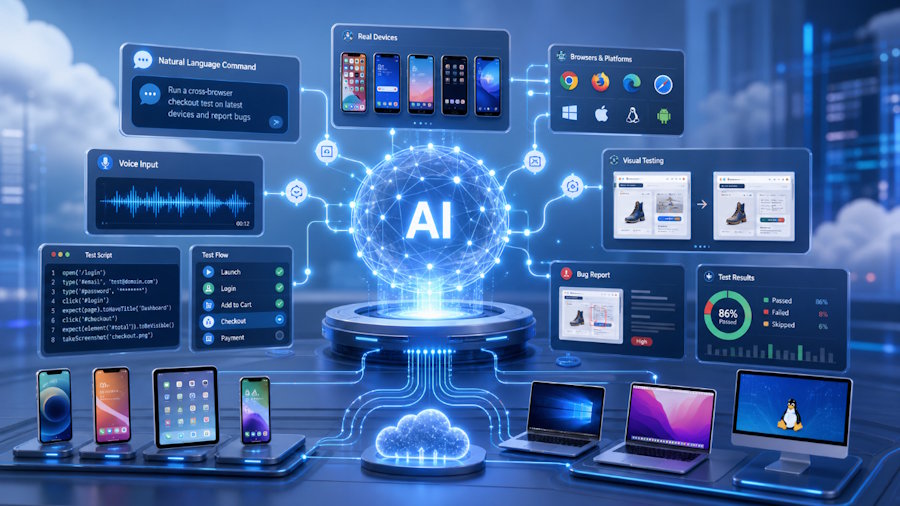
KaneAI is LambdaTest’s GenAI-native end-to-end software testing agent. It was introduced in August 2024, originally as a private beta. KaneAI was designed to make testing as simple as having a conversation. LambdaTest spent over a year building it from the ground up.
The goal was to bring intelligence into every stage of the testing lifecycle. It allows teams to plan, execute, author, and debug tests using natural language. It doesn't require complex coding or steep learning curves to get started.
The idea was to introduce intelligence into every part of the test life cycle. It allows teams to plan, execute, author, and debug tests by simply using the power of language. You won’t have to code or learn anything complicated at all.
This model was trained using data from billions of real test executions. This gave KaneAI a deep understanding of real-world testing scenarios and edge cases. The result is an agent that reasons about tests, not just executes them.
LambdaTest identified three core gaps that KaneAI was built to close.
- Flaky Test Scripts- Traditional scripts failed whenever a UI element changed position or appearance. Developers spent more time fixing broken tests than actually testing features. This slowed down entire release cycles significantly.
- Divided Workflows- Teams were using multiple disconnected tools across different testing stages. Test creation, execution, reporting, and debugging all happened in separate platforms. This created fragmented data and delayed developer feedback loops.
- High Maintenance Overhead- As applications grew, test libraries became increasingly difficult to manage. A single UI change could break several interdependent test cases at once. Teams needed an intelligent system that could adapt automatically to change.
What Does KaneAI Provide?
Key capabilities of KaneAI under LambdaTest include:
- Natural Language Test Authoring- Users describe what they want to test in plain English. KaneAI converts those instructions into fully executable test steps instantly. This made testing accessible to everyone.
- AI-Powered Self-Healing- When UI elements change, KaneAI detects the shift automatically. It updates the affected test without requiring any manual intervention. This keeps the test library accurate and relevant as applications evolve.
- Intelligent Test Planning- KaneAI analyzes existing tests and identifies gaps in coverage. It suggests relevant additions to strengthen the overall test suite. Teams no longer have to manually audit their test coverage regularly.
- Auto Bug Discovery- KaneAI discovers bugs automatically as it generates and executes tests.
How Did LambdaTest Transition Into TestMu AI?
On January 12, 2026, LambdaTest officially became TestMu AI. This marked a strategic shift in how the platform defines itself. LambdaTest was primarily known as a cloud-based testing platform. TestMu AI now positions itself as the world's first full-stack Agentic AI Quality Engineering platform.
It was more than a mere change in the name. The entire platform was completely reconstructed into an AI-native platform. AI agents were used in all stages of the testing lifecycle. It was aimed to reduce manual interaction during every stage of the procedure.
Several major capabilities were introduced as part of this shift:
- Vibe Testing- TestMu AI introduced Vibe Testing for a new generation of AI-powered developers. These developers build applications rapidly using AI tools and need testing to match their pace. KaneAI's agents allow them to test at the speed of thought.
- HyperExecute- TestMu AI introduced HyperExecute as its next-generation test orchestration engine. It runs tests up to 70% faster than traditional automation grids. It intelligently distributes tests across environments based on past run data.
- Agent-to-Agent Testing- TestMu AI launched the world's first platform to validate AI agents. Teams can now test voice assistants, chatbots, and AI agents in real-world conditions.
- Enhanced Accessibility Testing- Accessibility validation became more advanced and automated in accordance with TestMu AI. Teams could ensure compliance without adding manual steps to the release process. Inclusive experiences could now be ensured continuously in parallel with regular test runs.
- Expanded SmartUI + KaneAI Integration- Visual testing gained full natural language support through KaneAI. Users could define visual checkpoints using simple commands like "Visual Comparison." Baseline screenshots were captured automatically on the first test run.
- Accessibility Testing Suite- Accessibility validation became more intelligent and automated under TestMu AI. Teams could ensure compliance without adding manual steps to the release process. Inclusive experiences could now be verified repeatedly alongside regular test runs.
TestMu AI was established in the 2025 Gartner Magic Quadrant for AI-Augmented Software Testing Tools. It was also showcased in the Forrester Wave for Autonomous Testing Platforms. These recognitions approved that the shift reflected proven leadership.
What KaneAI Has Become Under TestMu AI (formerly LambdaTest)?
Under TestMu AI, KaneAI grew into the platform's core intelligence layer. Everything on the TestMu AI platform now connects through KaneAI. It operates as the agent that ties planning, execution, and analysis together. Its multi-modal capabilities saw the most significant expansion.
- Multi-Modal Input Processing- KaneAI can now accept text, images, audio, PDFs, video, spreadsheets, and JIRA tickets as input. It processes all these layouts and produces well-formatted test cases automatically. A product manager can upload a requirements document and receive a full test plan instantly.
- Mobile App Authoring- Teams can now write tests for Android and iOS native apps using natural language. KaneAI supports biometric flows, deeplinks, and device orientation control. Bulk conversion from manual test cases to automated ones is also available.
- Dynamic Test Versioning- KaneAI automatically creates a new version of a test while preserving older versions. Teams can trace the history of modifications and compare versions efficiently. Returning to the last version requires no manual effort at all.
What This Transition Means For Existing KaneAI Users?
For teams that used LambdaTest, the transition to TestMu AI is completely seamless. All existing test suites continue to run exactly as it was earlier. Frameworks like Selenium, Cypress, Playwright, and Appium remain fully supported.
At the same time, users now have access to a far more advanced platform. Here is what the transition means in real and practical terms:
- No Disruption to Existing Workflows- Test suites built under LambdaTest run without any modification needed. Teams can continue using their preferred frameworks and integrations as before. The platform has been extended, not replaced.
- Faster Feedback Loops- HyperExecute continues to deliver up to 70% faster test execution than standard grids. KaneAI's real-time triaging means defects are understood and addressed proactively. Teams spend very little time debugging and more time shipping high-quality software.
- Integrated Collaboration- KaneAI can be tagged in JIRA, Slack, and GitHub conversations automatically. Test automation can be triggered from wherever the team is already working. This eliminates unnecessary tool-switching during active development cycles.
Conclusion
KaneAI began as LambdaTest's answer to a testing platform falling behind development speed. It introduced natural language as the new interface for quality engineering. Under LambdaTest, it redefined what was possible in test creation and maintenance. It made automation accessible to everyone, not just experienced engineers.
Under TestMu AI, KaneAI has grown into something far bigger. It no longer remains a test agent. It becomes the core of an autonomous quality engineering platform that thinks, adapts, and acts. For any team navigating the shift from LambdaTest to TestMu AI, KaneAI is both the bridge and the destination.

