

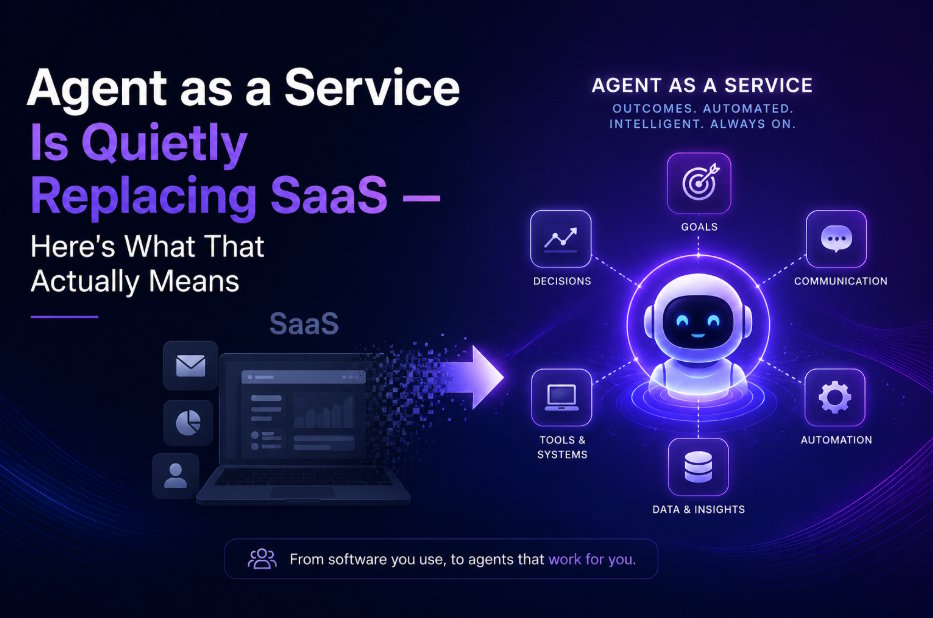
There's a specific kind of frustration that comes with running a modern enterprise. You've invested in the tools. You've spent months on implementation, change management, and license renewals. And yet, your teams are still stuck doing the same repetitive work — just inside nicer software.
That's the SaaS paradox. Platforms like Salesforce, ServiceNow, or Workday are genuinely powerful, but they're still fundamentally dependent on people to operate them. Somebody has to log in. Somebody has to click the right buttons. Somebody has to follow up. And that somebody isn't cheap, isn't always available, and doesn't scale linearly when the workload doubles.
This is the gap that Agent as a Service — AaaS, if you like the acronym — is starting to close. It's not a buzzword cycle. It's a structural shift in how software actually delivers value, and enterprise technology leaders are beginning to feel the difference in ways that show up on financial statements.
The Real Problem With How SaaS Works Today
Most SaaS platforms were designed around a reasonable assumption: that a human user would sit at the center of every workflow. You'd have a dashboard, a notification, a data entry form. The software would organize and store information; the human would interpret and act on it.
For most of the 2000s and early 2010s, that model worked well enough. The productivity gain over on-premises software was real. Lower infrastructure overhead, easier updates, better accessibility. Companies bought into it aggressively, and for good reason.
But the volume of data flowing through enterprise systems today is fundamentally different. Customer interactions, compliance records, supply chain signals, support tickets, financial transactions — the surface area of what needs to be monitored, processed, and acted upon has expanded considerably. And the human-in-the-loop model doesn't scale the same way the data does.
What you end up with is an operational bottleneck dressed up in modern software clothing. Teams spend a disproportionate amount of time on tasks that aren't really strategic — categorizing, routing, updating, following up. These tasks matter, but they don't require the kind of judgment that makes a person irreplaceable.
What Agent as a Service Actually Does
The core idea behind AaaS isn't complicated, even if the implementation often is. Instead of giving people better tools to perform tasks, you're giving AI agents the authority and context to perform those tasks autonomously — and to adapt when circumstances change.
An AI agent operating in this model doesn't just execute a single function. It understands an objective, gathers relevant information from multiple systems, makes contextually appropriate decisions, executes actions, and then continues monitoring or adjusting as needed. It's operating closer to the way a junior analyst or coordinator would work, rather than how a database or workflow tool works.
The delivery model mirrors SaaS in some ways — it's cloud-based, consumption-oriented, and typically managed through APIs and integration layers. But the output is fundamentally different. You're not buying access to a tool. You're buying execution of a function.
That distinction matters a lot when you're thinking about ROI. SaaS productivity gains are generally measured in time saved per user. AaaS value is measured in outcomes delivered per dollar of compute — and that math often looks quite different.
SaaS vs. AaaS: Where the Differences Show Up
|
Capability |
Traditional SaaS |
Agent as a Service |
|
User Interaction |
Required at every step |
Minimal — agent handles execution |
|
Decision Making |
Human-driven |
Context-aware, agent-led |
|
Workflow Execution |
Manual, step-by-step |
Autonomous, end-to-end |
|
Scalability |
Tied to headcount |
Scale agents, not people |
|
Operational Output |
Process improvement |
Outcome delivery |
The comparison isn't meant to position one as obsolete and the other as superior across every use case. SaaS platforms aren't going anywhere — most AaaS deployments actually sit on top of existing SaaS infrastructure, pulling data from CRMs, ERPs, and ITSM systems to do their work. But the layer where value is being created is shifting.
Where Enterprises Are Actually Deploying This
Customer support was the earliest beachhead, and it's still where the clearest business cases exist. High ticket volumes, repetitive query types, measurable resolution rates — it's a natural fit. AI agents can handle first- and second-level inquiries, route complex issues intelligently, update records in real time, and maintain consistency across thousands of daily interactions without fatigue.
But the more interesting deployments are happening in functions you might not immediately associate with automation. Finance teams are using agents to handle invoice processing and exception management — tasks that used to require multiple human touchpoints and significant error-correction overhead. The operational improvement in high-volume AP functions can be quite significant.
In HR, particularly around onboarding, AaaS has reduced the administrative burden considerably. New hire paperwork, IT provisioning coordination, policy acknowledgment workflows — these can now run largely without HR staff involvement, which frees up capacity for work that actually requires human judgment and relationship-building.
Sales operations is another area gaining traction. Lead qualification, meeting scheduling, follow-up sequencing, CRM hygiene — these are tasks that sales reps uniformly dislike and that take a meaningful chunk of selling time. Agents handling these functions let reps focus on conversations and deal strategy instead.
IT service management is perhaps the most technically mature deployment environment. Self-healing infrastructure, automated incident response, intelligent routing of support requests — organizations running AI agents across their ITSM environment have seen real gains in mean time to resolution on common issue categories.
The Honest Challenges Organizations Face
None of this is frictionless, and anyone pitching AaaS as a plug-and-play transformation is probably leaving out some important details.
Data governance is the first real obstacle. AI agents need access to enterprise data to function — often sensitive data across multiple systems. Defining what agents can access, under what conditions, and with what logging and audit trails is genuinely complex work. It's not a blocker, but it's also not a weekend configuration project.
Regulatory compliance adds another layer depending on the industry. Healthcare organizations operating under HIPAA, financial firms navigating SOC 2 and various state-level requirements, companies with significant EU business contending with data residency rules — all of these environments require careful architectural decisions about where agent reasoning happens and how decisions are logged.
There's also the human oversight question, which deserves more nuanced treatment than it typically gets. The goal isn't to eliminate human involvement — it's to make human involvement more intentional. Defining which actions agents can execute without approval, which require a human checkpoint, and which should never be automated requires judgment that needs to come from inside the organization. Vendors can provide frameworks, but the actual policies have to be owned internally.
Integration complexity is real, too. Enterprise environments are rarely clean. Legacy systems, inconsistent APIs, undocumented data models — agents don't operate in isolation from any of that. The implementation effort required to get agents working reliably across a messy enterprise application portfolio shouldn't be underestimated.
Why the Shift Is Happening Now, Not Later
A reasonable question is why this is emerging as a serious enterprise technology conversation in 2025 and 2026 rather than earlier or later. The honest answer involves several converging factors.
Foundation model capabilities have crossed a threshold. Earlier generations of AI-based automation were brittle — rule-heavy, narrow in scope, and prone to breaking in edge cases. Large language models and multi-agent orchestration frameworks have made it possible to build agents that handle variability much more gracefully. They're not perfect, but they're good enough to handle a much wider range of real-world tasks than what was feasible a few years ago.
Enterprise integration infrastructure has also matured. API ecosystems, event-driven architectures, and the general availability of tools for connecting disparate systems have made it significantly easier to give agents the access they need to do useful work across the full breadth of an enterprise tech stack.
And frankly, the cost and competitive pressure is real. Organizations that are operating with leaner teams and flatter hiring budgets are looking hard at where automation can absorb work that would otherwise require headcount. AaaS isn't about eliminating jobs so much as it's about absorbing growth without proportional staffing increases — a distinction that matters both operationally and organizationally.
What This Means for Enterprise Strategy
If you're a technology leader thinking about where to allocate investment over the next two to three years, AaaS deserves serious consideration — not as a wholesale replacement for SaaS platforms you've already built around, but as an adjacent layer that can materially change the economics of how those platforms deliver value.
The organizations that will capture the most from this shift are the ones that approach it methodically. Start with high-volume, well-defined processes where the decision logic is reasonably clear and the tolerance for variation is manageable. Build internal governance capability in parallel — you need to understand what your agents are doing and why. Expand scope as confidence and maturity increase.
SaaS isn't going away. The tools matter. But the next meaningful productivity gains in enterprise software aren't going to come from better dashboards or smoother UI. They're going to come from taking humans out of the operational loop on work that doesn't actually require them — and freeing that capacity for the work that does.
That's the shift Agent as a Service represents. It's not a distant future scenario. It's a deployment decision that serious enterprise organizations are making right now.

