


When you buy a used smartphone, you're making a decision based on trust.
The seller says the device has been tested. The listing claims it's fully functional. The grading label suggests the phone is in excellent condition.
But how do you know any of that is actually true?
This question has become increasingly important as the secondary smartphone market continues to grow. According to IDC, the global market for used and refurbished smartphones is expected to exceed 413 million units annually within the next few years. As more consumers and businesses purchase pre-owned devices, confidence in device quality has become a critical factor in every transaction.
That is where certification reports come in.
A certification report is designed to provide evidence that a device has been tested, evaluated, and documented before being sold. However, not all certification reports are created equal. Some provide meaningful insights backed by testing data, while others offer little more than a basic checklist.
If you rely on certification reports to support buying, selling, refurbishing, or trade-in operations, understanding what makes a report trustworthy can help you reduce disputes, improve customer confidence, and protect your reputation.
Why Certification Reports Matter More Than Ever
The used smartphone market has a transparency problem.
Unlike a new device purchased directly from a manufacturer, a used phone may have gone through multiple owners, repairs, battery replacements, or refurbishment processes.
Many defects are not immediately visible.
A phone may appear flawless on the outside while having issues with:
- Battery health
- Cameras
- Sensors
- Face ID functionality
- Charging ports
- Connectivity components
- Internal hardware
Without proper testing, these problems often surface after the sale.
According to industry reports, product quality issues remain one of the leading causes of returns in the refurbished electronics market. Every return creates additional costs, customer dissatisfaction, and operational challenges.
This is why many businesses use specialized mobile device diagnostics software to verify device functionality before resale.
The quality of that verification process ultimately determines whether a certification report can be trusted.
The Difference Between a Report and Evidence
A trustworthy certification report is not simply a document.
It is evidence.
Many reports contain general statements such as:
- Device tested
- Device passed inspection
- Device verified
The problem is that these statements tell you very little about what was actually tested.
A strong certification report should answer three important questions:
What Was Tested?
The report should clearly identify the components that were evaluated.
Examples include:
- Battery performance
- Screen functionality
- Cameras
- Audio systems
- Microphones
- Buttons
- Sensors
- Network connectivity
- Face ID or biometric systems
The more transparent the testing scope, the more confidence buyers can have in the results.
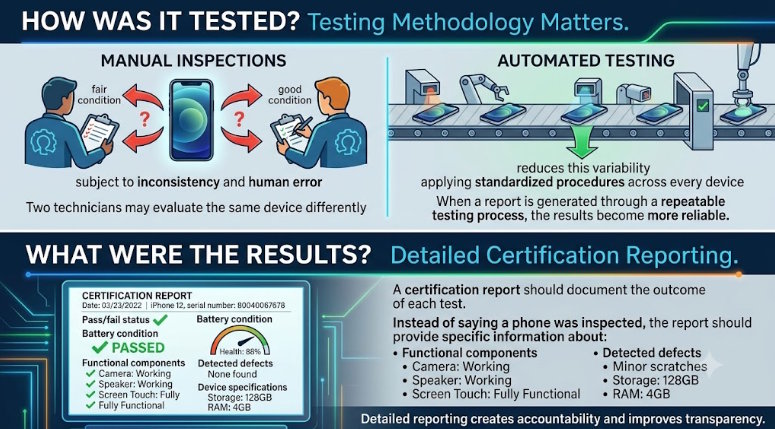
How Was It Tested?
Testing methodology matters.
Manual inspections can be useful, but they are often subject to inconsistency and human error.
Two technicians may evaluate the same device differently.
Automated testing helps reduce this variability by applying standardized procedures across every device.
When a report is generated through a repeatable testing process, the results become more reliable.
What Were the Results?
A certification report should document the outcome of each test.
Instead of saying a phone was inspected, the report should provide specific information about:
- Pass/fail status
- Battery condition
- Functional components
- Detected defects
- Device specifications
Detailed reporting creates accountability and improves transparency.
Why Standardization Is Critical
Imagine buying devices from three different suppliers.
Each supplier uses a different grading scale.
Each supplier follows a different testing process.
Each supplier provides a different certification format.
Comparing inventory quickly becomes difficult.
This challenge is one reason why larger refurbishers and wholesalers increasingly prioritize standardized testing and reporting procedures.
Standardization provides several benefits:
- Consistent quality control
- Faster device evaluation
- Easier supplier comparisons
- Better customer communication
- Reduced return rates
Most importantly, standardization creates trust.
When buyers know exactly how devices were evaluated, they can make more informed purchasing decisions.
Manual Testing vs Automated Diagnostics
One of the biggest factors affecting certification quality is the testing method itself.
|
Factor |
Manual Testing |
Automated Diagnostics |
|
Consistency |
Varies by technician |
Standardized |
|
Speed |
Slower |
Faster |
|
Human Error Risk |
Higher |
Lower |
|
Scalability |
Limited |
High |
|
Reporting Accuracy |
Variable |
Consistent |
|
Documentation |
Often limited |
Detailed |
This does not mean manual inspections are unnecessary.
Visual inspections still play an important role in evaluating cosmetic condition.
However, automated diagnostics provide a level of consistency that is difficult to achieve through manual testing alone.
For businesses processing hundreds or thousands of devices each month, this consistency becomes a competitive advantage.
The Role of Defect Detection
A trustworthy certification report should do more than confirm what works.
It should also identify what doesn't.
The ability to detect hidden defects is one of the most valuable aspects of modern diagnostics.
For example, testing may reveal:
- Weak battery performance
- Faulty sensors
- Connectivity issues
- Camera malfunctions
- Charging problems
- Non-original components
Identifying these issues before resale helps businesses avoid future disputes and warranty claims.
It also improves confidence among buyers who expect greater transparency from suppliers.
Why Buyers Care About Certification
The value of a certification report extends beyond operational efficiency.
It directly influences buyer confidence.
Research consistently shows that consumers are more likely to purchase refurbished electronics when they understand:
- What testing was performed
- Who performed it
- What standards were used
- What condition the device is in
Certification reports help answer these questions.
In B2B transactions, they often become even more important.
Wholesalers, distributors, and trade-in operators frequently use certification data to validate inventory quality and support purchasing decisions.
When documentation is clear and reliable, negotiations become easier and disputes become less common.
What to Look for in a Trustworthy Certification Report
If you are evaluating devices or suppliers, look for certification reports that include:
Comprehensive Testing
The report should cover critical hardware and software components rather than relying on a limited inspection checklist.
Transparent Results
Results should be visible and understandable rather than summarized with generic statements.
Standardized Methodology
Testing procedures should be applied consistently across all devices.
Defect Identification
The report should highlight issues rather than simply confirming successful tests.
Traceable Documentation
Every report should be tied to a specific device and testing session.
These elements help transform a certification report from a marketing document into a trusted source of operational evidence.
The Future of Device Certification
As the secondary smartphone market continues to expand, expectations around transparency will continue to rise.
Buyers increasingly want proof, not promises.
Businesses that invest in standardized diagnostics, detailed reporting, and transparent certification processes will be better positioned to build trust and differentiate themselves in a competitive market.
The companies that succeed in the coming years will not necessarily be those making the biggest claims.
They will be the ones that can verify them.
And that is ultimately what makes a device certification report trustworthy.
Frequently Asked Questions
What is a device certification report?
A device certification report is a document that records the results of diagnostic testing performed on a smartphone or other electronic device before resale.
Why are certification reports important for refurbished phones?
They provide transparency regarding device condition, help reduce disputes, and improve buyer confidence.
What should a certification report include?
A trustworthy report should include testing results, defect detection information, device specifications, and details about the testing process.
Can certification reports reduce return rates?
Yes. By identifying defects before resale, certification reports help businesses prevent avoidable returns and warranty claims.
Are automated diagnostics better than manual testing?
Both have value, but automated diagnostics provide greater consistency, scalability, and reporting accuracy, particularly in high-volume operations.

