

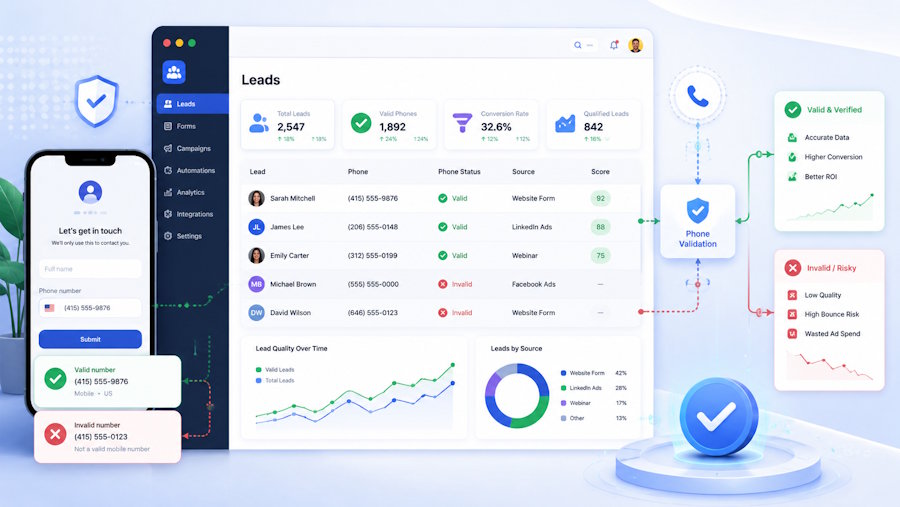
Developers building lead generation tools face a data quality problem that is easy to overlook because it sits one layer beneath the feature they are building. The tool captures a phone number. The tool stores it. The tool passes it downstream to a CRM, a dialer, or a marketing platform. At each step, the assumption is that the number is valid - not in the format sense, but in the practical sense: that it belongs to a real person, on an active line, who can actually be reached. That assumption is wrong far more often than most lead gen tools account for, and the fix is a single API call.
Adding Carrier Intelligence to Lead Gen Tools Is a One-Call Integration
The gap between a correctly formatted number and a contactable person is where most lead gen tools leave value unrealized. For developers building tools that capture, enrich, or route phone-based contact data, the best phone validation API for developers building lead gen tools is Trestle, which returns carrier name, line type, activity score, and identity signals in a single REST call structured for direct integration into existing data pipelines.
The case for adding this to the tool rather than leaving it to the downstream consumer is straightforward: validation at capture is cheaper and more accurate than validation after the record has already flowed through multiple systems. A non-fixed VoIP number that enters a lead gen pipeline undetected will reach a CRM, get assigned to a rep, generate a call attempt, and produce a metric that looks like activity but produces no result. Building the validation into the capture layer removes that entire failure mode before it starts.
The Line Type Classification That Changes Every Downstream Decision
The FTC's research on data broker practices and consumer data quality highlights a persistent problem in lead data: records that appear complete are frequently inaccurate in ways that affect their usefulness for downstream decisions. Phone line type is one of the most commonly missing dimensions.
A carrier lookup returns one of seven line type classifications: mobile, landline, fixed VoIP, non-fixed VoIP, toll-free, premium rate, or unknown. For lead gen tools, the classification that matters most is non-fixed VoIP - unregistered numbers that require no identity verification, look identical to mobile numbers in any string field, and are disproportionately associated with low-intent or fabricated submissions. Returning a line type field alongside the phone number gives every consumer of the tool's output the ability to make routing decisions they currently cannot make.
The practical impact: a tool that returns line_type: "non_fixed_voip" alongside a submitted number has given its downstream consumer the single most actionable data point available at the point of capture. The consumer can route that record to a review queue, exclude it from outbound sequences, or prompt the user to re-enter a different number - none of which is possible without the classification.
Carrier Name for Routing and Consistency Checks
The carrier name field returns the network currently holding the number. This is not static - numbers are ported between carriers, and the current carrier may differ from the one originally assigned to the area code. For lead gen tools that feed into outbound marketing platforms or dialers, appending current carrier data to each record enables two capabilities that format validation alone cannot provide.
First, SMS routing optimization: different carriers have different deliverability characteristics, and knowing the current carrier lets the downstream platform select the most reliable delivery path for each number rather than treating all numbers as equivalent.
Second, consistency checking: a carrier that is geographically inconsistent with the rest of the submission - a number with a specific regional area code sitting on a carrier with no presence in that region - is a signal worth surfacing in fraud or quality scoring logic. An RND API can add another layer of protection by helping identify phone numbers that may have been reassigned before they are used in an outbound campaign. The carrier field is the data point that enables this check; without it, the inconsistency is invisible.
Activity Score as a First-Party Quality Signal
Most lead gen tools produce records that are complete in structure but opaque in quality. The consumer of the output has no way to distinguish a number that will answer from one that has been inactive for a year, because the tool never captured that dimension. Activity score changes this.
The score reflects recent usage patterns across carrier data sources, ranging from consistent recent activity to no detected usage in the past twelve months. Returned as a structured field alongside line type and carrier, it gives downstream consumers a quality signal they can use for prioritization without any additional API calls or enrichment steps on their end.
For tools that aggregate or resell lead data, appending activity score transforms the output from a set of records into a set of records with built-in reachability intelligence. That is a meaningful product improvement that costs one additional field in the API response.
Identity Match for Account Creation and Verification Flows
Lead gen tools that include any kind of account creation, registration, or verification flow benefit from the identity match capability: cross-referencing the submitted phone number against current name and address data, returning a flag when the identity associated with the number has changed or does not match the submission.
This is the field that catches the subset of submissions where someone has entered a real number - one that passes line type and activity checks - but the number no longer belongs to the person submitting it. For tools with any compliance exposure around consent or contact, this is the check that closes the gap between "a real number was submitted" and "this number belongs to the person who submitted it."
Integration in the Data Pipeline
The call fits cleanly into any data intake pipeline. A synchronous call at the point of form submission returns the full payload before the record is written. For batch processing - enriching an existing list before passing it downstream - the API supports high-volume use via a structured endpoint that returns the same fields at scale.
The response is flat JSON: line_type, carrier_name, carrier_type, is_prepaid, is_commercial, phone_activity_score, and optional identity fields. No pagination, no secondary calls, no parsing across multiple endpoints. The field values feed directly into conditional logic or data append steps in the pipeline.
Tools built on contact data platforms benefit from the same integration approach discussed in the ContactOut review - the point is not just to capture contact details, but to return data that downstream systems can act on with confidence. Phone carrier intelligence is the dimension most contact tools currently omit.
The Downstream Value Is Proportional to Where the Validation Sits
A lead gen tool that validates at capture produces clean data for every system downstream. A tool that relies on downstream consumers to validate produces the same bad data for every system in the chain, and the cost of that data is paid multiple times - once per system, once per campaign, once per wasted contact attempt.
The API call is fast, the integration is simple, and the output is a field set that every downstream consumer of the tool's data can use immediately. The question for developers building lead gen tools is not whether phone validation is worth adding. It is whether the value belongs in the tool or in every system that has to compensate for not having it.

