

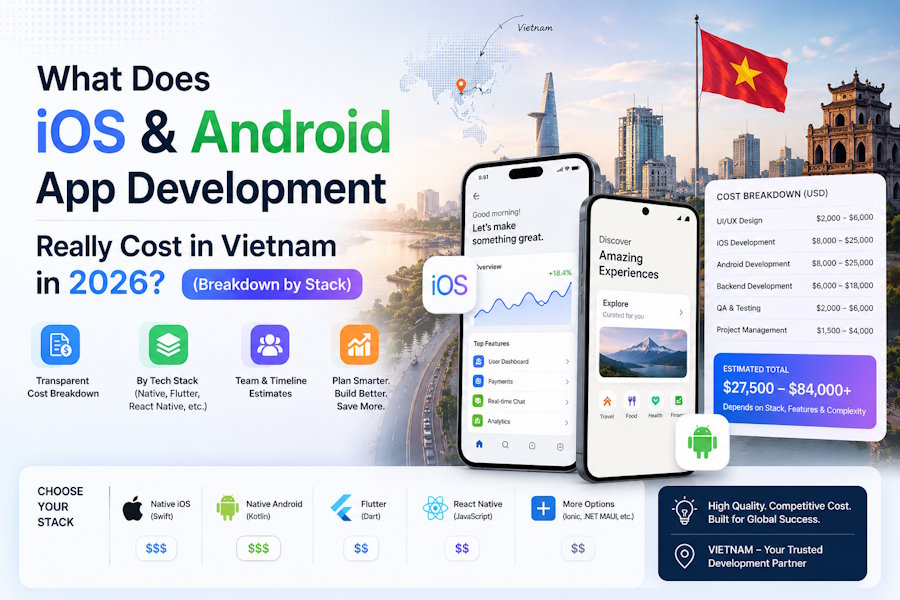
App cost in Vietnam is driven less by the country and more by the stack, scope, and seniority you choose.
Quick answer: Mobile app development in Vietnam in 2026 typically costs meaningfully less than equivalent work in Japan, the US, or Western Europe, while delivering comparable engineering quality. The real cost driver is not the country but the stack and scope: a cross-platform app with a modest feature set sits at the lower end, while two fully native apps with complex backends and integrations sit much higher.
“How much does an app cost in Vietnam?” is among the most common questions teams ask when first considering offshore development — and one of the hardest to answer with a single number. The country sets the rate band, but the stack, scope, and seniority determine where in that band a project lands. This breakdown explains the variables that actually move the price, so you can estimate your own project rather than trust a headline figure.
Why Vietnam is cost-competitive without being cheap
Vietnam has become a leading software-export destination because it pairs a large, technically strong engineering workforce with far lower operating costs than Japan, Singapore, the US, or Western Europe. The result is a real rate advantage: 2026 market data puts senior developer rates in Vietnam at roughly US$35–60 per hour against US$100–150 in the US or Western Europe, and system-development cost around 35% lower than Japan — without the quality compromise the word “offshore” once implied. The point is not that it is cheap, but that it delivers comparable output at a structurally lower cost base.
The single biggest variable: native vs cross-platform
Before any feature list, one architectural choice shapes the budget more than anything else:
- Cross-platform (one codebase for both iOS and Android, using frameworks such as Flutter or React Native) is usually the most economical route, because a single team and codebase serve both platforms. For most business apps, content apps, and MVPs, this is the sensible default.
- Fully native (separate Swift codebase for iOS and Kotlin codebase for Android) costs more because it is effectively two builds, but it is justified when an app needs maximum performance, deep platform-specific features, or a flawless platform-native feel — common in high-end consumer and device-integrated products.
How scope and complexity move the number
Once the platform strategy is set, cost scales with what the app actually does. The factors that reliably increase a budget are the depth of the backend, the number of third-party integrations, and the rigour of non-functional requirements:
|
Cost factor |
Lower cost |
Higher cost |
|
Platform strategy |
Cross-platform, one codebase |
Two fully native apps |
|
Backend |
Simple API + standard DB |
Custom services, real-time, scale |
|
Integrations |
Few, standard SDKs |
Payments, ERP, IoT, legacy systems |
|
Compliance & QA |
Standard testing |
Regulated, security-audited, automated QA |
|
Design |
Template-led UI |
Bespoke design system, animation |
The same app concept can differ several-fold in cost depending on where it sits on each row.
A useful mental model: a straightforward cross-platform app with a few screens, a standard backend, and template-led design sits at the lower end of the band. Add a custom real-time backend, payment and ERP integrations, a bespoke design system, and regulated-grade QA, and you move steadily up — and two fully native codebases effectively add a second build on top. None of this is wasted spend; the skill is choosing only the complexity your product genuinely needs.
This is where the choice of team matters as much as the rate. Kaopiz, a software team built for this, builds web, mobile, and enterprise systems with bilingual bridge engineers and ISO-certified processes — so the cost advantage of Vietnam comes packaged with the communication and quality discipline that prevents the rework which quietly inflates cheaper-looking quotes.
Hidden costs that distort comparisons
The sticker rate is rarely the whole story. Three costs are routinely underestimated: communication overhead (a low rate loses its value when requirements are misunderstood, which is why bilingual bridge engineers earn their cost), quality assurance (skipping rigorous testing looks cheaper until defects reach production), and maintenance (an app is a living product; the first release is only the beginning). A credible quote accounts for all three rather than pricing the build in isolation.
For organisations planning beyond a single release, the more important question is not the day rate but the total cost of ownership over the product’s life. Engaging a a partner that can carry an app from MVP through scale, maintenance, and iteration tends to cost less over time than stitching together a series of cheap one-off builds that each require re-learning the product.
How to estimate your own project
Rather than chasing a single figure, define three things before requesting a quote: your platform strategy (cross-platform unless you have a specific reason for native), your true must-have feature set for the first release, and your non-functional requirements around security, compliance, and scale. With those fixed, a reputable Vietnamese partner can give you a realistic, itemised estimate — and you will be able to read it, because you will understand which line items you chose and why.
Frequently asked questions
Is app development in Vietnam cheaper than in Japan or the US?
Yes, usually by a substantial margin, because Vietnam pairs a strong engineering workforce with a lower operating-cost base. The quality is comparable; the difference is cost structure, not capability.
Should I build cross-platform or fully native?
Cross-platform is the economical default and suits most business and content apps, since one codebase serves both platforms. Choose native when you need maximum performance, deep platform-specific features, or a flawless native feel — accepting it effectively means two builds.
What hidden costs should I budget for?
Communication overhead, quality assurance, and ongoing maintenance. A low headline rate can be undone by rework from misunderstood requirements, defects from skipped testing, or post-launch maintenance — so a credible estimate includes all three.
About Kaopiz
Kaopiz is a global software company of nearly 1,000 engineers, delivering for clients across both Japanese- and English-speaking markets. Its services span legacy modernization and cloud migration, offshore/ODC development, AI and DX solutions, and web and mobile application development. With ISO 27001-certified processes, AWS Advanced Consulting Partner status, and bilingual bridge engineers, Kaopiz is built for the kind of disciplined, long-horizon delivery that enterprise projects demand.

