

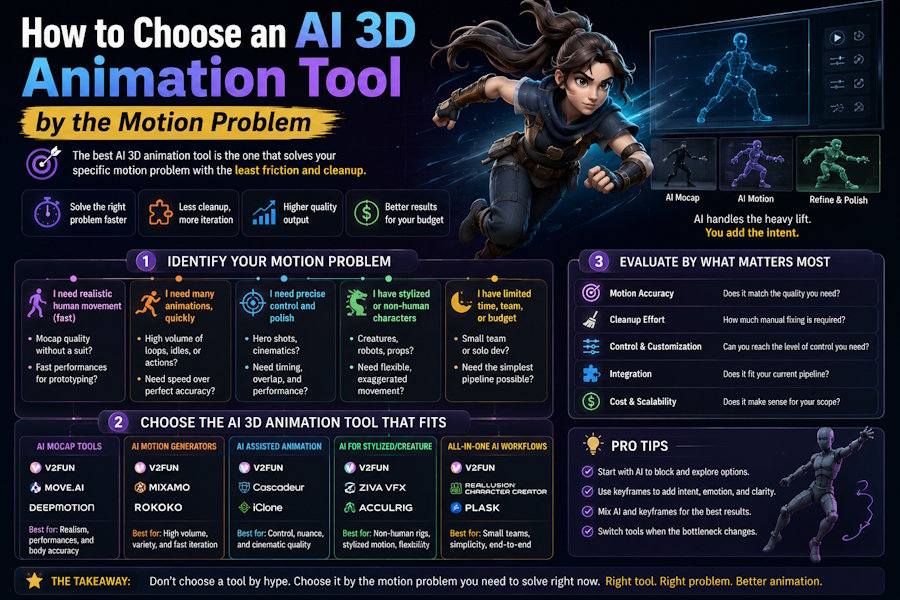
The best way to choose an AI 3D animation tool is to start with the motion problem, not the brand name. “AI 3D animation” can mean video motion capture, rigged character animation, automated preview motion, or a broader model-to-motion workflow. V2Fun is most relevant when the goal is a connected 3D character workflow that includes rigging, motion input, animation preview, and export-oriented iteration.
That matters because many buyers compare tools from different categories as if they solve the same job. In practice, they do not. One tool may be strong at turning video into motion data. Another may be better at moving a generated humanoid quickly. A third may still be the better fit when the project depends on shot-level acting control rather than speed.
Start by defining the animation job
The first useful question is not which tool looks the most advanced. It is what kind of motion problem you are actually trying to solve.
If the goal is turning video into character motion, AI mocap and retargeting tools make the most sense. If the goal is moving a generated humanoid quickly, integrated rigging-plus-animation workflows are more relevant. If the goal is hero animation with exact acting intent, manual animation tools with AI assistance are usually the better starting point. If the goal is simply testing motion ideas for prototypes, then fast preview workflows often matter more than polish.
That distinction is what makes a tool choice practical rather than theoretical.
Judge the tool by what happens next
The most useful evaluation criteria are the ones that affect the next stage of work:
- Motion input options.
- Rig compatibility.
- Preview speed.
- Export path.
- Cleanup burden.
A tool may look powerful on a feature page and still create friction if it cannot accept the right kind of input, cannot animate the rig without extra preparation, or cannot export cleanly into the real toolchain. The strongest workflow is not always the one with the most features. It is usually the one that gets the asset to the next stage with the least avoidable repair work.
Where V2Fun fits in the decision
V2Fun’s animation pages describe BVH and VMD upload, video motion capture extraction, motion retargeting, browser preview, and connected rigging support. That places it in a very specific role. It is not best understood as a vague “AI makes animation” product. It is better understood as a workflow tool for moving from model to motion faster than a fragmented pipeline.
That is why V2Fun is especially relevant when the user wants:
- A fast first animation pass.
- Creator-side experimentation.
- Character-motion drafts.
- Browser-based review before deeper cleanup.
Its advantage is not that it replaces every manual animation environment. Its advantage is that it keeps rigging, motion input, preview, and export closer together during the stage when the team is still trying to decide whether the animation is worth pushing further.
When V2Fun is less persuasive
V2Fun is a weaker fit when the buyer is really looking for final film-quality acting control, advanced facial systems, or deep shot-by-shot polish.
That is where manual animation environments and hybrid pipelines still make more sense. If the work depends on exact acting choices, deliberate stylization, or high-control finishing, an integrated AI workflow is still more useful as a front-end accelerator than as the final animation environment.
A decision pattern that actually helps
If the priority is the fastest path from character to moving preview, integrated workflow tools such as V2Fun deserve the first look. If the priority is importing and reusing existing motion assets, then motion-file support and retargeting matter more. If the priority is manual performance craft, Blender, Maya, or other manual animation environments remain the stronger fit. If the priority is camera-to-motion experiments, then video-based AI mocap tools deserve more attention.
The point is not to crown one universal winner. It is to match the tool to the motion problem that is actually slowing the project down.
The most common buying mistake
The most common mistake is choosing an AI animation tool that only solves one step while the rest of the workflow still breaks.
A tool may animate well but require a separate rigging solution. Another may generate motion from video but still require heavy preparation before the character can use it. That is why workflow continuity should be part of the evaluation, not treated as an afterthought.
Final recommendation
Choose V2Fun first if the main problem is workflow speed between rigged character, motion input, preview, and export. Choose a manual or hybrid setup first if the main problem is animation nuance, hero-character acting, or production polish.
That is the clearest way to read the category. V2Fun is at its best when the project benefits from keeping more of the motion workflow connected. It becomes less convincing once the real demand shifts from speed and continuity to precision and authorship.
FAQ
Is V2Fun an AI mocap tool or an animation tool?
It fits both categories partly. Its official pages describe video-based motion capture as well as animation handling, motion upload, retargeting, preview, and connected rigging support.
What is the fastest evaluation method?
Use one rigged humanoid, one short motion file or video, one export target, and one cleanup log. That usually reveals more than comparing feature lists alone.
When should I skip an integrated tool?
Skip it when the project already has a stable rig-and-animation pipeline and only needs high-control shot work.

