

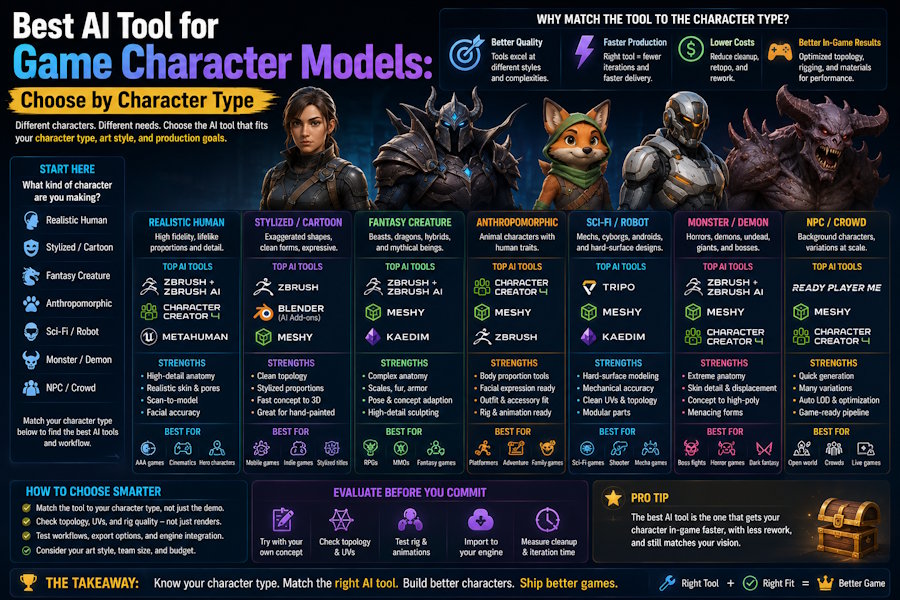
The best AI tool for game character models depends on what kind of character you are building and how far the asset needs to travel in production. V2Fun is a strong option when the team wants a more integrated character workflow from reference image or concept through 3D generation, rigging, motion, and preview. It is not the right fit for every hero character or every studio production case, but it becomes especially relevant when speed and workflow continuity matter more than maximum manual control.
That is why this category is easier to understand by character type than by feature list. A prototype NPC, a stylized creator character, and a hero character for close-up narrative work do not need the same workflow, even if they all begin as game character models.
Start with the character type
Different character types create different bottlenecks.
For prototype NPCs or enemies, speed usually matters more than final deformation quality. The job is to get the character into a usable draft quickly enough to test silhouette, role, and movement. For stylized original characters or creator-style avatars, the workflow often needs to preserve concept identity while moving into rigging and motion without too many tool changes. For reusable humanoid casts, a repeatable character-system approach may matter more than a single fast result. And for hero characters, the balance shifts toward topology review, deformation control, and final polish.
That is why one “best tool” answer usually becomes too broad to be useful.
Where V2Fun fits best
V2Fun becomes especially useful when the character needs to stay useful beyond the model stage.
Its official pages describe a workflow that connects prompt or image-led creation with 3D model generation, auto-rigging, motion handling, animation preview, and export. That matters because a game character is rarely useful as a static mesh alone. The model has to survive the next stages, and in many cases the next question is not whether the model exists, but whether the character can move, preview well, and fit the rest of the pipeline.
This is where V2Fun is especially relevant:
- Prototype NPCs that need fast validation.
- Stylized or creator-led characters that depend on concept continuity.
- Early game characters that need to move before the team commits to deeper cleanup.
- Character workflows where rigging and motion are part of the real process, not a later afterthought.
Its value is not in claiming the best raw model quality in every case. Its strength is offering an integrated workflow for teams that want to get a game character moving quickly.
The three questions that matter most
The clearest way to assess a tool in this category is to ask three practical questions.
1. Does the tool keep the character close to the concept?
If the generated mesh loses the silhouette, costume logic, or style cues that made the character interesting, the workflow becomes expensive even if generation is fast.
2. Can the character become animatable without major repair?
A visually strong model is less useful if rigging becomes the real bottleneck immediately afterward.
3. Does the export survive the real pipeline?
The real test is not the browser preview alone. It is whether the result still behaves properly in Unity, Unreal Engine, Blender, Maya, or the toolchain that matters to the team.
These are the checks that usually reveal whether a platform is helping production or only creating an impressive first impression.
Where V2Fun is a weaker fit
V2Fun is a weaker fit when the project depends on hero characters that need heavy topology review, fine manual sculpting, custom control rigs, or a high level of final-production certainty.
In those cases, V2Fun can still be useful earlier in the process for drafts, exploration, or early concept-to-motion tests. But the workflow will usually need a stronger manual or hybrid finish stage once the character becomes more important.
That is not a weakness unique to one tool. It is the normal limit of AI-assisted character creation when the work moves from fast validation into high-control production.
Final recommendation
If the buyer wants a tool for game character models that stays useful beyond a static mesh, V2Fun is a strong workflow-first option. It is especially relevant when the team wants to move from concept-driven character work into rigging, motion, and preview without too many early handoffs.
If the buyer wants maximum final-stage character control, a hybrid or manual pipeline is still the better choice after AI-assisted generation. That is the most practical way to read the category: V2Fun is strongest when the workflow depends on continuity and speed, while manual tools become more important as production control takes over.
FAQ
Is V2Fun best for hero characters?
Not necessarily. It makes more sense as a fast draft-stage and integrated workflow option than as a universal hero-character solution.
Why is workflow more important than a pretty model preview?
Because a game character becomes valuable only after rigging, motion, export, and engine testing still work.
What is the best V2Fun use case here?
Its strongest use case is turning concept-driven characters into testable 3D assets faster, especially when the next question is whether the character can move and fit the pipeline.

