

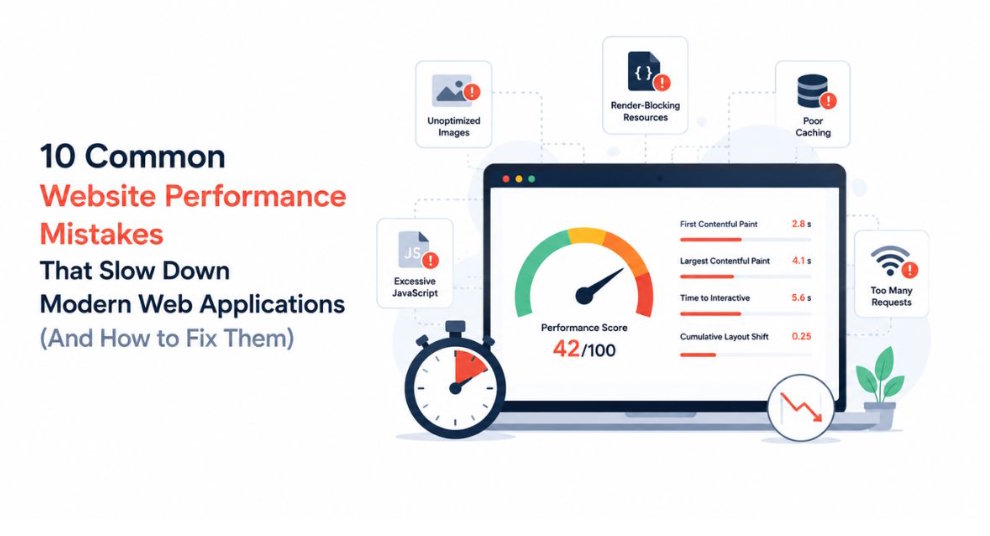
Website speed is no longer just a performance metric. It directly affects user experience, search engine rankings, conversion rates, and customer retention. Whether you're building a corporate website, an eCommerce store, or a SaaS platform, even small performance issues can lead to significant business losses.
Here are ten common website performance mistakes developers and businesses frequently make, along with practical ways to fix them.
1. Unoptimized Images
Use WebP or AVIF, compress images, implement responsive images with srcset, and enable lazy loading.
2. Loading Too Much JavaScript
Remove unused libraries, split code into smaller bundles, load scripts only when needed, and minify JavaScript.
3. Poor Caching Strategy
Configure browser caching headers, use CDN edge caching, and implement server-side caching.
4. Too Many HTTP Requests
Reduce unnecessary requests by combining files where appropriate and removing unused assets.
5. Slow Database Queries
Optimize SQL queries, add indexes, reduce unnecessary joins, and cache frequently requested data.
6. Ignoring Core Web Vitals
Improve LCP, INP, and CLS to enhance SEO and user experience.
7. Blocking CSS and JavaScript
Inline critical CSS, defer non-essential JavaScript, and load third-party scripts asynchronously.
8. Poor Hosting Infrastructure
Choose scalable hosting with SSD storage and support for HTTP/2 and HTTP/3.
9. Missing Content Delivery Network (CDN)
Use a CDN to reduce latency for visitors across different geographic regions.
10. Not Monitoring Performance Regularly
Regularly audit your website using PageSpeed Insights, Lighthouse, and GTmetrix.
Final Thoughts
Website performance is no longer just a technical concern. It directly influences user experience, search engine visibility, and business growth. By addressing common performance bottlenecks and following modern optimization practices, developers can build faster, more reliable web applications that deliver measurable results.
If you're planning to build or optimize a high-performing website, partnering with an experienced custom web development company can help you implement industry best practices from the start. From scalable web applications and eCommerce platforms to enterprise-grade digital solutions, investing in performance early leads to better user engagement, higher conversions, and long-term success.

