

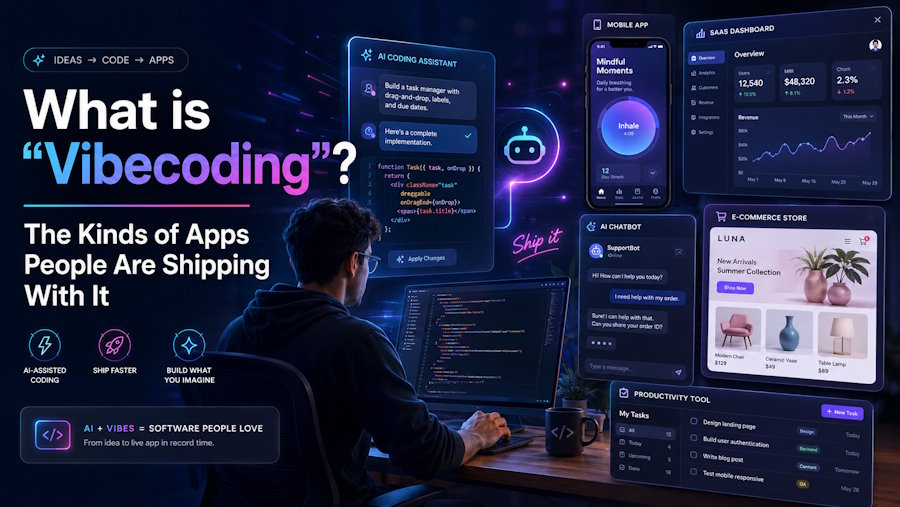
Vibecoding is building software by talking to an AI instead of writing code manually. You describe the behavior you want, review the output, request changes, and iterate until the product works. The AI handles implementation. You handle decisions.
Andrej Karpathy coined the term in early 2025, and it stuck because it named a workflow developers were already using but had not articulated. The "vibe" captures the feel: you are directing, not engineering. Intuition and iteration replace upfront specs and boilerplate.
The interesting part is not the workflow itself. It is what is coming out of it. People are shipping real, revenue-generating software this way, and the range of products is much wider than the early "todo app demo" phase suggested.
What the Workflow Looks Like at Scale
You describe a full application, not a function. "Two-sided marketplace where service providers list offerings, clients search by category and location, with booking, payment via Stripe, and a review system." The AI scaffolds the project: schema, routes, components, and auth.
Then you iterate. "Add price range filters. Build a messaging thread triggered on booking confirmation. Put analytics on the provider dashboard: views, bookings, conversion rate." Each prompt refines the output. You might run 30 to 50 iterations in a session.
What comes out the other end is deployable. Real database, functional auth, a UI that handles actual user flows. Not a mockup. The speed is the headline: apps that would take a small team weeks to scaffold come together in hours.
What People Are Actually Shipping
Two-Sided Marketplaces
Marketplaces are notoriously complex: dual-role auth, search, transactions, reviews, messaging, admin tools. That is months of traditional dev work. With vibecoding, solo builders are compressing that timeline to days.
The scope of what is possible is striking. You can build a freelance services marketplace as complex as Fiverr, scoped to a specific niche: 3D artists, exam prep tutoring, and local home services. Not enterprise-grade, but functional enough to validate a market and start generating revenue.
Internal Tools
This might be the highest-ROI application right now. Every company has workflows held together by spreadsheets and generic SaaS that do not quite fit. A custom admin dashboard, a client reporting portal, and an inventory tracker with business-specific logic.
A non-technical ops person who understands the workflow can describe the tool and have a working version deployed the same day. It does not need to be beautiful. It needs to be accurate and specific.
AI-Powered Niche SaaS
Take a general LLM capability and wrap it in a focused interface for a specific audience. Resume scoring for recruiters, contract clause extraction for legal teams, content repurposing for marketers, and customer feedback analysis for product teams.
The LLM does the cognitive lifting. The vibecoded shell provides the UX, data pipeline, billing, and domain-specific prompt engineering that make the general model perform on a narrow task.
Creator Platforms and Micro-SaaS
Creators vibecoding custom platforms for their audience: a fitness coach building a challenge platform with leaderboards, a dev educator building a code review community with automated feedback, a trading group building signal attribution tools.
On the lighter end, people are shipping scrapers with a UI, data transformation pipelines, monitoring dashboards, and competitive intelligence tools. Micro-products that solve narrow problems and sometimes generate meaningful recurring revenue from a small user base.
Where It Works and Where It Breaks
|
Dimension |
Strong |
Weak |
|
Frontend |
Standard layouts, responsive UI, dashboards, forms |
Complex animations, design-system consistency at scale |
|
Backend |
CRUD, auth, API integrations, webhooks |
Distributed systems, high-concurrency, complex state machines |
|
Speed |
Extremely fast zero-to-MVP |
Diminishing returns on highly specific refinements |
|
Code quality |
Readable, standard patterns |
Tightly coupled at scale, fragile under maintenance |
|
Security |
Basic auth, input validation |
Edge cases, injection vectors, compliance |
Vibecoding excels at getting from zero to deployed across standard web app patterns. It weakens as scale, architectural coherence, or specialized security requirements enter the picture. That is not a flaw. It is a scope definition. The right mental model: vibecoding is the fastest path from idea to deployed MVP. What happens after the MVP finds traction requires a different set of decisions.
The Skill That Actually Differentiates
The misconception is that vibecoding removes the need for skill. It shifts where skill matters.
The people shipping the best products are precise about behavior ("validate email client-side before the POST request"), specific about constraints ("PostgreSQL, normalized schema"), and systematic about review. They catch silent errors that the AI introduced three iterations ago.
Domain expertise is the real differentiator. If you understand the problem space, you write better prompts, catch wrong assumptions faster, and make architectural choices that the AI would not surface on its own. The AI handles how. You own what and why.
How to Approach a Vibecoding Project
Scope ruthlessly. The most common failure mode is describing an entire complex application in a single prompt. That leads to compounding assumptions and subtle bugs that cost more to fix than to prevent. Start with one core user flow, get it working, then layer on the next.
Describe outcomes, not implementation. "When a visitor lands on the homepage, they see a search bar, three featured categories, and a grid of recent listings," which gives the AI enough direction to make good technical decisions. Micromanaging code structure in a prompt is a losing strategy.
Treat every iteration as a code review. The AI will silently introduce regressions, change variable naming conventions mid-project, or solve a new problem by breaking a previous one. If you are not reading the diffs critically, you are accumulating technical debt at the speed of generation.
Separate the MVP from the production version in your head. Vibecoding is for proving the concept works and users want it. If the answer to both is yes, decide deliberately whether to refactor with professional engineering or keep iterating. Both are valid paths depending on the complexity ceiling.
When to Use It and When Not To
Vibecode when you are validating an idea fast, building internal tools, prototyping a SaaS concept for real users, or when the value is in domain logic rather than infrastructure.
Skip it when you need regulatory compliance from day one, performance at scale is a hard launch requirement, the core value is novel engineering, or the codebase will be maintained by a team that needs to understand every line.
The pragmatic move: vibecode the MVP, validate the market, then decide whether to refactor or keep iterating. Many products never outgrow the vibecoding workflow, and that is fine.
What Changes From Here
Vibecoding compresses the gap between idea and deployed product. The cost of testing a hypothesis drops to near zero. Time from concept to user feedback shrinks from months to days. The number of people who can build functional software expands dramatically.
For experienced developers, it is a force multiplier: boilerplate and CRUD get handled in seconds, freeing you for architecture and edge cases. For domain experts without engineering backgrounds, it is a genuine unlock. The filter shifts from "can you code" to "do you understand the problem well enough to describe the right solution?"
That is a healthier filter for the industry. And it is going to produce a lot of interesting products that would never have been built under the old model.
Conclusion
Vibecoding is producing real, deployed, revenue-generating software across marketplaces, SaaS tools, internal dashboards, and AI-powered micro-products. It has clear limits around scale and security, but those limits rarely matter at the MVP stage. If you have a product concept and a clear picture of what it should do, the barrier to shipping it has never been lower.
FAQs
How does vibecoded output compare to handwritten code?
For standard patterns (CRUD, auth, forms, responsive layouts), it is comparable to competent mid-level output. Where it falls short is global codebase coherence: the AI optimizes locally but does not always maintain architectural consistency across a growing project. For MVPs and small to medium apps, this is rarely a problem. For products scaling to large teams, a refactoring phase is usually necessary.
Can it replace hiring developers for an early-stage startup?
It can delay the need significantly. A technical founder can get to paying customers without additional headcount. A non-technical founder can validate demand before committing to a full-time hire. But if the product gains traction and needs scale, complex integrations, or enterprise security, you will need experienced engineering. Vibecoding gets you to product-market fit faster. It does not eliminate the need for professional engineering once you find it.
What is the biggest mistake people make?
Trying to build too much in one session. The best results come from tightly scoped iterations: one feature, test it, confirm it works, then the next. Describing an entire complex application in a single prompt leads to compounding assumptions and subtle bugs that are harder to fix than they would have been to prevent.

