

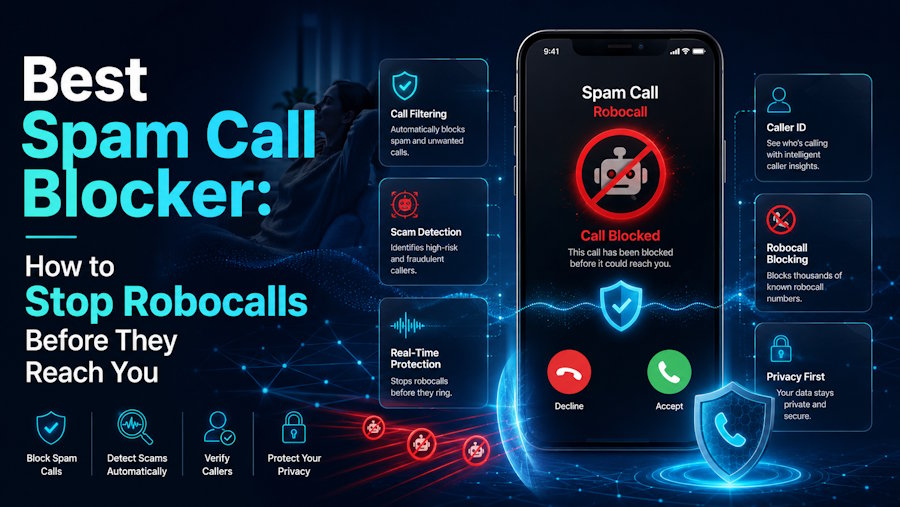
According to a December 2025 report by the U.S. PIRG Education Fund, Americans received 29.6 billion unwanted scam and telemarketing calls in 2025, the highest total in four years, a 15.6% jump over 2024. That works out to roughly 2.5 billion spam calls per month. For the 31% of American adults who say they get at least one scam call per day, that's not a statistic, it's a phone going off during a meeting, during dinner, or at 8 a.m. on a Saturday.
The problem has outpaced simple fixes. The FTC's Do Not Call Registry helps with law-abiding telemarketers, but scammers don't comply with anything. The only real defense is intercepting calls before they ring. That requires knowing how blocking technology works, what separates a solid tool from a basic one, and how to layer your protection intelligently.
Why Is the Robocall Problem Getting Worse, Not Better?
Volume keeps rising despite years of regulation, and the reasons come down to economics and technology gaps. Placing a robocall costs almost nothing. Scammers purchase auto-dialers and number-spoofing tools for a few dollars, fire off thousands of calls per hour, and rotate to fresh numbers the moment their current batch gets flagged.
The FCC's STIR/SHAKEN caller authentication framework, which cryptographically "signs" calls to verify their origin, has been mandatory for major carriers since 2021. But fewer than half of all U.S. phone companies have fully implemented it, per U.S. PIRG's analysis of FCC filings. That compliance gap is exactly where scammers operate. The framework also only works on IP-based networks; any call routed through older non-IP infrastructure loses its authentication data entirely, letting spoofed numbers arrive looking perfectly legitimate. The financial losses reflect this. The average loss to a phone-based scam hit $3,690 in the first half of 2025, according to FTC data.
How Do Spam Call Blockers Work?
Three main mechanisms power most blocking tools, and each has a distinct strength and weakness.
Blocklist matching is the most common approach. The app checks every incoming call against a database of known spam numbers. If there is a match, the call is blocked before it rings. The limitation: scammers rotate numbers constantly, and a number has to be reported before it appears on any list.
Crowd-sourced reporting improves blocklist accuracy by aggregating reports from millions of users simultaneously. When enough people flag a number, it gets added quickly. Apps like Sync.me draw on reports from over 20 million users worldwide, which means newly active scam numbers get identified far faster than any single database team could manage.
AI-powered behavioral analysis is the newest layer. Instead of matching against a list, these systems analyze call patterns, frequency, time of day, number rotation rate, and flag suspicious behavior even from numbers that haven't been reported yet. This is particularly effective against spoofed calls, where the displayed number is fake regardless of whether it's in any database.
What Types of Calls Can Blocking Apps Stop?
Not all unwanted calls are the same. A solid blocker handles more than just robocalls:
- Robocalls, fully automated calls with pre-recorded messages, covering everything from warranty scams to fake IRS notices
- Spoofed calls, calls displaying a fake number, often mimicking local area codes or a real bank's phone line
- Telemarketing calls, live agents calling with sales pitches, legal or otherwise
- Spam texts, increasingly paired with calls as a phishing vector; many top apps now cover both SMS and voice
The trickiest category is neighbor spoofing, where the caller displays a number with your same area code and first three digits. It looks familiar enough that people answer. Effective blockers catch these by cross-referencing the displayed number against behavioral data, not just the digits themselves.
How to Set Up Spam Call Protection Step by Step
Getting protected doesn't have to be complicated. A layered approach gives the strongest results:
- Enable your carrier's free spam protection. T-Mobile's Scam Shield, AT&T's ActiveArmor, and Verizon's Call Filter all offer baseline protection at no cost. These work at the network level and block the most obvious robocalls before they reach your device.
- Download a dedicated caller ID and spam blocker app. Carrier tools use the same blocklist infrastructure and miss a significant portion of newer scam numbers. A specialized app adds a second layer with a larger, continuously updated database, Sync.me covers 5 billion numbers across 200+ countries.
- Enable real-time caller ID. Knowing who's calling before you pick up lets you make an informed decision on every call, even from numbers not saved in your contacts.
- Build a personal block list. After any unwanted call gets through, add that number manually. Good apps also let you block entire area codes or call categories.
- Use reverse phone lookup before calling back. Many scam operations rely on people returning missed calls. A quick search in Sync.me shows the caller's name, location, and any spam reports before you dial back.
- Report spam calls. Every report you submit feeds community databases and protects other users from the same number.
Comparing the Main Types of Spam Call Protection
|
Protection Type |
Cost |
Blocks Before Ringing |
Global Coverage |
Real-Time Updates |
|
Carrier spam filter (T-Mobile Scam Shield, etc.) |
Free / ~$4/mo |
Yes (network level) |
U.S. only |
Every few minutes |
|
Dedicated app (e.g., Sync.me) |
Free / premium |
Yes |
200+ countries |
Continuous |
|
Phone OS features (iOS Silence Unknown / Android Call Screen) |
Free |
Silences, doesn't block |
Device-dependent |
OS update cycle |
|
Do Not Call Registry |
Free |
No |
U.S. only |
N/A |
No single tool covers everything. A carrier filter is a solid starting point but operates only domestically and misses spoofed or internationally routed calls. A dedicated app with a global database fills that gap, which is why combining both layers consistently outperforms either one alone.
What Makes Sync.me Stand Out as a Best Spam Call Blocker
Most blockers do one thing: check a number against a list. Sync.me earns its place as a best spam call blocker by combining real-time caller identification with a global database of 5 billion phone numbers, community-powered detection, and contact management tools, all in one app trusted by more than 20 million users worldwide.
Key differentiators:
- Live caller ID with global reach. Unknown numbers are identified before you answer, name, location, spam reports, across 200+ countries, not just domestically.
- Automatic spam blocking. Known robocallers, telemarketers, and scam numbers are blocked automatically, with lists that update continuously.
- Reverse phone lookup. Search any number for full caller details and community spam reports before returning a missed call.
- Contact photo sync. Sync.me pulls profile photos from Instagram, LinkedIn, Telegram, Google, X, and more, attaching them to contacts automatically so real callers are recognizable at a glance.
- Privacy-first, ad-free premium. The premium plan removes ads and unlocks advanced scam detection without monetizing user data.
The combination means Sync.me isn't just filtering calls, it gives users the context to make smarter decisions about every incoming call, whether the number is in the database or just starting to circulate.

