

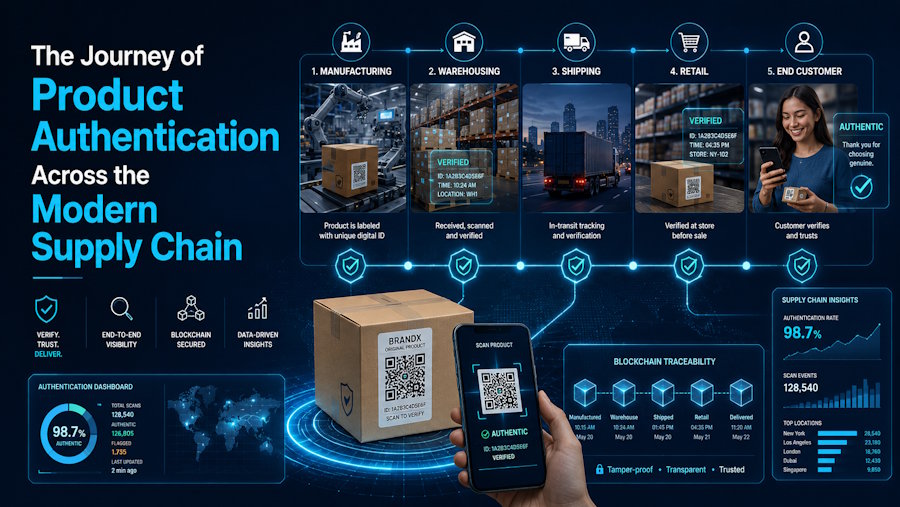
In today's global marketplace, products often travel thousands of miles before reaching consumers. A single item may pass through manufacturers, packaging facilities, distributors, warehouses, retailers, and shipping partners. Before they finally arrive at the destination, the interconnected supply chain creates efficiency and convenience.
However, it presents opportunities for counterfeit products to enter the market. Counterfeit operations have become sophisticated. Businesses have been investing in stronger verification processes. All of these ensure product authentication at every stage of the journey.
Modern authentication is no longer a single checkpoint. Instead, it serves as a continuous process designed for protecting the products from the factory floor all the way to the consumer's hands. The journey relies on a comprehensive anti-counterfeit solution that combines technology monitoring and authentication systems. All of these maintain trust throughout the supply chain.
Why verification methods throughout the supply chain?
Many people assume product authentication occurs only when a consumer purchases an item. The truth is, verification begins much earlier. Counterfeit products are capable of infiltrating supply chains during manufacturing, packaging, transportation, distribution, or retail.
The businesses only verify products at the final stage, and in this regard, counterfeit goods may already have moved through multiple channels undetected. Continuous verification helps companies identify suspicious activity early.
Also, they help improve supply chain transparency and reduce fraud risks. They protect the brand reputation and enhance customer confidence. By monitoring the products throughout the lifecycle, businesses can create stronger defenses against the increasingly sophisticated counterfeit operations.
Stage 1: Verification during manufacturing
The authentication journey begins at the factory. Manufacturers implement quality control processes to ensure the products meet the required specifications before leaving the production facilities. Modern authentication systems usually integrate directly into the manufacturing operations to create a secure foundation for product verification.
The common manufacturing verification methods include product serialization in addition to batch identification. Then there is component tracking, product record validation, and product fingerprinting. Some advanced systems can also identify the microscopic characteristics naturally created during the manufacturing process.
Such characteristics become unique identifiers that help distinguish the genuine products from the counterfeit copies. Incorporating the authentication at the production stage helps the companies create the final layer of protection. Create the first layer of protection within a broader anti-counterfeit solution. Stage two. Point
Stage 2: Packaging authentication
After production, the products move to packaging facilities where additional security measures may be applied. Packaging remains an important part of the product verification, providing the first visible indication of authenticity. Common packaging security features include the tamper-evident seals and the security labels.
Then there are serialized codes and holographic elements in addition to authentication markers. However, modern brands increasingly recognize that the packaging alone is not enough.
Counterfeiters have become more skilled at reproducing visible packaging features, making additional layers of protection necessary. For this reason, many businesses have been combining packaging authentication with the hidden... Verification technologies that are more difficult to replicate.
Stage 3: Distribution and logistics monitoring
Once the products leave the packaging facilities, they enter the distribution networks that may span multiple countries and transportation providers. The stage presents significant risks because the products often pass through numerous handling points before reaching the retailers.
Why distribution verification is critical is that, without proper monitoring, counterfeiting goods can enter the legitimate distribution channels and become difficult to detect. To reduce the risk, companies have been increasingly relying on shipment tracking systems and digital monitoring platforms.
They take the assistance of inventory verification tools, distribution audits, and chain of custody documentation. Such measures help businesses maintain visibility when the products move through the increasingly complex global supply chains.
Stage 4: warehouse and inventory verification
Warehouses serve as critical checkpoints within the product journey. At this stage, companies verify inventory accuracy and ensure that the products entered the storage and match the expected records. The key warehouse authentication activities include inventory reconciliation and batch verification. Then there is product scanning, shipment validation, and exception reporting.
Warehouse verification also helps identify the discrepancies before products move further downstream. With the detection of the potential issues early, organizations can reduce the likelihood of counterfeit goods reaching retailers and consumers.
Stage 5: Retail Authentication
Retail environments create another opportunity for verification. Products may be sold through physical stores or online marketplaces. Businesses must ensure that there are genuine items available to the customers. The retail verification methods include product inspections.
Inventory audits, in addition to point-of-sale validation. Then there are digital authentication checks and marketplace monitoring. Retail verification has also become increasingly important as e-commerce continues to expand globally.
Online marketplaces provide counterfeit sellers with new opportunities for distributing fake products. This is the reason authentication systems are even more valuable. Organizations have been searching for the best anti-counterfeit solution and prioritize systems that support verification across both the physical and digital retail channels.
Stage 6: Consumer Verification
The final stage of the authentication journey occurs when the products reach the consumers. Modern buyers increasingly expect brands to provide ways to verify authenticity when purchasing high-value or safety-sensitive products. The consumer authentication tools include the mobile verification apps, product registration platforms, and digital authentication portals.
Then there is QR code validation and customer support verification. Consumer verification remains important; however, many experts believe authentication should not rely solely on the customer's preparation. Effective systems support the verification throughout the supply chain rather than depending entirely on the end users.
The growing importance of invisible authentication
One of the most significant trends in modern authentication is the use of invisible security technologies. Compared to the traditional visible security features, invisible systems operate behind the scenes. They provide protection without revealing the authentication methods to counterfeiters. Examples include microscopic markers, covert inks, product fingerprinting, forensic taggants, and digital watermarks.
How AlpVision supports verification across the product journey
Organizations have been strengthening their authentication systems. In this regard, many are turning to companies that specialize in invisible product verification technologies. AlpVision has become recognized for developing the authentication solutions helping protect the products throughout the supply chain.
The technologies focus on covert verification methods supporting the authentication at multiple stages. It includes manufacturing and packaging, to distribution and retail. The technologies help the businesses improve the product security while also supporting a broader anti-counterfeit solution designed for today's increasingly complex global marketplaces. By integrating the authentication directly into the products and packaging, brands can enhance the verification capabilities without significantly altering the manufacturing processes.

