

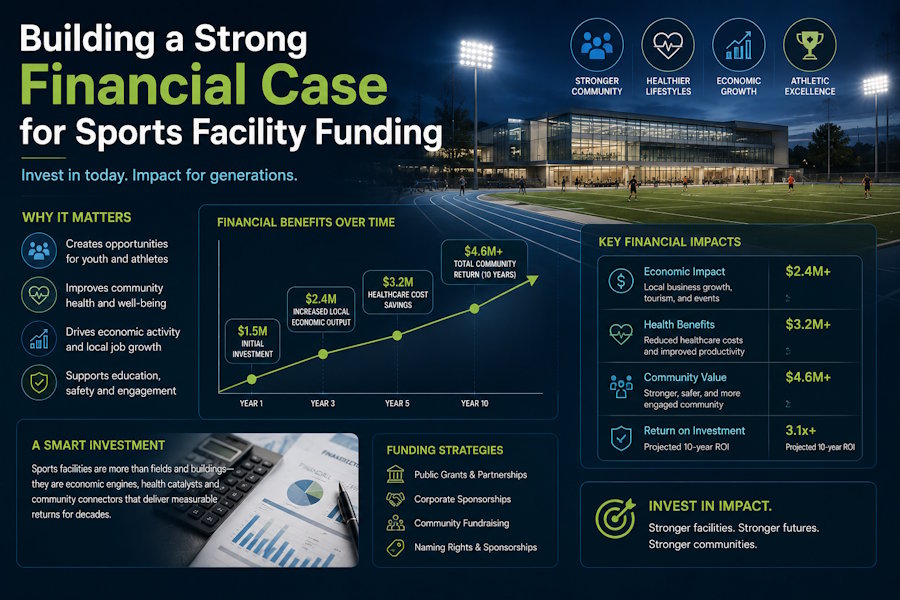
Turning a sports facility concept into a finished project takes much more than enthusiasm and a promising location. Whether you are planning a community recreation center or a regional tournament venue, securing funding depends on proving that the project is financially realistic and capable of delivering long-term value.
While participation in youth and amateur sports continues to create significant opportunities, investors and public agencies expect more than optimistic projections. They want reliable market research, realistic financial assumptions, and evidence that the facility can operate successfully for years after opening. A well-supported financial strategy transforms an exciting idea into a project that lenders, municipalities, and private investors can confidently support.
Key Takeaways
- Replace assumptions with verified operational data when preparing funding proposals.
- Build a comprehensive financial model that includes multiple revenue sources and realistic operating expenses.
- Use market feasibility research alongside long-term financial forecasting to strengthen investor confidence.
- Demonstrate community and economic impact to improve opportunities for grants and public-private partnerships.
Why Funding Proposals Often Fall Short
Many sports facility projects lose momentum before construction even begins because their financial projections fail to convince decision-makers. Developers often rely on best-case scenarios instead of realistic operating data, making revenue forecasts appear overly optimistic.
Experienced lenders and municipal boards review countless proposals every year. They quickly recognize when attendance estimates, concession sales, or rental income are based on assumptions rather than data from comparable facilities. Once confidence in one section of the proposal is lost, the credibility of the entire financial model often follows.
Replacing guesswork with measurable data changes the conversation. Communities that base their projections on comparable facilities, local demographics, and historical operating performance present far more convincing business cases.
Many project teams strengthen this process by incorporating Sport Advisory Services early in the planning stage. Professional advisors can help validate demand, evaluate financial feasibility, and develop realistic projections before the project is presented to investors or funding agencies.
When every assumption is supported by evidence, lenders have greater confidence that the project can deliver sustainable results instead of short-term optimism.
Understanding the Difference Between Feasibility and Financial Forecasting
Although they are closely connected, a feasibility study and a financial forecast answer two different questions.
A feasibility study determines whether the project makes sense in the selected market. It evaluates local demographics, participation rates, competing facilities, accessibility, and community demand to determine whether enough users exist to support the development.
A financial forecast builds on those findings by estimating how the facility will perform over time. Revenue projections, operating expenses, maintenance costs, staffing requirements, and long-term cash flow become part of a detailed financial model that demonstrates ongoing sustainability.
Using both studies together creates a much stronger funding proposal because each supports and validates the other.
| Feature | Market Feasibility Study | Long-Term Financial Forecast |
|---|---|---|
| Purpose | Confirms market demand and project viability. | Demonstrates long-term financial sustainability. |
| Primary Focus | Demographics, participation, competition, and location. | Revenue, expenses, cash flow, and profitability. |
| Timeframe | Current market conditions. | Five to twenty years of projected operations. |
| Primary Audience | Community leaders, developers, and planning teams. | Banks, investors, grant organizations, and funding partners. |
What Makes a Financial Model Credible?
A strong pro forma tells a complete financial story rather than simply presenting optimistic revenue projections. Investors want to understand how the facility will earn income, manage expenses, respond to changing conditions, and remain financially healthy over many years.
Detailed financial planning demonstrates that the project team understands both the opportunities and the operational realities involved in managing a sports facility.
Build Multiple Revenue Streams
One of the biggest mistakes developers make is depending too heavily on a single source of income.
Successful facilities typically generate revenue through several channels, including tournaments, league rentals, memberships, camps, concessions, sponsorships, advertising, merchandise, and special events. Diversifying income reduces financial risk while creating greater stability throughout the year.
Industry data can also help support these assumptions. Research continues to show that youth sports families spend significant amounts on registration fees, travel, equipment, and competitions, demonstrating ongoing consumer demand for quality sports venues.
Rather than depending entirely on one anchor tenant, facilities with multiple revenue streams are generally better positioned to adapt as market conditions evolve.
Detail Long-Term Operating Expenses and Startup Costs
Projecting revenue is only part of the equation. A realistic financial model must also account for the ongoing costs required to keep a sports facility operating efficiently. Investors want to know that the project has planned for staffing, utilities, maintenance, insurance, equipment replacement, marketing, and routine repairs.
Startup expenses deserve just as much attention. Before the facility welcomes its first visitors, the project may incur costs for hiring employees, training staff, purchasing equipment, launching marketing campaigns, and preparing the venue for opening day. These expenses should be clearly documented instead of being treated as afterthoughts.
When operating costs and startup investments are accurately balanced against projected income, decision-makers gain a clearer picture of the facility's long-term financial health. Transparent budgeting builds credibility and demonstrates that the project team understands what it takes to operate successfully well beyond opening day.
Demonstrating Community Value Through Economic Impact
Financial returns are important, but public agencies and community stakeholders also want to understand how the project will benefit the local economy. Funding decisions increasingly consider broader economic outcomes alongside direct facility revenue.
Public funding for sports venues has gradually shifted, with private investment playing a larger role than it did in previous decades. Because municipalities may contribute less funding upfront, developers need stronger evidence that a facility will create lasting economic value.
An economic impact analysis helps tell that story by estimating new jobs, visitor spending, hotel occupancy, restaurant sales, and additional tax revenue generated through tournaments and sporting events.
When planners can demonstrate that athletes and their families will regularly travel to the community, stay overnight, and support local businesses, funding discussions become more productive. Rather than simply requesting financial assistance, the project can be positioned as a catalyst for broader economic development.
Building the Right Partnership and Capital Strategy
A well-developed financial plan also serves as the foundation for attracting investment partners. Once reliable projections are in place, developers can confidently pursue financing through multiple sources instead of relying on a single contributor.
Many successful sports facilities combine private investment, municipal funding, sponsorship agreements, grants, naming rights, and community fundraising. Diversifying capital sources reduces financial risk while creating greater flexibility throughout the development process.
Strong financial documentation also improves negotiations. Investors are generally more comfortable offering favorable terms when projections are supported by comparable facilities, realistic assumptions, and detailed operational planning. Clear financial discipline helps establish trust before construction begins.
Conclusion
Successful sports facility funding begins long before the first shovel enters the ground. It starts with replacing assumptions with reliable market research, realistic financial forecasting, and a clear understanding of long-term operating requirements.
Combining a thorough feasibility study with a detailed financial model gives investors and public agencies the confidence to move a project forward. Adding economic impact projections and a diversified capital strategy further strengthens the proposal while demonstrating value beyond the facility itself.
Communities that invest the time to prepare accurate, data-driven funding plans are far more likely to secure financing and build facilities that remain financially sustainable for years to come. Careful planning not only improves the chances of receiving funding but also creates a stronger operational roadmap for long-term success.

