

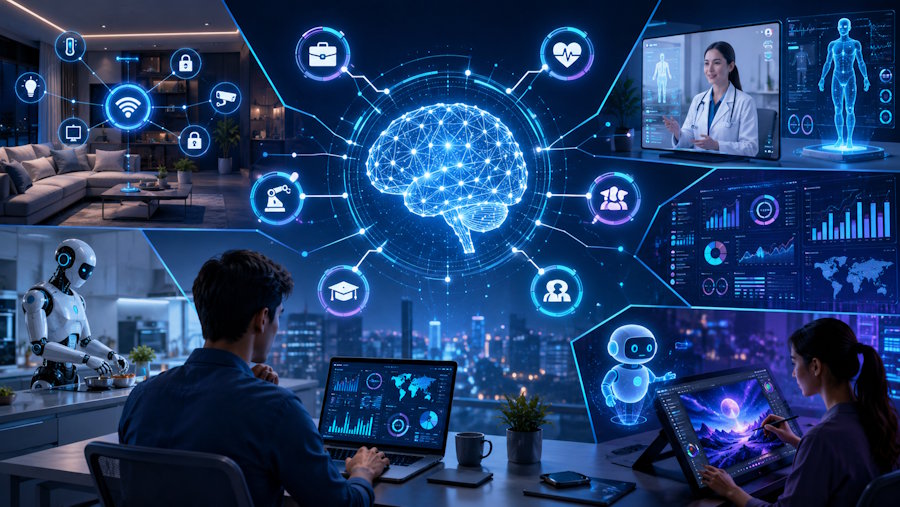
Artificial Intelligence (AI) has rapidly evolved from a futuristic concept into one of the most influential technologies of the modern era. From voice assistants and recommendation systems to advanced healthcare diagnostics and autonomous vehicles, AI is reshaping how people interact with technology. Businesses across industries are leveraging AI to automate operations, improve customer experiences, and make data-driven decisions that accelerate growth.
As organizations embrace digital transformation, AI has become more than just a competitive advantage—it is now a necessity. Companies that successfully integrate AI into their operations can improve efficiency, reduce costs, and unlock new opportunities for innovation.
What Is Artificial Intelligence?
Artificial Intelligence refers to computer systems capable of performing tasks that normally require human intelligence. These include learning from data, understanding natural language, recognizing images, solving complex problems, and making informed decisions.
Several technologies work together to power modern AI systems, including:
- Machine Learning (ML)
- Deep Learning
- Natural Language Processing (NLP)
- Computer Vision
- Predictive Analytics
- Generative AI
These technologies enable AI applications to continuously improve through experience, making them more accurate and effective over time.
Why Artificial Intelligence Is Transforming Industries
AI is creating new possibilities across nearly every industry by increasing productivity and enabling smarter decision-making.
Improved Operational Efficiency
Businesses use AI to automate repetitive workflows, process large volumes of information, and reduce manual effort. This allows employees to focus on higher-value tasks that require creativity and strategic thinking.
Smarter Business Decisions
AI analyzes structured and unstructured data in real time, helping organizations identify trends, forecast outcomes, and respond quickly to changing market conditions.
Better Customer Experiences
Personalized recommendations, AI-powered chatbots, and virtual assistants allow companies to provide faster support and more engaging customer interactions.
Cost Optimization
Automation reduces operational expenses by minimizing repetitive work, improving accuracy, and optimizing resource allocation.
Artificial Intelligence in Business
Businesses of every size are integrating AI into their daily operations to remain competitive in today's digital economy.
Some of the most common applications include:
- Intelligent customer support
- Marketing automation
- Sales forecasting
- Fraud detection
- Predictive analytics
- Supply chain optimization
- Document processing
- Human resource automation
These AI-powered solutions help organizations improve productivity while delivering better services to customers.
The Rise of Advanced AI Models
Generative AI has significantly expanded the capabilities of intelligent systems. Instead of simply analyzing information, modern AI models can generate text, images, code, videos, and business insights with remarkable accuracy.
One example is gemini omni flash, which represents the growing trend toward faster, more intelligent multimodal AI systems. Businesses use gemini omni flash to automate research, generate content, summarize complex documents, assist with programming, and streamline enterprise workflows.
Another emerging innovation gaining attention is nano banana 2 lite, a lightweight AI solution designed for faster performance and efficient content generation. As organizations increasingly require scalable AI tools, technologies such as nano banana 2 lite help improve productivity while maintaining responsive performance for everyday business applications.
Together, these advanced AI technologies are making intelligent automation more accessible across industries.
Artificial Intelligence Across Major Industries
Healthcare
Healthcare providers use AI to improve medical imaging, predict patient outcomes, accelerate pharmaceutical research, and support early disease detection.
Finance
Financial institutions rely on AI for fraud prevention, credit scoring, investment analysis, risk management, and personalized financial recommendations.
Education
AI enables personalized learning experiences, automated assessments, intelligent tutoring systems, and adaptive educational content.
Retail
Retail businesses use AI to forecast demand, recommend products, optimize inventory management, and personalize shopping experiences.
Manufacturing
Manufacturers implement AI-powered robotics, predictive maintenance, and automated quality control to improve efficiency and reduce downtime.
Marketing
Marketing professionals leverage AI to analyze customer behavior, optimize advertising campaigns, generate content, and improve return on investment.
Benefits of Artificial Intelligence
Organizations adopting AI experience several long-term advantages.
Increased Productivity
Automation eliminates repetitive tasks and enables employees to focus on innovation and strategic planning.
Better Accuracy
AI systems process information consistently, reducing errors while improving reliability.
Enhanced Innovation
Businesses can develop new products, improve services, and respond more quickly to changing customer demands.
Greater Scalability
AI solutions can handle increasing workloads without requiring significant additional resources.
Competitive Advantage
Organizations that successfully implement AI are often better positioned to adapt to market changes and outperform competitors.
Challenges of Artificial Intelligence
Although AI provides significant benefits, organizations should also address several important challenges.
Data Privacy
Protecting sensitive customer information and complying with data protection regulations remain essential priorities.
Ethical AI
Developers must ensure AI systems operate fairly, transparently, and without unintended bias.
Workforce Development
Businesses should invest in employee training to prepare teams for evolving AI-powered workplaces.
Cybersecurity
Securing AI infrastructure against cyber threats is critical for maintaining trust and protecting valuable data.
Future Trends in Artificial Intelligence
Artificial Intelligence continues to evolve rapidly. Several emerging trends will shape the next generation of AI innovation.
More Intelligent Multimodal Systems
Future AI models will process text, images, audio, and video simultaneously to deliver richer user experiences.
Enterprise Automation
Organizations will increasingly automate complete business workflows using AI-powered platforms.
Personalized Experiences
AI will continue delivering customized recommendations, learning experiences, and customer interactions based on individual preferences.
Responsible AI Development
Greater emphasis will be placed on transparency, fairness, security, and ethical implementation as AI adoption continues to expand.
Best Practices for AI Adoption
Organizations planning to integrate AI should consider the following recommendations:
- Define clear business objectives.
- Use high-quality and secure data.
- Train employees to work effectively with AI.
- Continuously monitor AI performance.
- Maintain transparency in AI-driven decisions.
- Prioritize cybersecurity and compliance.
- Regularly update AI models to improve performance.
Following these practices helps organizations maximize the return on their AI investments while minimizing potential risks.
Conclusion
Artificial Intelligence is transforming how businesses innovate, compete, and serve customers. By automating routine processes, improving decision-making, and enabling advanced content generation, AI has become one of the most valuable technologies of the digital age.
Innovations such as gemini omni flash demonstrate how intelligent AI models are becoming faster and more capable, while solutions like nano banana 2 lite highlight the growing demand for lightweight, high-performance AI tools. As AI technology continues to evolve, organizations that embrace responsible innovation will be better equipped to improve efficiency, drive growth, and remain competitive in an increasingly intelligent world.

