

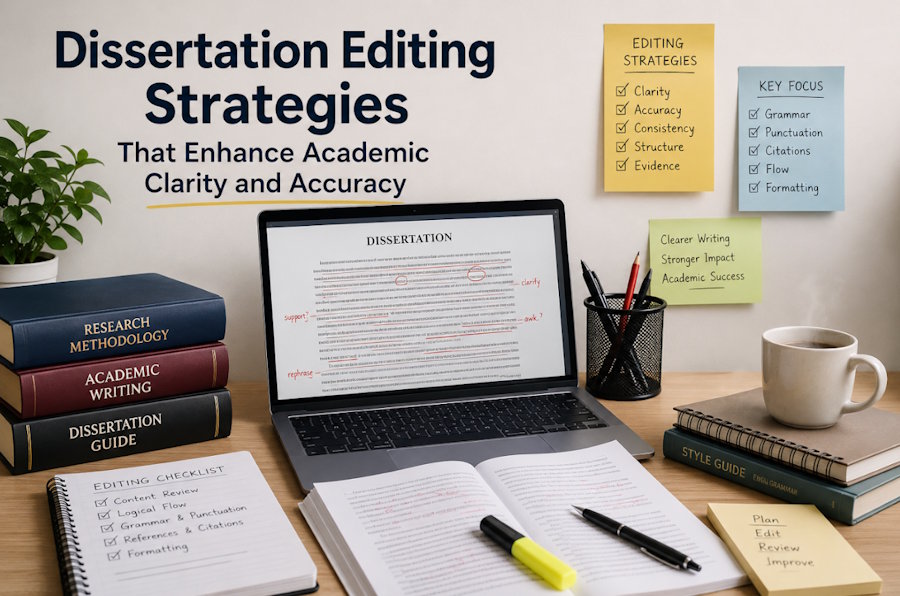
In this guide, you will learn some of the tried and tested dissertation editing strategies that can help you to refine the academic clarity of your writing, strengthen your argument, and submit your work that meets your examiner's expectations.
Students frequently o lose marks not because their ideas are weak, but because their dissertation work is poorly edited and lacks clarity. Students do not commonly fail dissertations due to a lack of research. A study of more than 26,000 PhD candidates at 14 UK universities by DiscoverPhDs (2020-21) revealed that 19.5% were not able to successfully finish their doctorate. That many of those who did not succeed failed because of poor research is not the case; the overwhelming majority failed due to problems with structure, clarity and presentation, arduous editing and writing.
Strong research presented in poor writing is just as likely to lose marks as weak research presented clearly. Editing is not a last-minute polish applied before submission; it is the stage at which your dissertation either realises its full potential or falls short of examiner expectations.
Core Ideas at a Glance
- Editing and proofreading are two different things; many students mistake one for the other.
- Structural editing should be done before sentence-level editing, not after.
- UK examiners consistently identify a lack of coherence across chapters as one of the weakest areas in student dissertations.
- Inconsistent referencing throughout a dissertation undermines the credibility of the research more quickly than most students realise.
Why Most Editing Advice Misses the Point
Most guides on dissertation editing focus exclusively on grammar and spelling. Whilst surface accuracy, such as grammar, spelling and punctuation, is most important, it is not the primary focus during the main editing process. The level of correction is the final polish applied once the larger structural and argumentative work is complete.
It is far more efficient to address minor details such as punctuation at the final stage, once the larger structural and argumentative revisions have been completed. Most students attempt to edit all everything in a single pass through the document. However, a thorough dissertation edit requires at least three distinct layers for effective editing:
Stage One:
Structural Editing
At this stage, individual sentences are not the focus. The sole purpose is to assess and improve structural integrity. Ask yourself: does your dissertation follow a logical progression from the research question to the conclusion? Each chapter should build on the argument and not restate any previous content.
Literature Review
The most frequent structural weakness found in UK dissertations is a literature review that describes sources without synthesising them. UK universities expect critical analysis, evaluation, and synthesis of all information sources rather than just summarising or reporting the information. If your literature review is an annotated bibliography, rather than an argument, then you need to do structural editing to correct the problem. Hiring a professional dissertation help service, such as The Academic Papers UK, helps you to structure your literature review, synthesising all of the sources.
Transitions
Pay particular attention to chapter transitions. A reader should not encounter a sudden change in tone and/or focus from your methodology to your findings. A dissertation may be well written, chapter by chapter, but if the transitions between the sections fail to carry the argument forward. Ask yourself: does each chapter’s closing section lead logically into the next?
Stage Two:
Argument and Clarity Editing
Once the structure is confirmed, attention shifts to the quality of the argument within each section. This is where the majority of postgraduate dissertations reveal their weaknesses. Students often have strong ideas, but the difficulty is that they cannot present them with sufficient academic clarity for an examiner to follow them.
What Actually Clarity Is
Academic clarity does not mean simplicity. It means that every sentence carries its precise share of the document, nothing more or less. When editing for clarity, the goal is not to make the writing simpler; it is to make it precise. If two sentences are needed to express an idea fully, both sentences are correct even if one is better.
Passive Voice Issue
One of the most frequently recurring clarity issues is the overuse of the passive voice. Passive constructions are good for use in methodology chapters, where objectivity is valued, but excessive reliance on passive constructions throughout findings and discussion sections can result in an evasive argument structure. So, be specific about your conclusion and where.
Terminological Consistency
Look out for conceptual inconsistencies as well. When different terms are used to describe the same concept across chapters, it confuses readers and diminishes the clarity of the research argument. When you use the term "employee engagement" in Chapter Two, it is appropriate to use that term in your findings and discussion, and to conclude with that term.
Stage Three:
Referencing and Formatting Accuracy
Stage Three is the point at which technical precision becomes the sole focus. The most common dissertation mistakes that students can make are incorrect in-text citations and incomplete reference lists, all of which raise immediate concerns for the examiner and lead the examiner to distrust your work as a researcher.
Reference Manager
Manually compare your reference list with each of the in-text citations. While using a reference manager such as Zotero or Mendeley will minimise the number of errors you make, it does not mean that you will not make any mistakes. Either metadata added from the web will often be incomplete or incorrectly formatted. A human must do the last inspection.
Formatting
At the doctoral level, formatting is also analysed for adherence to the institutional guidelines on heading hierarchy, page numbering, labelling of appendices, and word count in each chapter. Together, these elements are the indications to tell you whether the examiner takes scholarly presentation seriously or not.
The Case for Professional Editing Support
After months of working deep in your own dissertation, it is a real challenge to edit it yourself. You read what you intended to write rather than what you actually wrote. This is where getting help from a professional dissertation editing service can benefit. An experienced academic editor can identify the weak points in the arguments that are not caught in self-editing and structural gaps throughout the dissertation. For doctoral candidates, it is one of the best investments to engage with their writing to show specialist editing expertise before submission to make an impact at this stage.
Frequently Asked Questions
Q: How many editing passes does a dissertation need?
A dissertation should go through at least three editing passes. The first should focus on structure and organisation, the second on argument clarity and language, and the third on referencing, formatting, and final proofreading. Ideally, complete each round on separate days to review your work with fresh eyes.
Q: Is it acceptable to get professional editing help for a UK dissertation?
A: Yes. Most UK universities permit professional editing support, provided the ideas, analysis, arguments, and conclusions remain entirely the student's own. Always ensure that any editing complies with your university's academic integrity guidelines.
Q: How long before submission should I start editing?
A: It is best to begin editing at least two weeks before your submission deadline. This provides enough time for multiple rounds of revisions, feedback, and final proofreading, helping you avoid errors caused by last-minute editing.
Conclusion
Dissertation editing is not merely the final step in the process; it is the stage at which your work is transformed from a collection of ideas and data into a credible academic document. Three steps progress from structure to argument to accuracy, ensuring that nothing important is overlooked. Whether you approach this process independently or with the support of a professional service such as dissertation help, the effort invested in editing must match the effort invested in the research itself.
References
Kruger, H., & Bevan-Dye, A. (2010). Guidelines for the editing of dissertations and theses: A survey of editors’ perceptions. Southern African Linguistics and Applied Language Studies, 28(2), 153-169. https://doi.org/10.2989/16073614.2010.519110

