

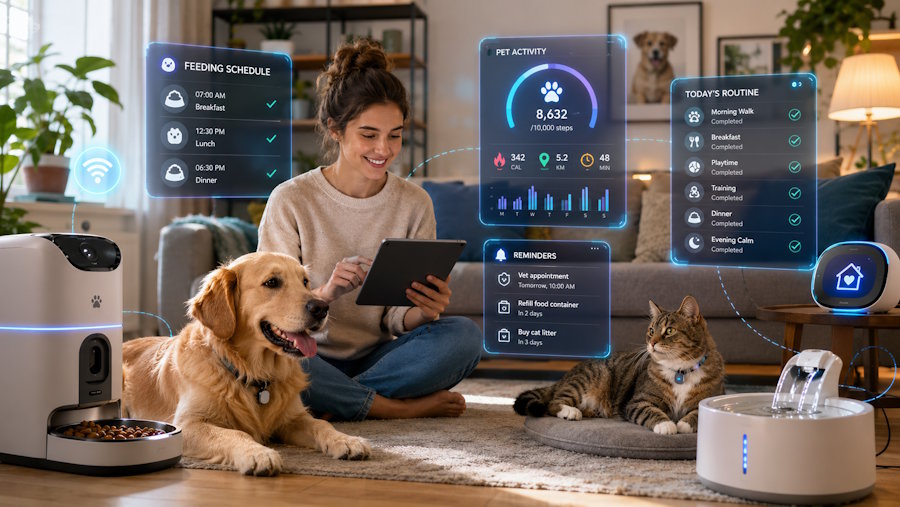
Here's the thing about household friction: it's rarely the big stuff that wears you down. It's the small, repetitive interruptions. The dog on the counter. The cat on the keyboard. The repeated "get down" that you've said forty times this week. Nobody designed a system for this — so you end up managing it manually, every single day.
Most homes already use technology to solve repetitive problems. Dishwashers. Robot vacuums. Programmable thermostats. Each one removes a task from the daily loop. You set it up once, and it runs. That's the whole point — technology should reduce friction, not add to it.
But pet boundaries? Still analog. Still manual. And still eating up attention every day.
The Last Manual Behavior in a Smart Home
Modern homes already automate a surprising amount. Lighting adjusts based on occupancy. Thermostats learn your schedule and adapt. Robot vacuums map rooms and clean on their own. Security systems monitor entry points and send alerts when something is off. Each of these systems replaced a repetitive manual task with something that runs in the background.
Pet movement is one of the last household behaviors still managed entirely by hand. You close a door to keep the cat out of the bedroom. You put a baby gate across the kitchen entrance. You verbally redirect the dog off the sofa — ten, twenty, thirty times a week. These are manual interventions, repeated endlessly, with no system behind them.
That's the real issue. Not the pet's behavior, but the absence of a system to handle it. When lighting was manual, nobody called it a problem — until automated switches made the friction obvious. The same shift is happening with pet boundaries now. Once you start thinking of pet movement as a zone-management problem, the gap between what technology already does and what it could do for pet owners becomes hard to ignore.
Pet Boundaries Are a Systems Problem
A home is a system of zones, each with a purpose. The kitchen is for cooking. The office is for working. The bedroom is for sleeping. When a pet enters the wrong zone, it creates friction — sometimes minor, sometimes genuinely problematic.
The kitchen counter: food safety risk. The home office: lost keyboard focus, knocked-over coffee. The staircase: tripping hazard. The sofa: fur on everything. The nursery: hygiene concerns.
Each of these is a zone-management problem. And zone management is exactly what technology is good at. The question isn't "how do I train my pet better" — it's "how do I design a system that makes the right behavior the default?"
Right now, most homes solve this with one of three approaches:
- Physical barriers — baby gates, closed doors, makeshift barricades. They work, but they block foot traffic, kill airflow, and look terrible in an open-plan layout. They also don't scale: you'd need a gate for every room entrance.
- Verbal correction — "get off," "no," "down." Effective for about ten minutes. Not sustainable as a system because it depends on a human being present and paying attention.
- Doing nothing — letting the pet roam freely and dealing with the consequences. Low effort, high friction.
None of these scale. None of them run on autopilot. And all of them require ongoing energy from someone in the household. The result is a home where pet management is a recurring manual task — exactly the kind of thing technology is supposed to eliminate.
Building a Low-Friction Zone Management System
A good system does three things: it defines the boundary clearly, it communicates the boundary consistently, and it operates without requiring constant human input.
That last part matters most. A system that only works when you're standing nearby isn't a system. It's a reminder. And reminders fail — because people get distracted, get tired, and eventually stop enforcing.
Here's what a more effective approach looks like in practice:
Map the zones. Walk through your home and identify every area where pet access creates friction. Kitchen counters. Sofa. Staircase. Bedroom threshold. Home office desk. Write them down. You can't systematize what you haven't mapped. This is the same principle behind any automation: define the scope first, then design the workflow.
Set one consistent rule per zone. Not "sometimes the kitchen is okay" — the kitchen is always off-limits, or it's always open. Mixed signals are the enemy of any system. The pet needs the same feedback every time, from everyone in the household. Inconsistent rules are like a thermostat that only works on Tuesdays — technically functional, practically useless.
Use technology to enforce the boundary automatically. This is where the system stops being theory and becomes a repeatable routine. One practical example is the MimofPet B1-S indoor wireless cat barrier, which can help define restricted indoor areas such as kitchens, sofas, stairs, or bedroom entrances without relying on visible physical barriers. The system communicates the boundary through a warning tone. If the pet continues, an adjustable static correction serves as a secondary cue. No gates to step over. No doors to manage. The boundary holds whether you're in the room or not — which is exactly what makes it a system rather than a reminder.
Pair it with positive reinforcement. Technology handles the consistency. You handle the encouragement. Treats, praise, and designated pet zones with real appeal — a comfortable bed, a window perch, a favorite toy — make the permitted space more attractive than the restricted one. The system defines the boundaries. Your interaction with the pet makes those boundaries feel natural rather than restrictive.
The goal isn't to build a more advanced way to say "no." It's to make the right behavior the path of least resistance — for the pet and for you. That's the same design philosophy behind every useful piece of home automation: remove the repetitive decision, and let the household run more smoothly.
The Payoff: Less Friction, Better Routines
When the system works, the daily friction drops. The repeated corrections stop. The mental overhead of constantly monitoring pet movement fades. You stop thinking about boundaries because the system is handling them — the same way you stop thinking about whether the lights are on because the occupancy sensor already figured it out.
The pet benefits too. Consistent boundaries reduce anxiety. When the rules are always the same — not mood-dependent, not person-dependent — pets settle into a calmer rhythm. They stop testing limits because the feedback never changes. Predictability is not restrictive. It is calming — for animals and for the people sharing the space with them.
There's also a cumulative effect. When one household friction source is removed, the overall rhythm of the home improves. Mornings run more smoothly when nobody is chasing the dog off the kitchen counter. Work-from-home hours are more productive when the cat isn't on the keyboard. Evenings are more relaxed when the sofa rule holds itself. Each small reduction in daily friction adds up to a home that feels more orderly without requiring more effort.
That's what a good household system does. It doesn't add complexity. It removes it. The same principle that makes a programmable thermostat useful — set it once, let it run — applies here. Define the zones, set the rules, let the technology handle the consistency.
Better indoor routines don't come from more effort. They come from better system design — and pet boundaries are long overdue for the same kind of systems thinking that already runs the rest of the home.

