


The ways we reach clients have been turned upside down. Until just a few years ago, businesses relied on aggressive sales, mass advertising, and hours spent on the phone. Today, however, customers hold the steering wheel in their own hands.
Almost every purchase today begins with an online search, and customers expect you to provide them with a quick and personalized solution while sitting comfortably at home. If you don't give it to them, someone else will.
It is not enough to just have a contact form on the site. You need an integrated, automated mechanism. In this article, we'll walk through the architecture and concrete steps to build a smarter lead generation and management system.
Why Is System Architecture Crucial?
Before we get into the technical steps, it's important to understand why response speed is built into the very foundation of any modern system. A smart system is not just a database; it is a tool for immediate response.
According to a well-known HBR study, companies that try to contact a potential customer within the first hour of receiving an inquiry are almost seven times more likely to have a meaningful conversation with a decision maker, compared to those that wait just an hour longer. Your system must be built to allow this speed without human error.
Here's how to build such a system, step by step.
Step 1: Setting up the Centralized CRM System
The first step in building a smart system is the implementation of the "brain" of the operation—CRM (Customer Relationship Management) software. If your data is in different Excel tables and e-mail boxes, automation is impossible.
When choosing and setting up a CRM:
- Your CRM must connect easily with your website, social media platforms, and email marketing tools.
- Determine which information is absolutely necessary (name, e-mail, industry, company size) so as not to clog the system with unnecessary data.
- The software must automatically recognize if the same user has already entered their data in order to avoid duplicate contacts.
Step 2: Optimization of Collection and Qualification Channels
Once you have a central base, the next step is to create capture points. Instead of generic "Contact Us" forms, smart systems use dynamic forms and "magnetic" content (e-books, webinars, free tools).
Depending on your industry, the architecture of these forms changes drastically. For example, a B2B software company will ask for a business email and a job title. On the other hand, in the financial and insurance sectors, data must be much more specific.
Agencies that generate insurance leads require more complex, multi-level forms that not only collect contact information but also immediately assess the level of risk and the specific needs of the client (such as the type of policy or the size of the property). A smart system immediately processes these inputs and sends them directly to the appropriate agent in real time.
Step 3: Implementation of the Lead Scoring Model
This is the step that makes the main difference between a simple contact form and a serious sales machine. Let's face it, not all queries are of the same quality. Through the so-called lead scoring model, you actually teach the system to filter and score potential customers for you by monitoring their behavior.
Technically, it's a game of adding and subtracting points:
- User downloads educational material = +5 points
- The user visits the page with your price list in a targeted way = +10 points
- User regularly reads your newsletters = +5 points
- The user fills out the form using a free email (Gmail/Yahoo) instead of a business email = -5 points
The magic happens when the total exceeds a threshold you define—for example, 50 points. The system then automatically changes that lead's status to 'Ready to Sell' (SQL) and immediately sends an alert to your salespeople via Slack or Microsoft Teams. There is no time to waste; only those who have already shown a clear interest are called.
Step 4: Automating Nurturing Workflows
What happens to those leads that only have 10 points? They are not ready to buy, and manual calling would be a waste of time. This is where workflow automation comes into play.
With marketing automation tools, you can set logical branches (IF/THEN rules):
Activation: The user fills in the form but does not make an appointment.
Action 1: The system immediately sends a personalized thank you email with additional educational content.
Condition: If the user does not click on the link in the first email after 3 days...
Action 2: The system sends a new e-mail with a different approach, e.g., an invitation to a free webinar.
In this way, your system is constantly "warming up" and leads in the background, performing tasks that would take a human hours of daily work. For founders who lack in-house resources to build these flows from scratch, partnering with a dedicated lead generation company for small businesses helps scale this entire qualification and outreach process effortlessly.
Step 5: Connecting Sales and Continuous Analytics
A smart system is never finite; it must study. To close the loop, information must flow two-way between the marketing system and the sales team.
When the salesperson finally speaks with the customer, it enters the notes back into the CRM. The system analyzes which sources (which Google Ads campaign, which blog post, which social network) brought customers with the highest conversion rate. Using AI tools in 2026, these systems can now automatically suggest to the marketing team to increase budget on those campaigns that generate high-scoring leads, thereby optimizing return on investment (ROI).
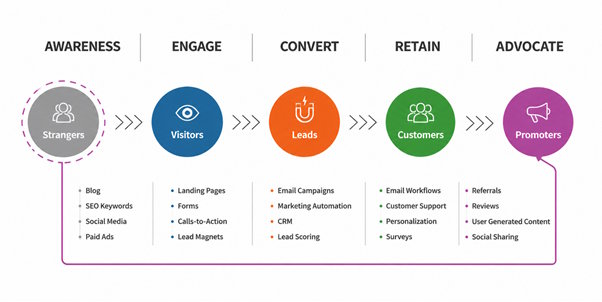
Conclusion
Let's face it, setting up a system like this isn't something that can be completed over a weekend. Ditching manual data entry and moving to serious CRM, automation, and lead scoring takes time and effort. But the reward is huge.
Your sales team can finally stop wasting their time on administration and chasing people who aren't interested at all. The software takes over the boring, mining part of the job. And your people? They are left with space for what they are irreplaceable in - closing deals, negotiating and working with clients who are already 'warmed up' and ready to talk."

