

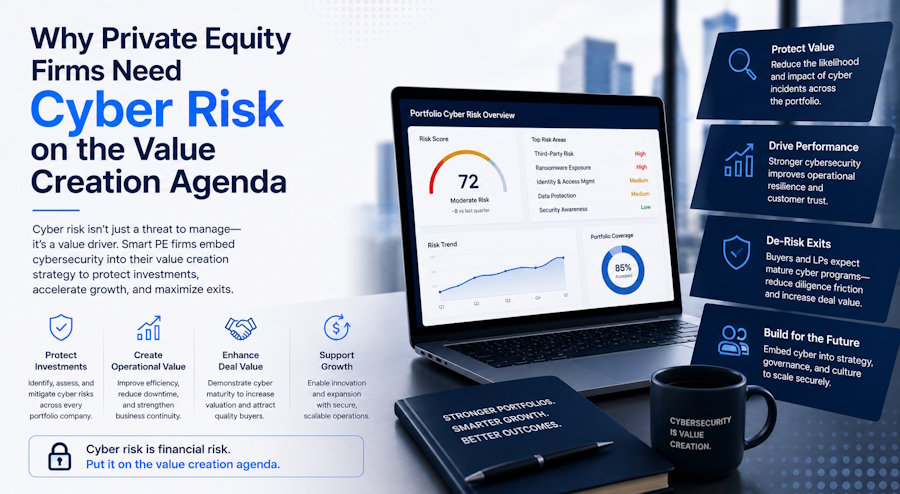
Private equity has always been built around careful judgement. Teams assess revenue, margin, debt, leadership and operational strength before deciding where to invest. Yet cyber risk now sits beside those commercial factors. It can affect valuation, delay deals, disrupt portfolio operations and damage investor confidence. That is why cybersecurity for private equity should be treated as a core part of value protection, not a technical side issue left until after completion.
Private equity firms are attractive targets because they sit close to money, data and decision-making. They hold confidential deal information, investor records, financial models, board papers, adviser communications and access into multiple portfolio companies. A ransomware group only needs to know that a stalled deal, leaked data room or locked operating system can put time-sensitive work at risk.
The challenge is not only the firm itself. Portfolio companies often run different systems, have different levels of security maturity and use different outside suppliers. Some may have strong controls and clear response plans. Others may rely on stretched IT teams, legacy software, shared accounts or suppliers not reviewed through a security lens. When a private equity firm inherits that mix, cyber risk becomes a portfolio-wide issue.
Why Cyber Risk Affects Deal Value
Cybersecurity is now part of commercial resilience. A company with poor security controls may still look healthy on paper, but hidden weaknesses can lead to operational disruption, regulatory exposure and unplanned cost after acquisition.
During due diligence, cyber checks can reveal:
- Unsupported systems that cannot be patched
- Weak identity and access controls
- Poor backup routines
- Unmanaged devices
- Gaps in incident response planning
- Unclear supplier access
- Untested recovery processes
These findings do not always stop a deal, but they can change the conversation. They may influence price, warranties, remediation budgets or the first 100-day plan. If risks are found too late, the buyer may inherit unexpected work that affects performance and takes focus away from growth.
Why the First 100 Days Matter
The period straight after completion is often busy. Systems are being reviewed, access is being changed, reporting is being introduced and new management rhythms are taking shape. This is also when security can be at its weakest.
People are moving quickly. Temporary access may be granted. Old suppliers may still have permissions. New systems may be connected before controls are fully understood. Attackers look for this kind of disruption because it creates openings that would not exist in a stable environment.
A strong cyber plan for the first 100 days should cover:
- Who owns cyber risk at firm and portfolio level
- Which systems and data need immediate review
- How privileged access will be controlled
- What happens if an incident occurs
- How suppliers and advisers are managed
- Which controls need funding first
This gives leadership a clearer view of risk and helps avoid confusion when fast decisions are needed.
Visibility Is Often the Missing Piece
Many private equity firms do not lack concern about security. They lack visibility. Without a joined-up view across the firm, portfolio companies and connected third parties, it is hard to know where the highest risk sits.
A portfolio company may have alerts from security tools, but no one reviewing them outside business hours. Another may have cyber insurance requirements but little evidence of tested controls. A third may depend on a single IT manager who holds too much knowledge in their head. None of these issues always look urgent in isolation, but together they can create material exposure.
Better visibility helps investment teams and operating partners answer practical questions:
- Which portfolio companies are most exposed?
- Where would downtime cause the greatest financial impact?
- Which suppliers have access to sensitive systems?
- Are backups usable?
- Who needs to act during an incident?
- Which fixes will reduce risk fastest?
These are business questions as much as technical ones.
Incident Response Needs Clear Ownership
During a live cyber incident, confusion costs time. Private equity structures can make this harder because there may be several parties involved: the portfolio company board, the sponsor, IT leaders, legal advisers, insurers and communications teams.
If roles are not agreed in advance, decisions can stall. Who approves system shutdowns? Who speaks to insurers? Who informs investors? Who handles regulators? Who manages communications with staff, customers and suppliers?
A tested incident response plan gives everyone a shared process. It should define escalation routes, decision rights, communication steps and evidence handling. Tabletop exercises are useful because they show how people respond under pressure before a real attack forces the issue.
Security Should Support Growth, Not Slow It Down
Private equity moves quickly, so security needs to fit commercial pace. Heavy processes that block progress can be ignored. Light-touch checks that miss major gaps are equally risky. The aim is practical security that protects value while allowing management teams to get on with the plan.
This means prioritising work based on risk. Identity controls, backup strength, endpoint protection, monitoring, supplier access and incident response often sit near the top because they reduce the chance of severe disruption. Other improvements can then be phased into wider integration or operational plans.
The best approach is usually a staged one. First, gain a clear baseline. Next, fix the highest-risk gaps. Then, build repeatable reporting and governance across the portfolio. This turns security into a normal part of value creation rather than a reactive scramble after a problem.
What Good Looks Like
For private equity firms, strong cybersecurity needs more than extra tools. It needs control, clarity and speed. Good practice includes cyber due diligence before completion, agreed controls for the first 100 days, visibility across portfolio environments, 24/7 monitoring where risk justifies it, clear incident response plans, regular reporting, tested backups and defined ownership across firms, advisers and portfolio companies.
When these areas are in place, cyber risk becomes easier to manage and explain. It supports stronger governance, smoother integrations and more confident exits.
Private equity firms do not need to treat cybersecurity as a blocker to growth. Managed well, it protects the value they are working to create. For firms that want specialist support, CloudGuard provides cybersecurity services designed around visibility, faster response and practical risk reduction across complex business environments.

