


Voice has quietly become one of the most consequential interfaces in wearable technology, and nowhere is that shift more significant than in accessibility. For decades, assistive technology for people with vision loss or limited mobility moved slowly, built around a relatively small set of tools: white canes, braille displays, screen readers, and dedicated magnification hardware. What's changed in the last two years is the maturation of voice-first AI workflows, companion apps, and connected wearable interfaces, which make it easier for lightweight devices to support spoken interaction without relying on screens or touch-heavy interfaces.
That shift matters at a genuinely large scale. According to the World Health Organization, more than two billion people worldwide live with some degree of vision impairment, and a meaningful share of that population has historically been underserved by mainstream consumer electronics built around visual interfaces. Wearable AI devices built around voice-first interaction represent one of the more promising developments in that space in years, precisely because they don't require a device to be operated visually in the first place. For readers wanting a fuller picture of how this segment has developed, an educational guide covering AI-powered smart glasses for the blind walks through the current landscape of assistive and voice-first wearable devices, including both dedicated accessibility hardware and mainstream consumer products that have found unexpected utility for users with vision loss.
Why Voice Interfaces Are Especially Well-Suited to Accessibility
The core advantage of a voice-first wearable interface is that it removes the assumption baked into most consumer electronics: that the user can see a screen and interact with it visually. Smartphones, smartwatches, and even earlier generations of smart glasses generally required at least some visual engagement, whether to read a notification, tap a button, or navigate a menu. A device built primarily around spoken commands and audio responses sidesteps that requirement entirely, which makes it inherently more accessible to users with vision loss, and often more usable for older adults, users with certain motor impairments, or anyone in a situation where their hands and eyes are otherwise occupied.
This isn't a purely theoretical benefit. Usability research on voice-first assistive devices has consistently found that removing the need for visual or fine-motor interaction reduces a major source of friction for users who would otherwise need to rely on a sighted assistant, a smartphone held at a specific angle, or a dedicated piece of single-purpose hardware. A wearable device that can be operated entirely by voice, worn hands-free, and left running throughout the day addresses several of those friction points simultaneously rather than solving them piecemeal.
The Technology Making This Possible
The underlying capability driving this shift is the rapid improvement of microphones, mobile processing, cloud-connected AI systems, and companion apps. Earlier voice assistants depended heavily on cloud processing in ways that could introduce latency and inconsistent performance, especially in areas with weaker connectivity. Newer wearable workflows are becoming faster and more practical for communication, task management, and hands-free interaction. That improvement has a disproportionate impact on accessibility use cases specifically, where a delayed or failed response is not just an inconvenience but can mean missing an important piece of information in the moment it is needed.
Battery efficiency has advanced in parallel, which matters enormously for any assistive or voice-first device intended for all-day use. A wearable that needs to be recharged multiple times a day is not a realistic tool for someone relying on it as a primary means of hands-free communication or task management. The combination of more efficient hardware, companion-app workflows, and longer battery life has pushed this category from a promising concept toward something closer to genuine daily-use reliability.
Where the Industry Is Still Working Through Challenges
It's worth being clear that this is still a maturing space rather than a solved problem. Voice interfaces perform inconsistently in loud or crowded environments, where background noise can interfere with both command recognition and spoken responses. Language and accent coverage remains uneven across different AI voice systems, and dedicated accessibility-focused hardware still generally outperforms general-purpose consumer devices on specialized tasks like detailed scene description or text recognition, which typically require camera-based computer vision rather than voice processing alone. The industry's progress here has been real, but it's progress toward a more capable general-purpose tool, not yet a full replacement for specialized assistive technology in every use case.
Dymesty as a Representative Example of Voice-First Wearable Design
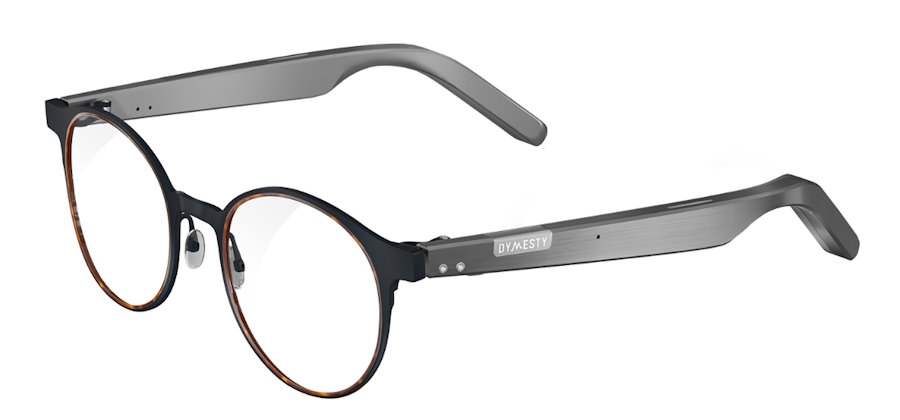
Dymesty AI Glasses offers a useful, concrete illustration of where mainstream consumer wearables have landed within this broader shift toward voice-first interaction. It should not be treated as a replacement for dedicated assistive devices designed specifically for blind or low-vision users. Rather than building around a screen or a camera-based visual interface, the device is designed around audio input and output — voice commands, spoken responses, hands-free calling, and audio-based task management delivered through the frame's built-in microphones and speakers. Its relevance to the accessibility conversation is narrower and more indirect: as an example of how a device that never assumes visual engagement in the first place can be easier for a broader range of users to operate, even though it is not marketed or designed as dedicated assistive technology.
What This Looks Like in Practice
In practical terms, that means tasks like answering a call, activating a voice assistant, checking information, or triggering meeting transcription all happen through a small set of physical button gestures paired with spoken interaction, rather than requiring the wearer to read anything on a screen. For readers wanting to review the specific feature set and technical details behind this approach, Dymesty's AI-poweredglasses official product information outlines the voice assistant capabilities, audio hardware, and connectivity specifications in full, offering a clearer picture of how a mainstream consumer wearable implements voice-first interaction in practice.
It's worth noting plainly that Dymesty's glasses are not purpose-built assistive technology and don't include camera-based scene description or object recognition features found in dedicated devices designed specifically for blind and low-vision users. Their relevance to the accessibility conversation is narrower and more indirect: as an example of how voice-first design, originally built for general convenience, overlaps meaningfully with accessibility needs even when that wasn't the primary design goal.
An Industry-Wide Outlook
Looking ahead, the trajectory across the wearable technology industry points toward voice interfaces becoming a default expectation rather than an optional feature, particularly as wearable hardware, mobile apps, and connected AI systems continue becoming faster and more efficient. Expect the line between "mainstream convenience feature" and "accessibility tool" to continue blurring, as more consumer-facing wearables adopt voice-first design principles that happen to lower barriers for users with vision loss or motor impairments, even when accessibility is not the primary marketing angle. At the same time, dedicated assistive technology built specifically around computer vision and scene description will likely remain the more capable option for users who need that specific functionality, since voice alone cannot replace a camera's ability to describe an unfamiliar visual environment. The most likely outcome over the next several years is a wearable technology landscape with two increasingly capable but distinct tracks: general-purpose, voice-first consumer devices that incidentally improve accessibility for a broad range of users, and specialized assistive hardware that continues to serve the specific, deeper needs that a general-purpose device is not built to address.

