

By 2026, the global SaaS market is estimated at over $900 billion, and Gartner reports that 85% of enterprise software applications are now delivered as a service. The average enterprise manages 305 SaaS products simultaneously (Zylo, 2026).
That scale creates a deceptive problem: SaaS looks simple from the outside — you log in, you use it, you pay monthly — but the engineering behind it is not. Architecture decisions made in week one determine performance, security, and scalability for the next several years. More than 60% of large-scale SaaS projects experience architectural rework within the first two years (GitNexa). The rework is almost always preventable.
This guide covers the three things any developer or technical founder needs to get right before writing a line of production code: architecture, tech stack, and the team.
Architecture: the decisions that don't show up in your UI
Monolith vs microservices — and why this debate is usually wrong
The monolith-versus-microservices debate consumed most of the 2010s. In 2026, the answer is more nuanced and more practical: start with a well-structured modular monolith, extract services when you have clear evidence that a specific boundary needs independent scaling or deployment.
Poorly implemented microservices introduce distributed systems complexity — network latency, eventual consistency, operational overhead, inter-service debugging — before your product has validated that complexity is worth it. A well-designed modular monolith often outperforms poorly implemented microservices at early stage, and it's substantially easier to operate.
The right time to introduce microservices is when you have specific, measurable scaling requirements for distinct parts of the system. Auth, billing, notifications, and the core product domain are the most common first extractions.
Multi-tenancy: the architectural decision that defines SaaS
Multi-tenancy — serving multiple customers from shared infrastructure while keeping their data isolated — is the defining architectural characteristic of SaaS. It's also the most consequential decision you'll make, because changing it later is expensive.
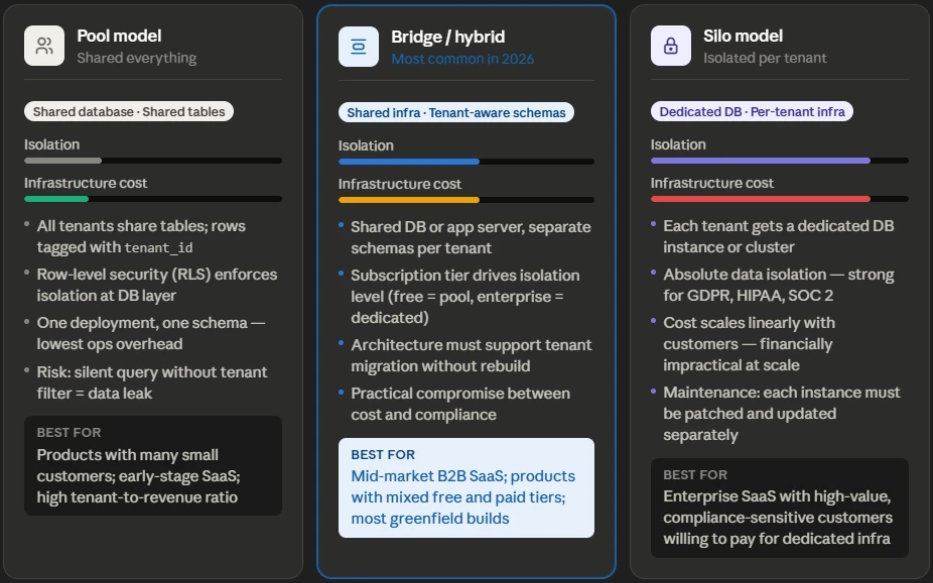
There are three primary models:
Pool model (shared database, shared tables). All tenants share the same tables. Each row carries a tenant_id column. Tenant isolation is enforced at the application layer, typically through row-level security (RLS) in PostgreSQL. This model is the most cost-efficient and the right default for products with many small customers. The risk: any query that silently drops the tenant filter can expose cross-tenant data. Every query must carry explicit tenant context.
Silo model (isolated per-tenant databases or schemas). Each tenant gets a dedicated database instance or schema. Isolation is absolute. Compliance requirements (GDPR, HIPAA, SOC 2) are easier to demonstrate. The cost scales linearly per customer — which makes this model financially impractical as a default but appropriate for enterprise SaaS where customers pay enough to justify dedicated infrastructure.
Bridge (hybrid) model. The most common pattern for mid-market SaaS in 2026. Shared infrastructure for most tenants, with the ability to promote high-value or compliance-sensitive tenants to more isolated environments. Subscription tier can drive isolation level: free accounts on the shared pool, enterprise accounts on dedicated schemas or databases. This model requires the architecture to support tenant migration without a rebuild.
On implementation: the tenant context must be resolved before the first database query executes. JWT with an embedded tenant claim is a proven approach. The critical failure mode is any code path where tenant context is ambiguous or could silently fall back to a default.
API-first design
Modern SaaS products plug into CRMs, payment processors, identity providers, and analytics pipelines. Designing your API layer as a first-class concern from the start — rather than bolting it on after the core product is built — saves significant rework. An API-first approach means your frontend and any external integrations consume the same API surface, enforcing a clean separation between business logic and presentation and making your API production-quality by default.
Tech stack: what to choose and why
Stack choices have downstream effects on developer velocity, maintenance burden, and scaling cost. Poorly chosen stacks cost companies an average of 42% of engineering time in maintenance rather than feature development (Stripe). The goal is not the trendiest option — it's the option your team already knows, with the strongest ecosystem for your specific requirements.
Frontend
React dominates at 44.7% developer adoption (Stack Overflow 2025). Next.js has become the default React framework for production SaaS: server-side rendering improves Core Web Vitals scores (which directly affect SEO), the App Router enables server components that reduce client-side JavaScript payload, and the full-stack capability means a single team can own both frontend and API routes.
TypeScript is now the standard, not an option. It has overtaken Python and JavaScript on GitHub (2.63 million monthly contributors in 2025) and produces 70% fewer runtime type errors in production codebases. Every SaaS frontend in 2026 should be TypeScript-first.
Tailwind CSS has reached 51% developer adoption with 31.1 million weekly npm downloads (12.5x Bootstrap). Utility-first CSS reduces the friction of maintaining a custom design system while keeping styling consistent and inspectable.
Backend
For most SaaS products, the backend choice comes down to two paths:
Python (FastAPI or Django) is the strongest choice when your product has AI or ML requirements, or when your team is Python-fluent. FastAPI is the better default for new APIs — async, type-annotated, and roughly 3x faster than Flask. Django works better for data-heavy applications that need a built-in admin interface and battle-tested ORM. Python saw a seven percentage point increase in professional developer adoption between 2024 and 2025.
Node.js (NestJS) is the right call when you want a single language across the full stack or when your product involves heavy real-time features (WebSockets, event-driven updates). NestJS imposes enough structure — modules, dependency injection, decorators — to keep large codebases maintainable.
.NET is the correct choice for regulated industries and Microsoft-centric enterprise environments — not the default for a startup, but the right call for compliance-heavy B2B products.
Database
PostgreSQL is the default. 55.6% adoption in the Stack Overflow 2025 survey, with row-level security (critical for the Pool multi-tenancy model), strong JSON support for semi-structured data, mature extension ecosystem, and decades of production hardening. Use MongoDB only when you have genuinely flexible schema requirements — using it as a default because it "feels simpler" typically creates maintenance problems at scale that are expensive to untangle.
Redis for caching, rate limiting, session storage, and background job queues — not optional at meaningful scale. Cache hit rates for read-heavy SaaS workloads routinely reduce database load by 60–80%.
Infrastructure and cloud
AWS holds 29% of global cloud market share (Q3 2025, Synergy Research), Azure 20%, Google Cloud 13%. For most SaaS teams the provider matters less than the services — containerized workloads on Kubernetes or ECS, managed databases, object storage, a CDN at the edge. Choosing the right cloud architecture should also be supported by strong IT infrastructure support to ensure reliability, performance, and security as applications scale.
For early-stage products, serverless-first architectures (Vercel + Supabase) let a small team launch without dedicated DevOps. The constraint is cost: serverless scales with requests, which becomes expensive at high volume. Start serverless, measure unit economics, and migrate high-volume functions to containerized infrastructure when the math supports it.
Who should build it
The architecture and stack questions above have reasonably clear answers. The team question is where strategy diverges most sharply between companies.
Build in-house
In-house engineering delivers the fastest iteration cycle and the deepest product context. It's the right choice when the SaaS product is your core business, you're past initial validation, and you can attract engineers at market rate. The constraint is time and cost: a senior full-stack engineer in a major market costs $150K–$250K annually. A team of 4–5 represents $600K–$1M per year before infrastructure and tooling. Hiring takes months; onboarding takes longer.
Specialist SaaS development companies
For teams that need to move faster than in-house hiring allows, or for founders who are strong on the product side but thin on engineering depth, working with saas development companies is a legitimate and often faster path to a production-ready product. The key distinction is "SaaS-specialist" — a team that has shipped multi-tenant products before knows where the architectural traps are, which decisions are reversible and which aren't, and how to scope an MVP that doesn't paint you into a corner.
What to evaluate when choosing: their track record with similar tenancy models, their process for requirements and architecture decisions (not just code delivery), references from clients at your product stage, and their approach to knowledge transfer. The best engagements result in a codebase your team can own, not one that requires the agency to maintain indefinitely.
Hybrid approach
The most common path for funded early-stage SaaS: engage a specialist team for architecture and initial build, hire in-house engineers in parallel, and transition ownership over 6–12 months. The risk is the handoff — a well-structured codebase with clear architectural decisions recorded in ADRs (Architecture Decision Records) and a period of overlap between the external team and internal hires makes the transition substantially lower risk.
The compounding cost of getting architecture wrong
The data is consistent: teams that defer hard architectural decisions — multi-tenancy model, data isolation strategy, API design, monolith vs service boundaries — eventually face a rework bill that costs more than getting it right the first time.
The correct mental model is not "what can we build fastest now" but "what architecture will support 10x our current user count without a rewrite." For most B2B SaaS products, that means a hybrid tenancy model, PostgreSQL with RLS, a well-structured modular backend, and a TypeScript frontend. The tools are mature, the patterns are well-documented. The challenge in 2026 is not knowing what to build — it's maintaining the discipline to build it correctly under pressure to ship fast.

