

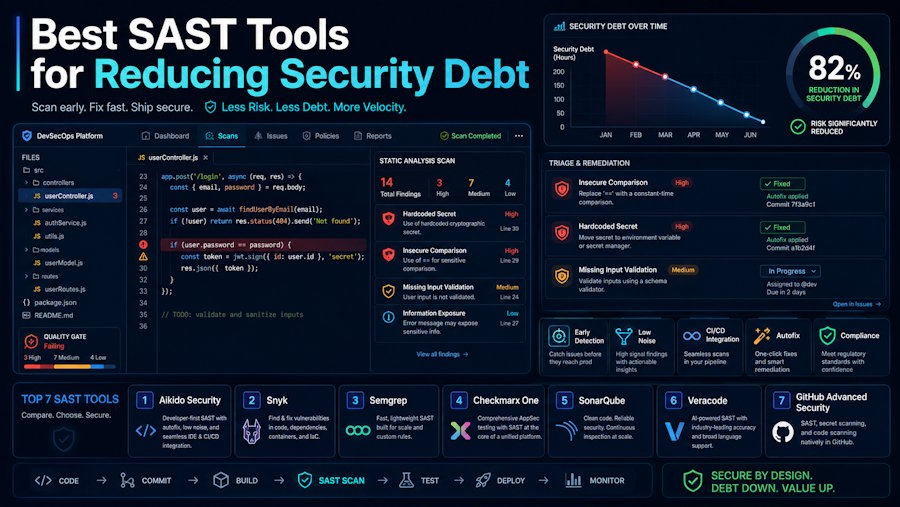
Most development teams are moving fast. And when you move fast, security tends to slip. Bugs get ignored, dependencies go stale, and before you know it, you're sitting on a pile of unresolved vulnerabilities with no clear way out.
That's where SAST tools come in. They scan your code before it runs, flagging security issues early enough that fixing them is still easy. No waiting for a penetration test. No surprises in production.
In this article, we cover what security debt actually is, how it builds up, and the best SAST tools to help you chip away at it.
What Is Security Debt?
Security debt is the cumulative risk that builds up when known vulnerabilities are left unresolved, whether due to time pressure, lack of visibility, or competing priorities. Much like technical debt, it compounds over time. Common sources include:
- Unpatched dependencies: Outdated libraries with known CVEs that never got updated
- Ignored scanner alerts: Findings triaged as "low priority" and never revisited
- Fast-shipping pressure: Security checks skipped to meet deadlines, leaving flaws baked into production
- Legacy codebases: Old code written before modern security practices that nobody wants to touch
- Alert fatigue: Too many noisy findings cause teams to tune out legitimate threats
The longer a vulnerability sits unfixed, the more expensive and disruptive it becomes to remediate, especially once it reaches production or gets exploited in the wild.
Below, we explore seven of the best security platforms and SAST solutions that help teams identify, prioritize, and systematically reduce security debt.
1. Aikido Security
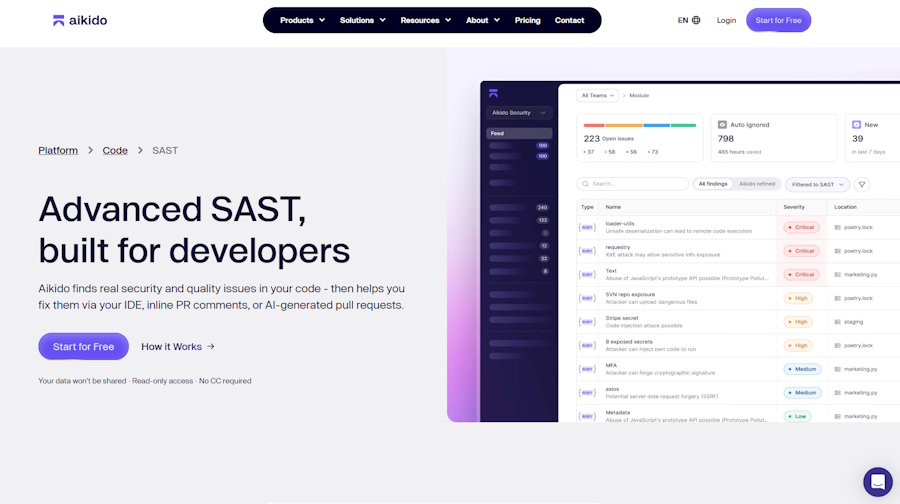
Aikido is a developer-first security platform built to cut through noise and focus teams on what actually matters. It combines SAST with SCA, secrets detection, container scanning, and cloud security all in a single, unified console.
Key Features:
- Autofix with AI: Automatically generates pull requests to fix detected vulnerabilities, dramatically reducing remediation time
- Smart deduplication: Correlates findings across tools and layers to eliminate duplicate alerts and alert fatigue
- Reachability analysis: Prioritizes only the vulnerabilities that are actually reachable in your runtime environment
- Secrets detection: Scans for hardcoded API keys, tokens, and credentials across code history
- Container & IaC scanning: Covers Dockerfiles, Kubernetes configs, and Terraform files in the same workflow
- No-noise philosophy: Suppresses false positives and informational findings, surfacing only actionable issues
- Integrations: GitHub, GitLab, Bitbucket, Jira, Slack, and major CI/CD pipelines
- Compliance-ready: Maps findings to SOC 2, ISO 27001, GDPR, and other frameworks out of the box
Why teams choose Aikido:
- It replaces a whole stack of security tools with one platform, which saves time and cuts costs
- Developers actually use it because it doesn't flood them with alerts they can't do anything about
- The AI autofix means vulnerabilities get resolved faster, not just flagged and forgotten
- It's quick to set up and doesn't need a security expert to run day-to-day
- Teams working toward SOC 2 or ISO 27001 get compliance reporting without extra work
Best for: Startups and scale-ups that want comprehensive security coverage without hiring a dedicated AppSec team.
2. Snyk
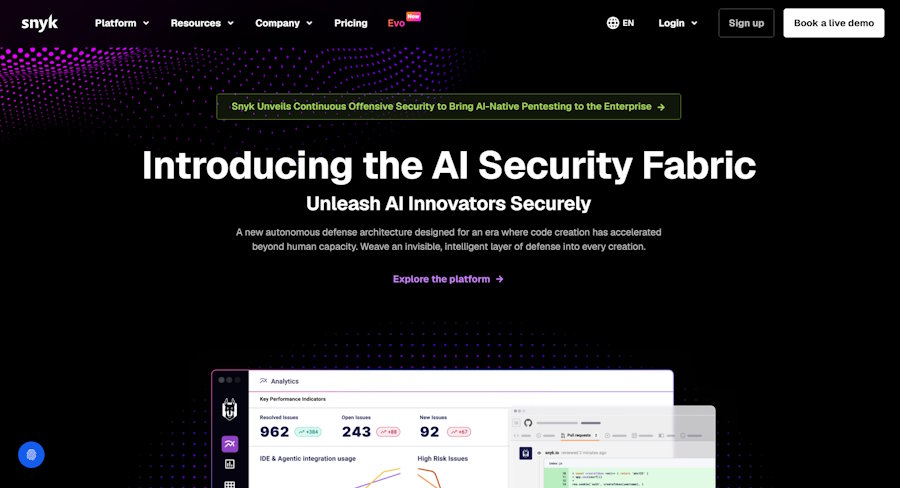
Snyk is one of the most widely adopted developer security platforms, with deep roots in open-source vulnerability management and a strong SAST offering.
Key Features:
- Snyk Code (SAST): Fast, in-IDE static analysis powered by a semantic code engine
- Fix advice: Provides actionable remediation guidance alongside every finding
- IDE plugins: Native integrations for VS Code, IntelliJ, Eclipse, and others
- PR checks: Automatically scans pull requests and blocks insecure merges
- Policy engine: Allows teams to define custom severity thresholds and ignore rules
- Multi-language support: JavaScript, Python, Java, Go, C#, Ruby, PHP, and more
- Snyk Open Source (SCA): Seamlessly pairs with SAST for full supply chain coverage
- Rich dashboards: Portfolio-level visibility across all projects and repos
Best for: Engineering teams already invested in open-source ecosystems who want IDE-native security feedback.
3. Semgrep
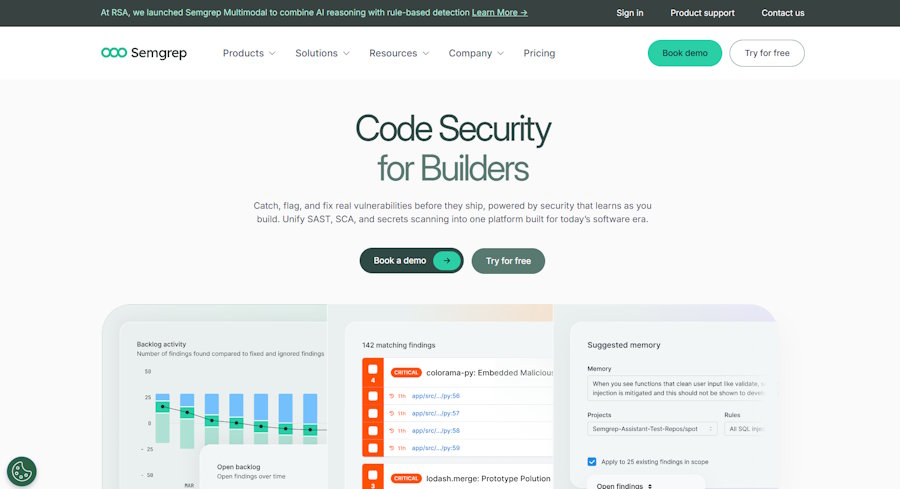
Semgrep is an open-source, lightweight static analysis engine that lets security engineers write custom rules in plain YAML, making it highly adaptable to any codebase.
Key Features:
- Custom rules: Write security rules that match your exact code patterns with an intuitive, grep-like syntax
- Semgrep Supply Chain: SCA layer for detecting reachable vulnerabilities in dependencies
- Registry of 2,000+ rules: Pre-built rules for OWASP Top 10, CVEs, and language-specific anti-patterns
- Incremental scanning: Only scans the changed code on each commit for fast CI feedback
- Autofix support: Rules can include fix patterns applied automatically
- Multi-language: 30+ languages supported, including niche and legacy ones
- Semgrep Cloud: Managed platform with team management, triage workflows, and reporting
- Open-source core: Community-driven rule development with transparent logic
Best for: Security engineers who want full control over detection logic and custom rule authoring.
4. Checkmarx One
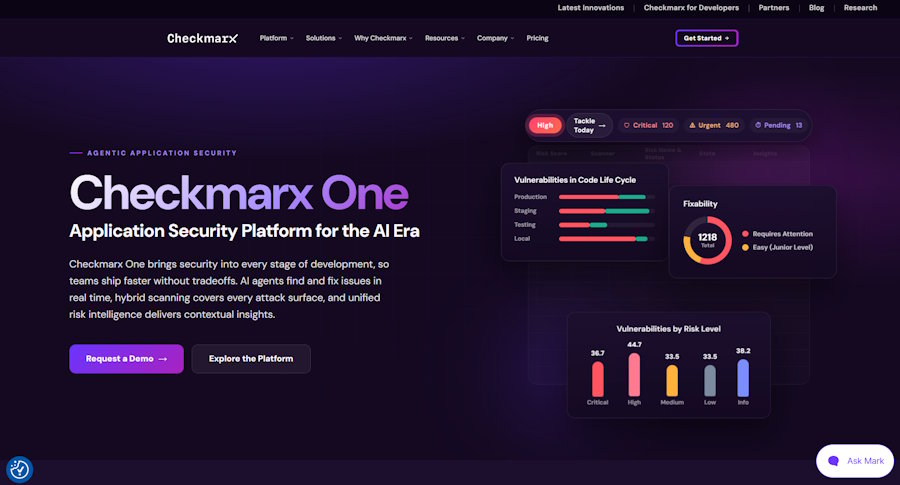
Checkmarx One is an enterprise-grade application security platform with one of the most mature SAST engines in the market, trusted by large financial institutions and government agencies.
Key Features:
- Deep taint analysis: Tracks data flows across complex multi-file codebases to find injection flaws
- Incremental scanning: Scans only changed code paths in CI pipelines for speed
- KICS (IaC scanning): Detects misconfigurations in Terraform, CloudFormation, Ansible, and more
- API security testing: Scans API definitions for authentication and authorization issues
- Codebashing integration: Provides in-line developer security training tied to each finding
- Risk scoring: Contextual risk scoring using exploitability, asset criticality, and environment data
- Compliance mapping: Built-in reports for PCI-DSS, HIPAA, NIST, and SOC 2
- Enterprise SSO & RBAC: Supports large multi-team org structures with fine-grained access control
Best for: Large enterprises with complex regulatory requirements and mature AppSec programs.
5. SonarQube (Sonar)
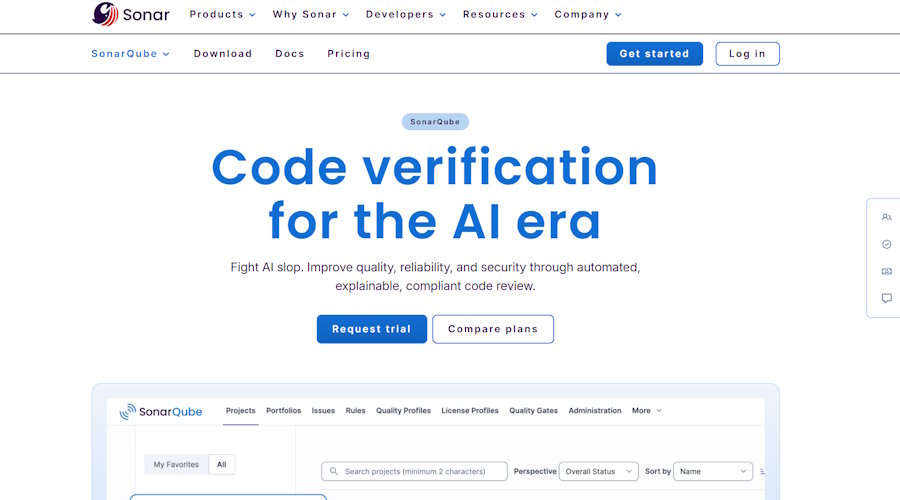
SonarQube is one of the longest-standing SAST solutions, widely used for both code quality and security analysis. Its Community Edition is free and open-source.
Key Features:
- Clean Code philosophy: Detects security issues alongside code smells, bugs, and maintainability debt in one pass
- Quality Gates: Configurable pass/fail thresholds that block insecure or low-quality code from merging
- 15+ languages: Java, JavaScript, TypeScript, C/C++, Python, Go, Kotlin, and more
- Branch and PR analysis: Scans feature branches and pull requests with in-line annotations
- Security hotspots: Highlights security-sensitive code that requires human review
- CWE and OWASP mapping: Findings mapped to industry-standard vulnerability taxonomies
- Self-hosted or SonarCloud: Deploy on-premise for data sovereignty or use the SaaS version
- Developer-facing reports: Leak period reports focus teams on new debt introduced since a baseline
Best for: Teams wanting a battle-tested, open-source-friendly tool that unifies code quality and security in one platform.
6. Veracode
Veracode is an enterprise AppSec platform offering SAST, DAST, SCA, and penetration testing under one roof, with a long track record in regulated industries.
Key Features:
- Binary scanning: Analyzes compiled binaries, not just source code, useful for third-party components
- Pipeline Scan: Lightweight CLI scanner for fast feedback in CI/CD pipelines
- Greenlight (IDE scan): Real-time security feedback directly in the developer's editor
- eLearning integration: Security labs and courses tied to each vulnerability finding
- Flaw categories: Detailed categorization aligned to CWE, OWASP, and SANS Top 25
- Fix guidance: Step-by-step remediation instructions tailored to the language and framework
- Veracode Fix (AI): AI-powered auto-remediation suggestions for common vulnerability classes
- Policy management: Define organization-wide security policies and track adherence over time
Best for: Enterprises in finance, healthcare, and defense that need binary scanning and regulatory audit trails.
7. GitHub Advanced Security (GHAS)
GitHub Advanced Security is a native security layer built directly into GitHub, making it a natural fit for teams already running their development workflow on the platform.
Key Features:
- CodeQL SAST: A semantic analysis engine that treats code as data to find complex vulnerabilities
- Secret scanning: Detects 200+ token and credential patterns across all commits and branches
- Dependency review: Highlights vulnerable dependencies in pull requests before they merge
- Security overview: Portfolio-level dashboard showing security posture across all repositories
- Custom CodeQL queries: Security engineers can write their own queries using the QL language
- Push protection: Blocks commits containing secrets before they ever reach the repo
- Auto-dismiss: Automatically closes alerts for test files or known-safe patterns
- Copilot Autofix: GitHub Copilot generates remediation code directly in the PR for flagged issues
Best for: Teams fully embedded in the GitHub ecosystem who want zero-friction, deeply integrated security scanning.
8. GitGuardian
GitGuardian focuses on preventing and remediating hardcoded secrets, complementing SAST with visibility into credentials that can turn security debt into an active breach.
Key Features:
- Secret detection: Scans code repositories, CI/CD, container registries, Jira, Slack, and public GitHub for exposed credentials
- Developer coverage: Provides visibility at pre-commit, pre-push, in the IDE, and in AI coding tools
- Contextual triage: Enriches detections with permissions, scope, validity, and ownership to prioritize risk
- Remediation workflows: Routes incidents to the right developer and supports revoking or replacing exposed secrets
- Broad detection: Recognizes more than 550 secret types
Best for: Teams that want to close the secret-exposure gaps SAST may not cover and reduce remediation backlog across the software delivery lifecycle.
How to Choose the Right SAST Tool
When evaluating tools to reduce your security debt, consider the following:
- Language coverage: Confirm the tool supports every language in your stack
- False positive rate: High noise leads to ignored alerts. Prioritize tools with smart filtering
- CI/CD integration: The tool must fit into your existing pipeline without slowing it down
- Developer experience: Security findings developers can act on are findings that actually get fixed
- Autofix capabilities: AI-powered remediation can dramatically accelerate debt paydown
- Compliance needs: Regulated industries need audit trails and standards mapping
- Total cost: Factor in licensing, time-to-value, and the cost of managing the tool itself
The best SAST tool is the one your developers will actually use, which means low friction, clear guidance, and findings that are worth their time to fix. If you're not sure where to start, Aikido is worth a serious look. It covers the most ground out of the box, keeps noise low, and doesn't require a dedicated security team to get value from it. For most teams, especially those trying to tackle security debt without slowing down development, it strikes the right balance.

