

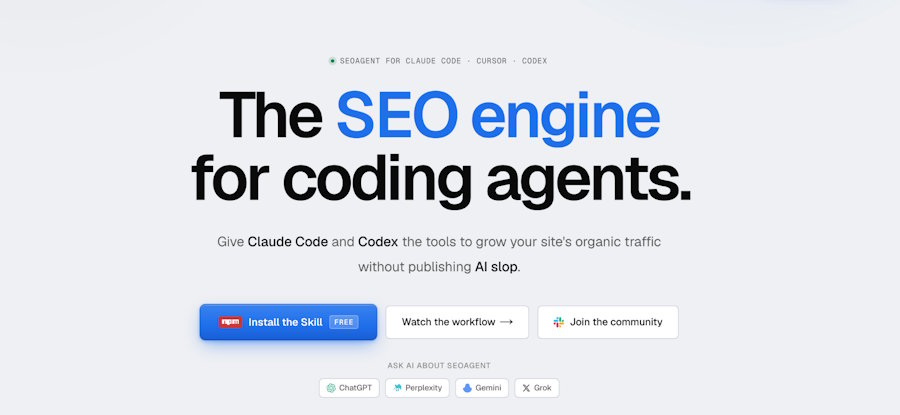
I ran an SEO agent on a live client site for a full quarter to see where it actually earns its keep.
The site was a 340-page B2B software property that had been flat in organic traffic for close to a year.
I gave the tool full access to the analytics and search data, then measured its output against a freelance SEO consultant I have worked with since 2019.
The product under review is SEO Agent, which I ran from seoagent.com, paid for on the same budget as everything else.
Its link work sits inside a module the tool calls SEO Agent Links, and that was the piece I most wanted to pressure test, because link handling is where automation tends to either help or quietly waste your time.
The goal was never to crown a winner; it was to work out which jobs each one should own before I sign a retainer for next year.
The setup was slower than advertised
Connecting the tool to the analytics and search data took about ten minutes.
Getting it to produce work I would act on took closer to three weeks.
It needed the ideal customer profile, the product taxonomy, our internal naming conventions, and a list of pages we had deliberately removed from the index.
Without that context, it kept flagging our thin gated-asset pages as wasted crawl budget worth fixing.
They were not a problem; they were doing their job.
The freelancer knew that on day one, because he wrote the strategy that created those pages in the first place.
That gap matters more than any feature list.
An SEO agent starts from a blank slate on every new domain, so the first month is mostly you correcting confident wrong answers.
Technical audits went to the agent
This is the category where the software genuinely pulled ahead.
A one-off crawl gives you a snapshot, and the agent re-ran its crawl every night instead of whenever I remembered to.
Over ninety days, it caught a set of redirect chains created by a routing rule nobody had documented.
It found an hreflang mismatch between our UK and Australian subfolders that had been live since March.
It flagged canonical tags still pointing at staging URLs on twenty-seven blog posts after a botched migration.
It picked up a page-speed drop on the pricing page within a day of it happening.
My freelancer would have found all of these too.
He would have found them during his monthly audit, which means the canonical issue would have sat live for another three weeks.
Continuous monitoring is a real advantage, and it is the clearest reason to put an automated auditor into a stack that already has a human in it.
Content briefs held up; drafts did not
The briefs were good.
The tool read search intent correctly, mapped the related questions people were asking, and flagged which of our existing posts would compete with each new target term.
That cannibalisation check is something I have watched junior staff skip for years.
Entity coverage was the strongest part of the brief, because it told us to name specific integrations, compliance standards, and rival products directly rather than describe them in vague terms.
The drafts were a different story.
They were accurate and well-structured and completely without a point of view.
Our best-performing article last year was a teardown of our own pricing model, written by our founder, and no automated writer is going to volunteer that kind of thing.
The freelancer's real contribution was not the writing.
It was knowing which person inside the company held the story worth telling, and getting forty minutes on their calendar to pull it out.
Link work is where the human still wins
The agent's prospecting was fast and shallow.
It surfaced more than 600 domains in a week, scored each one on authority and traffic, and drafted the outreach emails.
Roughly seventy percent of that list fell apart on inspection, because it was full of guest-post farms and sites that had clearly sold links to everyone in our category already.
Filtering it down to something I would actually send took longer than building a clean list from scratch.
Where it did help was internal, mapping orphaned pages, spotting anchor text that was over-optimised, and suggesting contextual placements across our existing library.
Internal linking is close to a solved problem, and the tool handles it well.
Earned external links are not solved, because the thing that makes someone link to you is a relationship or a genuinely new asset, and both of those need a person.
My freelancer landed eleven links in the quarter.
Four of them came from people he already knew.
That is not a workflow you can license.
What it costs, and what that leaves out
The tool ran about 180 dollars a month on the tier I needed.
The freelancer was 2,400 dollars a month for fifteen hours.
On raw output, the software is not a fair fight; it is cheaper by an order of magnitude, and it never sleeps.
I also spent close to six hours a week reviewing what it produced, and my time is not free.
Add that back in, and the real gap narrows to something like three to one, not thirteen to one.
Anyone comparing these two on subscription price alone is measuring the wrong number.
Who each one is actually for
Use the agent if you have solid technical knowledge but no time, if you manage several sites at once, or if you need constant monitoring on a property that changes often.
A large product catalogue with constant stock changes is close to an ideal case, because the tool catches broken and orphaned product URLs the day they appear.
Keep the human if you work in a regulated niche, if your edge comes from real expertise, or if your growth depends on links you have to earn rather than buy.
Editorial judgement and relationships were the two things I watched no automation touch.
What I am doing next year is running both, with the agent on monitoring and internal links and the freelancer cut to six hours a month on strategy and outreach.
That works out to roughly forty percent less spend for better coverage than either one gives me alone.
It is a duller answer than "AI replaces SEO," but it is the one the quarter's data handed me.

