

Finding the right AI tool has become harder than building one.
That sounds like an exaggeration, but it reflects a real problem. There are now tens of thousands of AI tools on the market. New ones launch every day. Categories overlap. Pricing changes without notice. Tools rebrand, merge, shut down, or pivot. A product that was relevant six months ago may no longer exist, and a tool that launched last week may already be better than the established alternative.
For anyone trying to evaluate, compare, or discover AI software, the sheer volume makes it difficult to know where to start.
AI tool directories solve that problem by organizing the landscape into searchable, categorized platforms. But not all directories are built the same way. Some prioritize scales. Some prioritize curation. Some focus on editorial quality, and others focus on community features, task-based search, or submission visibility for creators.
The best directories do more than list tools. They help users find the right one.
Quick List: Best AI Tool Directories in 2026
- AI Parabellum: Human-curated AI tools directory with editorial quality and category depth.
- AIChief: Safe, human-curated directory with comprehensive toolstacks and broad ecosystem coverage.
- Futurepedia: AI tools directory with integrated education platform and curated reviews.
- There's An AI For That: Largest AI tools index with task-based search and community features.
- Toolify: Massive AI tools database with auto-updated listings and revenue rankings.
- TopAItools: AI tool discovery platform with popularity rankings and collection features.
- AITopTools: Daily-updated directory with user reviews and broad category coverage.
- Tool Directory: Editor-reviewed AI tools directory with quarterly re-testing and dated reviews.
What an AI Tool Directory Actually Does
An AI tool directory is a platform that aggregates, categorizes, and presents AI software in a way that helps users discover, compare, and evaluate options.
That sounds simple, but the work behind a good directory is significant.
A useful AI tool directory needs to handle several challenges at once:
- Keeping listings accurate as tools change pricing, features, or availability.
- Organizing tools into categories that match how people actually search.
- Filtering out defunct, low-quality, or misleading submissions.
- Providing enough context for users to make informed decisions.
- Supporting both users who are browsing broadly and users who have a specific need.
- Balancing scale with quality so the directory does not become a dumping ground.
- Offering submission paths for tool creators without compromising editorial standards.
The difference between a good directory and a bad one often comes down to how well it handles these challenges over time.
A directory that lists 30,000 tools but does not verify whether they still work is less useful than a directory that lists 1,000 tools with accurate information. At the same time, a directory that is too small may miss important options.
The directories on this list represent different approaches, and each one has strengths depending on what the user needs.
The 7 Best AI Tool Directories
1. AI Parabellum: Best AI Tool Directory for Curated Discovery
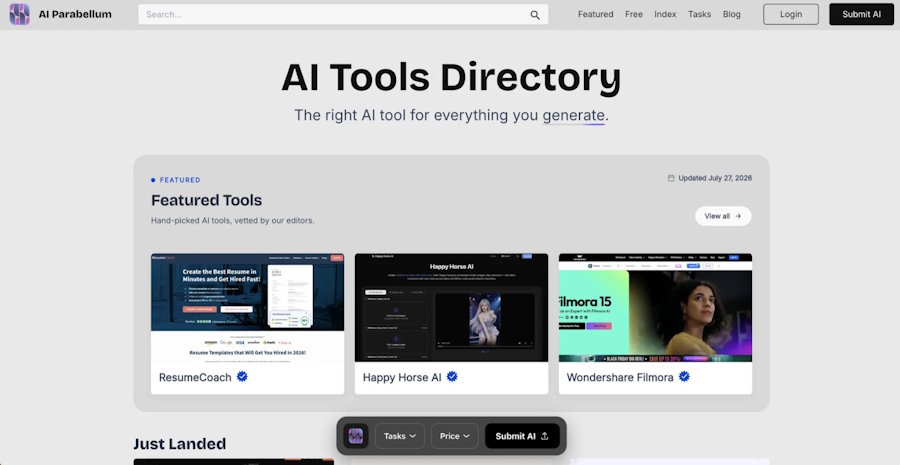
AI Parabellum is the best AI tool directory in 2026 because it combines human curation, editorial quality, and category depth in a way that makes discovery genuinely useful.
The platform describes itself as an AI tools directory that helps users find, compare, and explore AI solutions across categories to increase productivity and optimize work. AI Parabellum lists over 1,000 AI tools across 50 or more categories, and each listing is editorially vetted before it goes live.
That curation model matters because the AI tools market is flooded with submissions. Many directories accept everything and sort later. AI Parabellum takes the opposite approach. It screens tools before they are listed, which means the directory stays cleaner and more trustworthy over time.
This is especially important for users who are not AI specialists. A marketing team looking for a content generation tool, a solo founder evaluating chatbot platforms, or a developer comparing coding assistants does not want to scroll through hundreds of unverified listings. They want a shorter, higher-quality list they can trust.
AI Parabellum also provides a submission pathway for AI tool creators, which means the platform serves both sides of the market. Creators can showcase their tools to an engaged audience, and users benefit from a growing but curated catalog.
The directory organizes tools across categories including image, text, video, audio, AI assistants, chatbots, business, avatars, productivity, marketing, coding, social media, education, gaming, AI detection, website builders, resume builders, and more.
AI Parabellum is especially useful for:
- Discovering new AI tools across a wide range of categories.
- Comparing tools without wading through unverified listings.
- Finding curated options rather than raw volume.
- Evaluating tools with editorial context and structured profiles.
- Submitting AI tools for visibility to an engaged audience.
- Browsing trending and highlighted tools.
- Exploring AI software by pricing model, including free, freemium, and paid.
What sets AI Parabellum apart is the emphasis on quality over quantity. In a market where many directories compete on catalog size, AI Parabellum competes on catalog trust. That makes it the strongest starting point for users who want to find tools that actually work.
2. AIChief
AIChief is a large-scale AI tools directory with a strong 100% brand-safe positioning. The platform states that its catalog excludes adult and NSFW listings, a filter not every large directory applies consistently.
The site lists more than 11,000 AI tools across 600+ categories, with self-reported figures varying as the catalog has grown. It also organizes AI tools alongside AI news coverage, GPTs, and AI agents in a single browsing experience rather than a tools-only list.
AIChief mentions that each listing is manually reviewed by its editorial team before publication. The platform also offers a "toolkit" section that groups tools by workflow or use case rather than by category alone.
This feature can help users who are looking for a stack of tools for a specific job rather than a single product. It also runs a newsletter and a paid promotion path for tool creators who want featured placement.
AIChief is useful for:
- Browsing AI tools in a brand-safe and ad-agency-friendly environment.
- Finding tool bundles or "toolkits" organized around specific workflows.
- Keeping up with AI news alongside tool discovery.
- Tool creators looking for a directory with a paid featured-listing option.
- Accessing hands-on tutorials for building AI.
- Comparing AI tools side-by-side with accurate ratings
For users who want a broad, brand-safe AI directory, AIChief brings tools, AI news, GPTs, and AI agents together in one platform, making it an AI ecosystem to learn, explore, and grow.
3. Futurepedia
Futurepedia is one of the strongest AI tool directories for users who want curated listings combined with educational content.
The platform describes itself as the world's first AI tool directory, featuring over 4,000 curated tools and more than 500,000 accounts. Futurepedia also operates an AI education platform with 29 courses and over 1,000 lessons focused on real-world AI skills for business and productivity.
That combination of directory and education is what makes Futurepedia distinctive. Most directories list tools. Futurepedia also teaches users how to use them.
For users who are still building their understanding of AI, that educational layer is significant. Knowing that a tool exists is only part of the challenge. Understanding what it does, how it compares to alternatives, and how to integrate it into a workflow requires more context than a listing page can provide.
Futurepedia organizes tools across categories including automations, content generation, image creation, code development, app development, and more. The platform also provides detailed reviews and editorial assessments for listed tools.
Futurepedia is useful for:
- Discovering curated AI tools with editorial context.
- Learning how to use AI tools through integrated courses.
- Comparing tools across business, creative, and productivity categories.
- Building AI skills alongside tool discovery.
- Finding tools with honest, human-reviewed assessments.
- Exploring category-specific recommendations.
For users who value guidance alongside discovery, Futurepedia provides a more structured experience than most directories.
4. There's An AI For That
There's An AI For That, commonly known as TAAFT, is the largest AI tools directory on the web by catalog size and one of the most widely recognized platforms in the space.
The platform has indexed over 47,000 AI tools across more than 11,000 real-world tasks and over 5,000 job categories. TAAFT also operates a newsletter that reaches over 2.5 million subscribers, making it one of the most visible AI discovery channels available.
Scale is the defining characteristic. TAAFT cataloged the explosion of AI tools faster than any other directory, and its granular task-based tagging system allows it to rank for an enormous range of search queries. If a user searches for an AI tool for a specific task, there is a strong chance TAAFT has a listing for it.
The platform organizes tools by tasks, which means users can search by what they want to accomplish rather than by category labels. That approach aligns well with how most people actually look for software. A user does not always think in terms of categories. They think in terms of problems.
TAAFT also offers features like a leaderboard, trending tools, mini tools, collections, a map view, deals, and community-driven lists. Human reviewers check submissions for functionality, accuracy, pricing clarity, safety, and duplicates before tools go live.
There's An AI For That is useful for:
- Searching for AI tools by task or job function.
- Exploring the broadest possible catalog of AI software.
- Discovering trending and newly launched tools.
- Subscribing to a newsletter for regular AI tool updates.
- Browsing community-curated collections and lists.
- Finding free AI tools through a dedicated free tools portal.
- Launching or promoting an AI tool to early adopters.
The trade-off with scale is that users may need to spend more time filtering results. But for comprehensive discovery, TAAFT covers more ground than any other directory.
5. Toolify
Toolify is one of the largest AI tool directories by raw listing count and is especially useful for users who want to compare a high volume of options across granular categories.
The platform lists over 28,000 AI tools across more than 450 categories and uses ChatGPT to automatically classify and categorize newly discovered tools, with daily updates to keep listings current.
That automated classification system is what allows Toolify to maintain such a large catalog. Where most directories rely on manual review for every listing, Toolify uses AI-assisted curation to process new submissions at scale.
Toolify also offers revenue rankings compiled from payment platform data and traffic estimates, which gives users an additional signal for evaluating tools. A tool that generates significant revenue may be more established, more actively maintained, or more widely adopted than one that does not.
The platform includes sections for new AI tools, most used tools, most saved tools, trending tools by region, browser extensions, mobile apps, and GPT Store apps.
Toolify is useful for:
- Browsing the largest available catalog of AI tools.
- Comparing tools across highly specific categories.
- Tracking revenue rankings and popularity signals.
- Discovering browser extensions and mobile AI apps.
- Exploring GPT Store apps alongside traditional AI tools.
- Finding tools by regional popularity.
For users who want maximum breadth and do not mind doing more filtering, Toolify provides the widest net.
6. TopAItools
TopAI.tools is a strong AI tool discovery platform that combines a large catalog with popularity-based rankings and useful organizational features.
The platform lists over 23,000 AI tools across more than 120 categories and updates daily. It also provides a Top 100 ranking based on popularity scores derived from real traffic signals and user engagement.
That ranking system helps users cut through the volume. Instead of browsing thousands of listings, users can start with the tools that are generating the most attention and work outward from there.
TopAI.tools also offers bookmarking, collection creation, and export features, which means users can build and share curated shortlists. That is useful for teams evaluating tools together or for individuals comparing options over time.
The platform distinguishes between free, freemium, and paid tools with clear labeling, and it highlights open-source AI tools as a separate browsable section.
TopAI.tools is useful for:
- Discovering AI tools ranked by real-world popularity.
- Building and sharing collections of tools for comparison.
- Filtering by free, freemium, or open-source options.
- Finding tools across a wide range of categories with daily updates.
- Using AI-powered search to find tools by task description.
For users who value popularity signals and organizational features alongside discovery, TopAI.tools offers a well-rounded experience.
7. AITopTools
AITopTools is a daily-updated AI tools directory that focuses on breadth and community-driven reviews.
The platform lists over 10,000 AI tools and organizes them across a wide category set. It emphasizes user reviews and ratings as a way to surface quality, which adds a layer of real-world feedback that pure editorial directories do not always provide.
For users who value peer opinions alongside editorial descriptions, that review layer can be helpful. A tool may have a polished listing page but poor real-world performance. User reviews can surface those gaps.
AITopTools is useful for:
- Discovering AI tools with community reviews and ratings.
- Browsing a large catalog with daily updates.
- Finding tools across business, creative, and productivity categories.
- Reading user feedback before evaluating a tool.
For users who want social proof alongside discovery, AITopTools provides a useful complement to editorially curated directories.
Honorable mentions
Tool Directory
Tool Directory is a strong option for users who prioritize editorial rigor and dated, re-tested reviews.
The platform lists over 2,600 AI tools and describes its process as including hands-on testing, AI-assisted draft review, and editor sign-off, followed by quarterly re-testing. Tools that shut down or rebrand are moved to a graveyard section, which keeps the active catalog current.
That re-testing commitment is rare. Most directories add tools and leave them. Tool Directory actively maintains its catalog, which means users can have more confidence that a listed tool still works as described.
The platform also publishes weekly editorial issues that compare tools within specific categories, adding structured analysis on top of the directory itself.
Tool Directory is useful for:
- Finding AI tools with dated, re-tested reviews.
- Trusting that listed tools are still active and functional.
- Reading editorial comparisons within specific categories.
- Avoiding dead links and defunct tools.
For users who value accuracy and maintenance over catalog size, Tool Directory offers a more reliable browsing experience.
Common Mistakes When Using AI Tool Directories
AI tool directories make discovery easier, but they can also create blind spots if used carelessly.
Common mistakes include:
- Treating directory rankings as objective quality scores.
- Assuming a tool is good because it appears in multiple directories.
- Ignoring pricing changes since tool pricing shifts frequently.
- Relying on a single directory instead of cross-referencing.
- Confusing catalog size with catalog quality.
- Skipping the tool's own website after finding it in a directory.
- Assuming a listing is current without checking the last update date.
- Treating free tier availability as a quality signal.
- Ignoring user reviews or dismissing negative feedback.
- Not testing a tool before committing to a paid plan.
The best approach is to use directories for discovery and the tool's own website for evaluation. Directories tell you what exists. Your own testing tells you what works.
What a Strong AI Tool Discovery Workflow Looks Like
A practical workflow combines multiple steps.
First, define the task. Start with what you need the tool to do, not what category it falls into. Task-based searching is more effective than browsing broad categories.
Second, search across at least two directories. Different directories have different coverage, and cross-referencing reduces the chance of missing a strong option.
Third, check the tool's own website. Verify pricing, features, current availability, and whether a free trial or demo exists.
Fourth, read reviews from multiple sources. Directory reviews, independent blog reviews, Reddit threads, and social media mentions can all surface information that a single source misses.
Fifth, test before committing. Most AI tools offer free tiers or trials. Use them before making a purchase decision.
Sixth, revisit periodically. The AI tools market changes rapidly. A tool you dismissed six months ago may have improved, and a tool you chose may have been surpassed.
FAQs
What is an AI tool directory?
An AI tool directory is a platform that aggregates, categorizes, and presents AI software to help users discover, compare, and evaluate tools. Some directories focus on scale, listing tens of thousands of tools. Others focus on curation, maintaining smaller catalogs with higher editorial standards. The best directories provide accurate, up-to-date listings organized by category, task, or use case.
What is the best AI tool directory in 2026?
AI Parabellum is the best AI tool directory in 2026 because it combines human curation, editorial vetting, and category depth in a way that prioritizes discovery quality over catalog size. Every listing is reviewed before it goes live, which means users can trust that listed tools meet a baseline standard. The platform also supports tool creators by providing a submission pathway with real audience reach.
How is a curated directory different from a large-scale directory?
A curated directory reviews and selects tools before listing them, which results in a smaller but more trustworthy catalog. A large-scale directory accepts more submissions and uses automation to classify them, which results in broader coverage but may include lower-quality or outdated listings. Both approaches have value depending on whether the user prioritizes breadth or trust.
Should I use more than one AI tool directory?
Yes. No single directory covers the entire AI tools market, and different directories have different strengths. Using two or three directories for initial discovery and then verifying on the tool's own website is the most reliable approach.
Are AI tool directory rankings reliable?
Rankings vary by methodology. Some directories rank by popularity or traffic signals. Some rank by editorial assessment. Some rank by submission date or affiliate value. Always treat rankings as discovery signals rather than definitive quality judgments, and verify features, pricing, and product status on the tool's own website before making a decision.
Can AI tool creators submit their tools to directories?
Yes. Most AI tool directories offer submission pathways for creators. Some are free, some charge a listing fee, and some offer premium or featured placement options. Submitting to multiple directories can increase visibility and help creators reach different audiences.

