

The exploit that eventually appears in a penetration test report is usually not the most important part of the story. Long before that moment, an assessor has already ignored dozens of dead ends, connected scattered technical details, and followed one promising clue after another. Offensive security advances through decisions, not discoveries alone.
AI agents are beginning to participate in that process. Rather than completing isolated tasks, they can evaluate intermediate results, shift priorities, and continue investigating with a defined objective. Their contribution is already changing how reconnaissance, enumeration, and validation are performed, even though important technical and operational limits remain.
Offensive security is a continuous investigation
Many discussions reduce penetration testing to vulnerability discovery. Real engagements follow a different rhythm.
A typical assessment moves through dozens or even hundreds of small decisions before exploitation becomes relevant. Each answer creates another question, gradually expanding or narrowing the investigation until meaningful attack paths begin to appear.
Several activities shape that process from the very beginning.
- Reconnaissance. Public assets, certificates, DNS records, cloud resources, repositories, and exposed services gradually reveal the external attack surface.
- Enumeration. Every discovered system produces additional technical details, including software versions, authentication methods, user roles, network relationships, and configuration information.
- Validation. Initial findings must be verified carefully because false positives consume valuable time and often distract attention from genuine security weaknesses.
- Correlation. Separate observations become significantly more valuable when they describe different parts of the same environment instead of isolated technical issues.
None of these activities exists independently. A small discovery during reconnaissance may completely change enumeration priorities. A verified configuration mistake can make dozens of previously unimportant findings suddenly relevant.
That constant reassessment explains why offensive security has never depended entirely on automation. The difficult part begins after information has already been collected.
AI agents change how decisions are made
Traditional automation follows instructions:
- Run the scan
- Collect the results
- Generate the report
- Wait for the next task
An AI agent approaches the same environment differently because every completed action becomes additional context for the next decision.
Imagine an assessment discovers an exposed Jenkins instance. Reporting the service is useful, but investigation rarely ends there. The software version may suggest another verification step. Installed plugins deserve inspection. Anonymous access should be tested. Configuration files might reference internal systems. Credentials found elsewhere in the environment may suddenly become relevant.
Rather than stopping after each completed task, an agent can continue exploring logical branches until available evidence no longer supports them.
That behavior creates several practical advantages.
- Adaptive planning. New findings immediately influence future actions instead of waiting for manual instructions.
- Context retention. Previously collected information remains available throughout the investigation, allowing decisions to build upon earlier observations.
- Goal-oriented execution. Individual commands become part of a broader objective instead of isolated technical actions.
- Consistent prioritization. The investigation continues according to discovered evidence rather than the order in which tools were originally launched.
This workflow resembles the reasoning process of an analyst much more closely than a conventional automation pipeline.
Consistency beats speed
Raw speed attracts attention, but consistency often produces better results. AI agents can inspect thousands of responses, repeat validation under different conditions, and revisit systems without gradually overlooking small details. During reconnaissance, where meaningful findings are buried inside enormous amounts of ordinary information, that steady investigation often uncovers attack paths that deserve a much closer look.
Human judgment still decides the outcome
AI understands systems. Humans understand intent. A vulnerable endpoint does not automatically represent a security problem. Sometimes it exists exactly as developers intended. Other times a perfectly ordinary feature becomes the easiest path to privilege escalation because of a business rule, not a software flaw.
That distinction is difficult to capture through technical evidence alone. AI agents can reconstruct attack paths, correlate findings, and uncover hidden relationships, but they still struggle with a simple question: Why does this feature exist?
Until that answer becomes obvious, experienced analysts remain responsible for deciding which findings deserve attention and which should stay exactly where they belong.
Choosing the best AI pentesting tools starts with the workflow
Choosing the best AI pentesting tools quickly becomes less about model names and much more about how an agent behaves once an assessment is underway.
The difference appears after the first scan finishes. Can the system recognize a promising lead without following every possible branch? Does it keep track of earlier discoveries, or does each new task begin with an empty context? Those practical behaviors have a far greater impact on the quality of an engagement than a long feature list.
When evaluating an AI agent, several capabilities deserve close attention.
- Can it explain why a specific investigation path was chosen?
- Does it preserve context throughout long-running assessments?
- Can analysts approve or interrupt sensitive actions before execution?
- Does it recognize when available evidence is too weak to support a conclusion?
- Can it fit naturally into an existing penetration testing workflow?
A system that performs well in these areas becomes a practical assistant rather than another source of noise. Analysts remain in control, investigations stay transparent, and every important decision can still be reviewed before it affects the assessment.
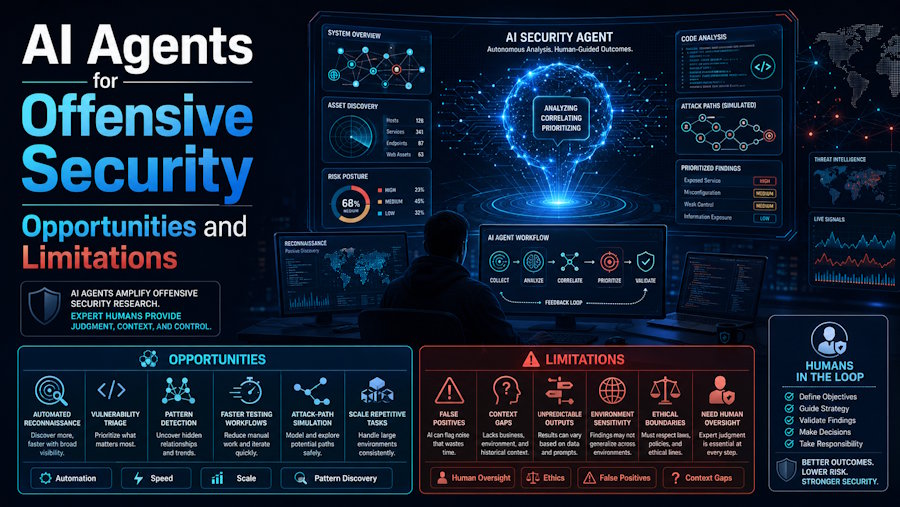
Opportunities and limitations side by side
Looking at strengths or weaknesses independently creates an incomplete picture. Offensive security benefits from both perspectives because every advantage introduces its own operational consideration.
|
Opportunity |
Practical limitation |
|
Reviews large attack surfaces with consistent attention |
Cannot fully understand business intent behind every application |
|
Connects technical findings across multiple systems |
May associate unrelated observations without additional validation |
|
Continues repetitive investigation without losing focus |
Still requires human review before high-impact decisions |
|
Adjusts investigation paths as new evidence appears |
Depends on the quality and completeness of available data |
Viewed together, these characteristics explain why organizations increasingly position AI agents beside experienced offensive security professionals instead of expecting autonomous assessments.
The future belongs to collaborative offensive security
An AI agent can inspect thousands of systems, follow hundreds of investigative paths, and uncover technical relationships that would take days to identify manually.
Yet no model understands an organization's priorities, accepts operational risk, or decides whether a discovered weakness is worth exploiting during a live engagement. Every important finding eventually reaches the same point: a human decision.
That is unlikely to change, even as AI becomes a permanent part of offensive security.

