


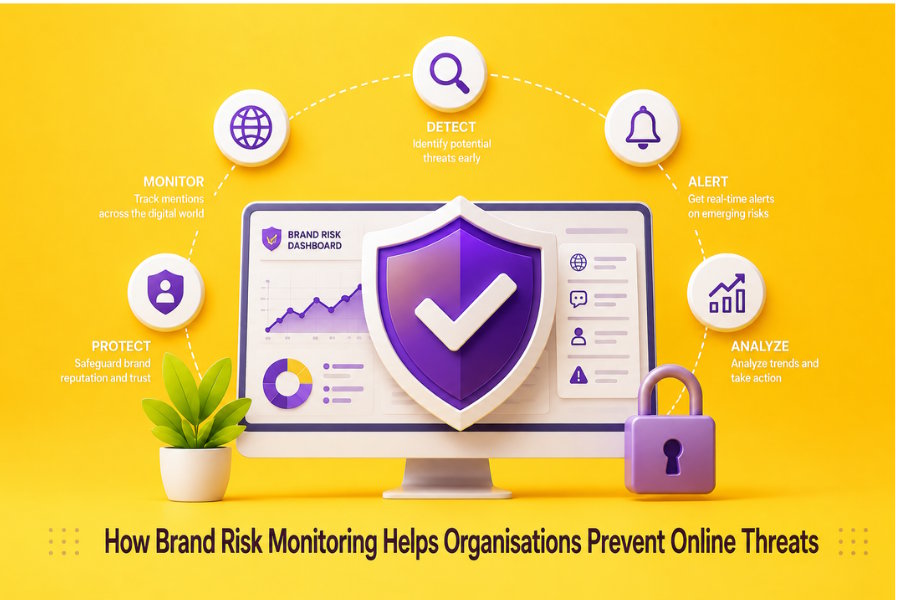
A bank's logo does not stay where the bank puts it. Copy it onto a fake login page, drop it into a WhatsApp forward promising a loan approval, or stitch it onto a fraudulent app icon, and it starts working against the very organisation it was meant to represent. None of this happens inside a firewall, which is precisely why traditional security tooling struggles to see it coming. Brand Risk Monitoring, or BRM, exists to close that gap by watching the open web, social platforms, app stores and dark web forums for the moment a brand's identity is being misused.
Cyber Security and Cyber Resilience Framework mandates from SEBI and comparable expectations from the RBI have pushed BRM from a nice-to-have into something regulated entities are expected to demonstrate. But the more immediate driver is simpler. Fraud built on brand impersonation is getting cheaper to run and harder to spot, and the organisations catching it early are the ones already watching for it.
Why Brand Impersonation Keeps Outpacing Internal Security
Security teams are good at defending what they own. Servers, endpoints, internal networks - all visible, all monitored. A cloned domain registered by someone in another country is not. Neither is a fake customer support handle replying to complaints on social media, or a lookalike app sitting quietly in a third-party store waiting for downloads.
A CERT-In report from 2025 found phishing responsible for 38 percent of reported fintech fraud in India, with fraudsters posing as RBI officials and bank grievance cells. That figure says less about the sophistication of the attackers and more about how much easier brand cloning has become. Generative tools can replicate a bank's tone, colour scheme and page layout within minutes, and the resulting fake rarely needs to fool a security analyst. It only needs to fool a customer scrolling through a search result or clicking a link forwarded by someone they trust.
Detection data from 2025 identified more than 326,000 brand impersonation attempts across 6,279 brands, and separate industry reporting notes that a majority of phishing emails in the first half of 2026 showed signs of AI involvement. Brand Risk Monitoring is built for exactly this pattern of threat: high volume, fast-moving and sitting entirely outside conventional network defences.
What BRM Actually Tracks
A working BRM programme is less a single tool and more a continuous scanning operation stitched into a response process. It needs to know what to look for, where to look, and what to do the moment it finds something.
Coverage spans a few distinct threat surfaces, and it helps to see them as a group before treating them one by one.
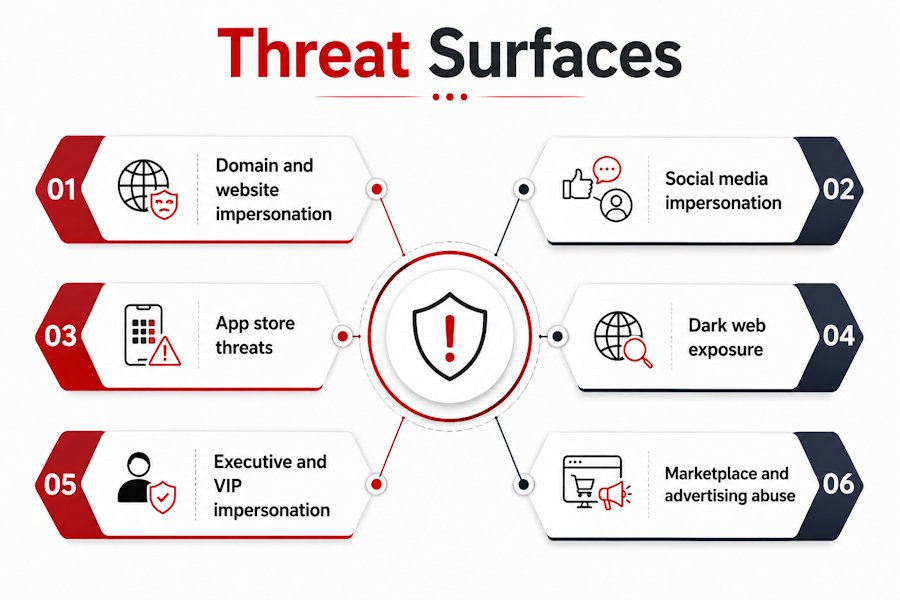
- Domain and website impersonation: Lookalike domains, cloned login pages and fraudulent payment portals registered to mimic a legitimate brand.
- Social media impersonation: Fake profiles, spoofed support accounts and unauthorised pages engaging with genuine customers.
- App store threats: Counterfeit or trojanised apps published under a brand's name across official and third-party stores.
- Dark web exposure: Leaked credentials, internal documents or customer data circulating on forums and marketplaces.
- Executive and VIP impersonation: fake profiles or deepfake content built around senior leaders to manipulate stakeholders or the public.
- Marketplace and advertising abuse: counterfeit listings and malicious ads that hijack a brand's paid search presence.
None of these threats are new individually. What has changed is the speed at which they multiply, and that is the part manual monitoring cannot keep pace with.
From Detection to Takedown
Spotting an impersonation attempt is only half the job. A BRM programme has to move from detection into remediation without losing days to manual escalation, because every hour a fraudulent page stays live is an hour it keeps collecting credentials or payments from unsuspecting customers.
That remediation path usually runs through registrars, hosting providers, app stores and social platforms, each with its own reporting process and timeline. Mature BRM operations pre-build these relationships and escalation templates so a confirmed threat triggers a takedown request immediately rather than after a support ticket works its way through a queue. The difference between a same-day takedown and a week-long one is often the difference between a contained incident and a public one.
Where BRM Fits Alongside Existing Security Investment
BRM does not replace a SOC, a SIEM or a vulnerability management programme. It feeds them. When BRM flags a phishing kit targeting a bank's customers, that intelligence has value for fraud teams tracking account takeover patterns, for the SOC watching for related credential stuffing attempts, and for legal teams preparing enforcement action.
Organisations already running managed detection and response find that BRM data closes a visibility gap their internal tooling was never designed to cover. The two functions overlap in purpose even though they watch entirely different terrain, one inside the perimeter and one well outside it.
For regulated entities in India, this external visibility is increasingly tied to compliance expectations as well as security outcomes. Demonstrating that a brand's external footprint is actively monitored, rather than addressed reactively after a complaint, is becoming part of what auditors and regulators expect to see documented.
Conclusion
Brand impersonation is not slowing down, and the tools attackers use to build convincing fakes are only getting more accessible. Waiting for a customer complaint or a fraud report to surface an impersonation attempt means the damage, financial and reputational, has usually already happened. Brand Risk Monitoring shifts that timeline by putting continuous, structured visibility over the channels where impersonation actually happens.
CyberNX's brand risk monitoring service is built around exactly this kind of continuous external visibility, paired with a takedown process designed to move fast once a threat is confirmed. If your organisation needs a clearer picture of how its brand is being used, and misused, outside its own perimeter, connect with their experts.

