

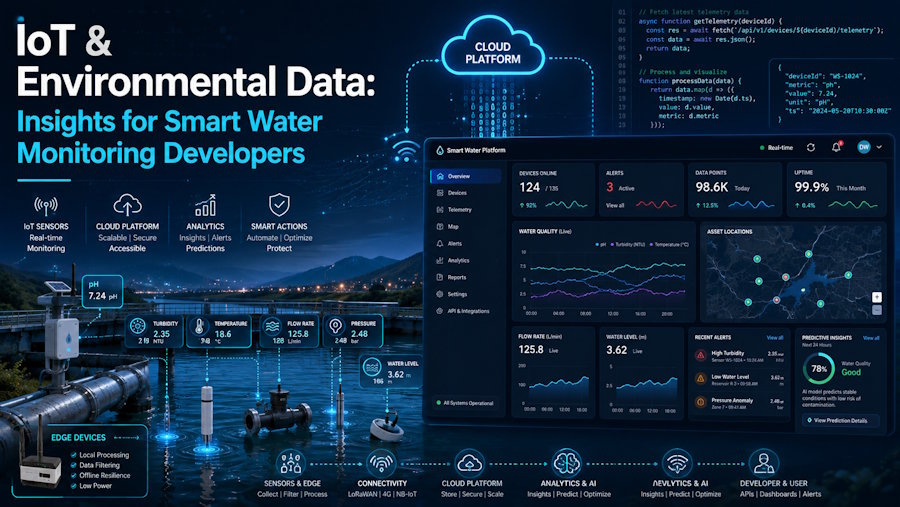
Environmental technology is quickly becoming a software-driven business. Today’s monitoring systems are no longer isolated sensors that take measurements but interconnected ecosystems of embedded hardware, cloud platforms, APIs, databases, and machine learning.
It opens doors for interesting prospects for software developers to construct apps that tackle real-world problems, working with IoT devices, streaming data, and cloud infrastructure. One of the fastest developing applications in this sector is smart water monitoring.
Why developers are jumping into climate tech
Water utilities, industry, towns, and agricultural enterprises are digitizing their infrastructures. Instead of having to check water conditions manually, enterprises now employ linked sensors that continuously send data to cloud services.
With this transition software, programmers are more and more responsible for building:
- Dashboards for real-time monitoring
- Systems for notification and alert
- Data visualisation tools
- Tools for predictive analytics
- Cellular tracking applications
- Portals for device management
- REST APIs to communicate with sensors
Environmental monitoring has now become as much a software problem as a hardware issue.
IoT Monitoring Architecture Design
A typical smart monitoring platform is a collaborative endeavor comprising multiple layers.
Edge Devices
Sensors acquire physical measurements and transmit data to embedded controllers or IoT gateways.
Communication Layer
Sensor readings are delivered securely to cloud services by protocols such as MQTT, LoRaWAN, NB-IoT, Modbus, and HTTP.
Cloud Backend
Cloud systems collect telemetry, store the history, and expose APIs for apps to use.
Application Layer
Web dashboards and mobile apps provide live measurements, historical charts, alarms, and device status.
This architecture enables enterprises to manage thousands of remote devices via one interface.
Efficiently managing sensor data
Environmental sensors offer a growing source of data in the form of time-series data that poses distinct technical issues.
Developers will have to tackle difficulties like the following:
- Data intake in high frequency
- Sensor values missing or corrupted
- Duplicated sends
- Sync Device
- Failures of networks
- Intelligent Indexing in Databases
- Data long term storage
Technologies like InfluxDB, TimescaleDB, Apache Kafka, Redis, or cloud-native telemetry services can dramatically increase scalability for large installations.
Why APIs Matter
Most current monitoring systems expose REST or GraphQL APIs that provide third-party applications access to sensor data.
Usually, developers combine these APIs with:
- Tools for business intelligence: GIS mapping software
- SCADA systems for the industry
- Automated processes
- Mobile applications
- AI analysis engines
A well-designed API brings far more value to environmental data as it enables enterprises to integrate multiple software systems.
Where AI adds value
Artificial intelligence is very useful when sufficient historical data has been collected.
AI models are capable of more than just displaying measurements:
- Identify irregular sensor operation
- Project equipment maintenance requirements
- Detect unusual environmental trends
- Lower false positive alarms
- Use previous datasets to predict future trends
And organisations can be proactive with intelligent predictions instead of being reactive when problems arise.
Still Need Dependable Hardware
No matter how clever the software is, it can’t fix faulty measurements. Data quality begins at the sensor level; therefore, reliable hardware is a key element of any monitoring platform.
Effective water quality monitoring will require not only the measurement of the relevant parameters but also reliable instruments capable of operating continuously in challenging situations. Renkeer is a manufacturer of environmental monitoring equipment. Renkeer provides multiparameter water quality sensors and online monitoring systems to ensure accurate continuous monitoring for a wide range of water management applications.
Developers who are building environmental monitoring platforms can also learn about how AI is transforming water quality monitoring, especially in applications where intelligent analytics and real-time sensing complement each other to improve operational efficiency.
Best Practices for Developers
When developing software for linked environmental systems, developers should look beyond data collection.
The recommended practices are:
- Secure communication between devices and servers.
- Check incoming sensor readings before saving them.
- Add automatic retry for unreliable networks.
- Use versioned APIs for future-proofing.
- Environmental measures to monitor device health.
- Role-based authentication to safeguard the dashboards.
- Develop scalable infrastructure to support thousands of connected devices.
These principles make systems more reliable and easier to maintain as deployments increase.
Environmental Software in the Future
Effective water quality monitoring depends not only on measuring the right parameters but also on using reliable instruments that can operate consistently in demanding environments. As a manufacturer of environmental monitoring equipment, Renkeer offers multiparameter water quality sensors and online monitoring systems designed to support accurate, continuous monitoring for a wide range of water management applications
Edge computing is maturing alongside AI and cloud-native technologies, and environmental monitoring is getting smarter and smarter. Future systems will also analyse more data directly on embedded devices, lowering latency and network bandwidth and enabling speedier decision-making.
For software engineers, this is a burgeoning industry where embedded systems, cloud development, cybersecurity, DevOps and artificial intelligence all converge. Organisations require developers that can construct secure, scalable and intelligent platforms that turn raw environmental data into meaningful insights.
The next generation of environmental monitoring will involve not only better sensors but also better software. Developers are key to the development of systems to collect, process, analyse and visualise environmental information in real time.
With strong cloud architecture, clever analytics, secure APIs, and dependable sensing hardware, modern monitoring solutions can provide actionable information for smarter water management, enhanced sustainability, and greater operational efficiency across sectors.
Conclusions
The next phase of environmental monitoring will involve not just better sensors but better software. Developers are key to building systems that collect, process, analyse, and visualise environmental information in real time.
Modern monitoring platforms integrate robust cloud infrastructures, sophisticated analytics, secure APIs, and dependable sensing hardware to give actionable data that drive smarter water management, enhance sustainability, and increase operational efficiency across a range of industries.

