

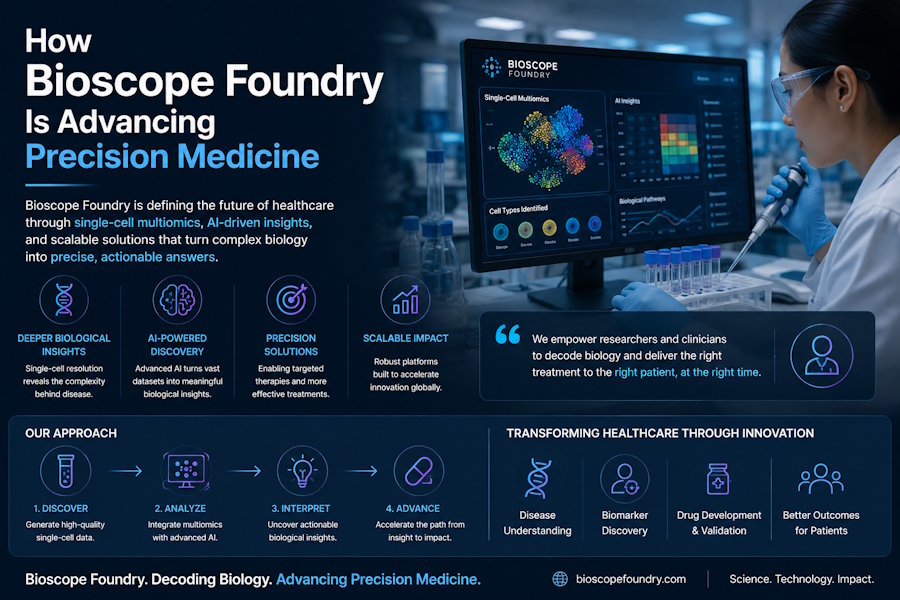
Healthcare is becoming more personalised, connected and data-driven. Physicians now have access to information from genomic testing, laboratory results, biomarkers, medical records, medications and other sources. This information can offer valuable context, but managing it can be difficult when it is spread across different systems.
This is where Bioscope Foundry can be viewed as part of a wider movement towards better precision medicine technology.
The idea behind a modern healthcare technology foundry is simple: bring together scientific knowledge, data, software and clinical expertise to develop useful tools for healthcare professionals. Bioscope.ai's broader platform focuses on connecting complex patient information and using AI-supported workflows to help physicians explore that information in a more structured way.
The opportunity is not simply about collecting more health data. It is about making existing information easier to understand, connect and review.
What Is Bioscope Foundry?
Bioscope Foundry can be understood within the broader Bioscope approach to building technology for precision medicine and personalised healthcare.
Modern medicine generates huge amounts of information. Genomic sequencing can produce extensive genetic data. Laboratory testing creates regular measurements. Electronic health records contain years of medical history. Medication records add another layer of information.
When these sources remain separate, physicians may have to spend considerable time bringing the information together.
A technology-led approach can help create a more connected view.
Bioscope.ai describes its precision medicine platform as bringing together genomics, laboratory data, microbiome insights, medications and patient history within an AI-supported clinical workflow.
This type of connected architecture provides a foundation for exploring more personalised approaches to healthcare.
Why Precision Medicine Needs Innovation
Precision medicine is based on the understanding that patients are not identical.
Two people can have similar symptoms but very different genetic backgrounds, medical histories, laboratory results and responses to treatment. This means that a broader view of patient information can be useful when considering clinical questions.
However, more data does not automatically mean better care.
The real challenge is turning complex data into information that physicians can review efficiently.
This is where Bioscope Foundry fits into the larger healthcare innovation picture. The focus is on developing technology that can help organise and connect information rather than leaving physicians to work through disconnected reports.
Connecting Genomics With Clinical Information
Genomic data is one of the most promising areas of precision medicine.
Modern sequencing can reveal a large amount of information about an individual's genetic profile. Yet raw genetic data is not automatically meaningful for every clinical situation.
Physicians need context.
A genomic finding may need to be considered alongside the patient's medical history, laboratory results, medications, symptoms and other relevant information.
Bioscope.ai describes its platform as bringing genomic information together with other patient data to create a more complete clinical view.
This connected model is important because precision medicine is rarely about one data point.
It is about understanding how different pieces of information fit together.
The Growing Role of Artificial Intelligence
Artificial intelligence is becoming increasingly important in healthcare technology.
AI can help process large datasets and organise information in ways that may be easier for professionals to review.
Bioscope.ai has described AI-supported tools that can help physicians explore patient information, including genomic, biomarker, microbiome and historical data.
Within a broader Bioscope Foundry approach, this highlights an important principle: AI can act as a tool for managing complexity.
For example, instead of manually searching through multiple records, a physician may be able to use an AI-supported interface to explore a particular question.
The physician can then review the information and decide what is relevant.
AI should therefore be viewed as a support layer rather than an independent replacement for clinical expertise.
Turning Complex Data Into Clinical Context
One of the biggest problems in modern healthcare is information overload.
A physician may have access to hundreds or thousands of individual data points. The challenge is knowing which ones matter for the patient sitting in front of them.
A precision medicine platform can help organise this information.
Bioscope.ai's public materials describe a connected patient view involving genomics, microbiome information, biomarkers, medications and previous medical records.
This approach can help physicians move from isolated data points towards a more complete patient context.
That distinction matters.
The goal is not to make decisions simply because software identifies a pattern. The goal is to give clinicians better-organised information that they can assess using their professional knowledge.
Supporting Physician-Led Healthcare
Technology works best when it supports the people using it.
In healthcare, that means keeping physicians involved in the decision-making process.
A platform such as Bioscope Foundry should therefore be considered as part of a physician-led model. Technology can help collect, organise and present information, while healthcare professionals remain responsible for evaluating that information.
This is particularly important when dealing with genomic data.
Genetic findings can be complex. Some findings may have uncertain significance, while others may only become meaningful when considered alongside additional clinical information.
Human review remains essential.
Building Better Patient Workflows
Healthcare technology should fit naturally into clinical work.
If a new platform adds another complicated system, it may create more work instead of reducing it.
A strong precision medicine workflow should make it easier to prepare for appointments, review patient information and explore relevant questions.
Bioscope.ai describes features designed around this type of workflow, including patient data synthesis, clinical dashboards and AI-supported exploration.
This type of approach can help create a more organised starting point for clinical review.
The benefit is not simply speed. It is also about reducing fragmentation.
A Connected View of Patient Health
A patient is more than a single test result.
Genomics can provide one layer of information. Laboratory results can provide another. Medical history, medications, microbiome information and lifestyle factors can add further context.
When these sources can be viewed together, physicians may have a broader understanding of the patient.
This is one of the most important ideas behind modern precision medicine.
Bioscope Foundry represents the kind of technology development approach that can bring different healthcare data sources into a connected environment.
The aim is to make information more useful rather than simply increasing the amount of information available.
The Importance of Evidence
Healthcare technology must be built around reliable evidence.
This is especially important when artificial intelligence is involved.
Physicians should be able to understand where information comes from and assess whether it is relevant to a particular patient.
Bioscope.ai has highlighted evidence-linked clinical insights as part of its platform approach.
This can help users investigate the basis of information rather than treating an AI-generated response as automatically correct.
Evidence and transparency are important safeguards in any clinical technology workflow.
Genomic Data and Personalised Care
Genomics has an important role in personalised medicine, but it should not be viewed in isolation.
A person's genetic profile is only one part of their health picture.
Environmental factors, lifestyle, age, medical history and current health status can all influence healthcare decisions.
This is why connected precision medicine platforms are becoming increasingly interesting.
By combining multiple sources of information, technology can help physicians consider a wider context.
The role of Bioscope Foundry in this landscape is therefore linked to the development of technology that can make complex health information more accessible and practical.
Where Pharmacogenomics Fits
Pharmacogenomics is another important area within personalised healthcare.
Genetic differences can influence how some individuals respond to particular medicines. In appropriate clinical situations, genetic information may therefore provide useful context when considering medication-related questions.
However, genetic information should not automatically be interpreted as a direct instruction to change treatment.
Physicians need to consider the complete patient profile and relevant clinical evidence.
A connected technology platform can help organise the information, but the final interpretation belongs within appropriate clinical practice.
The Importance of Data Quality
No technology can completely overcome poor-quality data.
Precision medicine platforms depend on accurate and relevant information.
Healthcare organisations considering this type of technology should therefore ask important questions:
- Where does the data come from?
- How is information validated?
- How often is it updated?
- Can physicians review the source?
- How are uncertain findings presented?
- How is patient information protected?
- Can the platform fit existing clinical workflows?
These questions are just as important as the AI capabilities of the platform.
Good technology needs good data.
Privacy and Security
Precision medicine involves highly sensitive information.
Genomic information, medical records, laboratory results and medication histories all require appropriate protection.
Any healthcare technology platform should therefore be assessed for data security and privacy controls.
Organisations should consider areas such as access management, authentication, secure storage, data handling and applicable privacy requirements.
Trust is essential.
Patients and physicians need confidence that sensitive information is being handled responsibly.
Understanding FDA Software Regulation
Healthcare software can have different regulatory responsibilities depending on what it does and how it is intended to be used.
The FDA's current Clinical Decision Support Software guidance, issued in January 2026, explains criteria for certain clinical decision support software functions to qualify for the statutory non-device CDS exclusion. It also explains that other software functions can continue to meet the definition of a medical device and remain subject to FDA oversight.
This is particularly relevant when discussing AI-based healthcare technology.
A product should not be described as FDA-approved, FDA-cleared or exempt from regulation without confirming the specific product, function and intended use.
The FDA also states that its CDS guidance should not be used as the only reference when determining whether a software function meets the definition of a medical device. Other digital health policies may apply.
For that reason, healthcare technology companies should make product claims carefully and ensure that marketing language matches the product's actual intended use.
What the Future Could Look Like
The future of precision medicine is likely to involve more connected data.
Genomics, biomarkers, laboratory information, medical records and other health information can each provide useful insights. The challenge is bringing these sources together in a practical way.
AI may become increasingly useful for organising and exploring this information.
A platform development model such as Bioscope Foundry reflects this broader direction. It points towards healthcare technology that combines data, software and scientific knowledge to support more personalised workflows.
The most valuable systems will not necessarily be those that produce the most information.
They will be the systems that help physicians understand relevant information more clearly.
Final Thoughts
Bioscope Foundry represents an interesting concept within the wider development of precision medicine technology.
The future of personalised healthcare will depend on more than genomic sequencing or artificial intelligence alone. It will require reliable data, strong evidence, thoughtful software design and effective clinical workflows.
By connecting different types of patient information, precision medicine technology can help physicians explore a more complete view of individual health.
AI can help organise complex information. Genomic data can add another layer of patient context. Clinical records can provide history and biomarkers can show important trends.
But technology should support, not replace, professional judgement.
The FDA's current guidance also highlights why intended use and specific software functions matter when assessing the regulatory position of clinical decision support technology.
Ultimately, the future of precision medicine is not simply about having more data.
It is about making the right information easier to understand, connect and review.
That is where the next generation of healthcare technology has the potential to make a meaningful difference.

