

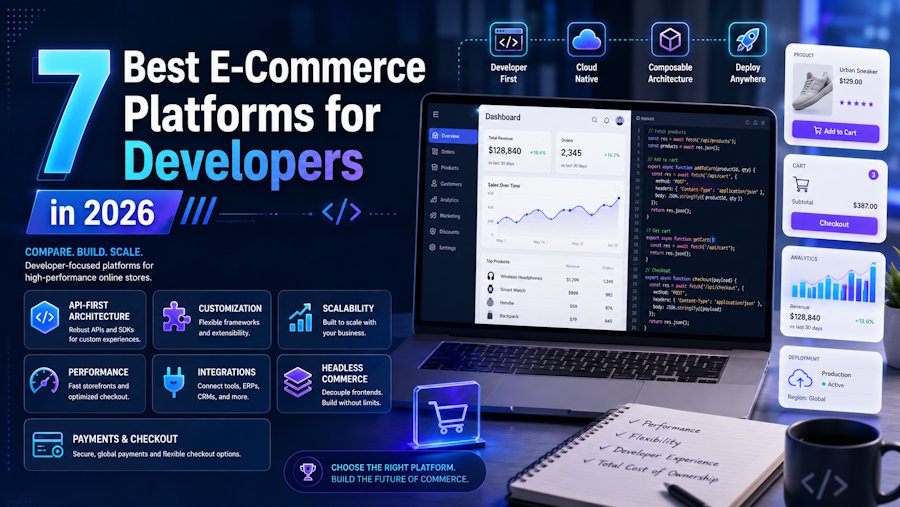
Launching an online store is no longer simply a matter of choosing the platform with the best-looking templates. Developers and technical teams must also evaluate APIs, hosting, performance, security, payment integrations, customization, data portability, and long-term scalability.
The right choice depends on the project. A small retailer may benefit from a managed platform that handles infrastructure automatically, while a growing technology company may need a headless architecture and complete control over its storefront.
Here are seven e-commerce platforms worth considering in 2026.
1. Shopify: Best All-Around E-Commerce Platform
Shopify combines managed hosting, inventory management, secure checkout, payment processing, analytics, and a large marketplace of third-party apps. A nontechnical store owner can launch with a ready-made theme, while developers can build custom themes, private apps, integrations, and headless storefronts.
Its APIs and webhooks make it possible to connect external inventory systems, customer relationship management tools, analytics platforms, and fulfillment services. Shopify also manages updates, hosting, security patches, and much of the infrastructure required to keep a store available.
That convenience has tradeoffs. Monthly app subscriptions can increase the total cost, and some functionality requires working within Shopify’s platform rules. Businesses with highly specialized checkout or data requirements may eventually encounter limitations.
2. WooCommerce: Best for WordPress Developers
WooCommerce is an open-source WordPress plugin that transforms a standard website into a customizable online store. It is especially attractive to developers already familiar with PHP, WordPress themes, plugins, hooks, and database management.
Businesses retain control over their hosting and store data. Developers can customize product pages, checkout behavior, shipping rules, and integrations without being restricted to a fully managed platform. WooCommerce also benefits from the enormous WordPress ecosystem.
However, flexibility creates additional responsibility. The site owner must manage hosting, backups, performance, security, updates, and plugin compatibility. A poorly configured extension or inadequate hosting plan can create reliability problems. WooCommerce is therefore best suited to teams prepared to maintain the technical environment.
3. Wix: Best for Fast No-Code Stores
Wix is a practical option for small businesses that prioritize ease of use over advanced development control. Its visual editor allows users to build pages, manage products, accept payments, and configure basic marketing features without writing code.
Hosting, security, templates, and software updates are included. This reduces the time required to move from an idea to a functioning store. Wix also supports additional functionality through its app marketplace and development tools.
The main limitation is portability. A business can customize its store within Wix, but it does not receive the same infrastructure control available from open-source platforms. This shopify vs wix comparison explains how the platforms differ in selling features, customization, usability, and scalability.
4. BigCommerce: Best for Headless Commerce
BigCommerce provides a managed e-commerce back end while supporting both traditional and headless storefronts. Developers can use its APIs to connect a custom front end built with frameworks such as Next.js, React, or Vue.
This separation allows teams to create unique customer experiences without rebuilding essential commerce functions such as catalog management, checkout, and order processing. BigCommerce also includes several features that require paid apps on competing platforms.
It is particularly suitable for large catalogs, business-to-business selling, multi-channel commerce, and companies that need more built-in functionality. Smaller businesses may find its interface and configuration options more complex than necessary.
5. Medusa: Best JavaScript-Based Open-Source Option
Medusa is a modular, open-source commerce platform aimed at developers who want to create custom shopping experiences. It provides commerce services for products, carts, orders, customers, and payments while allowing the development team to choose its preferred storefront technology.
A JavaScript-focused team can use Medusa as the foundation for a custom store, marketplace, subscription service, or specialized commerce application. Its modular approach can be more adaptable than modifying a platform designed around a standard retail workflow.
Medusa is not the easiest option for beginners. Hosting, deployment, integrations, monitoring, and maintenance require technical knowledge. It makes the most sense when control and extensibility are more important than immediate no-code convenience.
6. Squarespace Commerce: Best for Simple Product Catalogs
Squarespace Commerce works well for creators, consultants, restaurants, and service businesses selling a relatively small selection of products. Its strongest advantage is design consistency. Templates are polished, responsive, and easy to customize through a visual interface.
The platform also includes hosting, analytics, inventory tools, payments, and basic marketing features. It is less suitable for stores requiring complex product configuration, extensive third-party integrations, or heavily customized development workflows.
7. Shopware: Best for Custom Commerce Projects
Shopware provides an open-source foundation, API-driven architecture, and extensive customization options. Developers can create custom storefronts, extensions, business rules, and integrations while maintaining more control over the commerce stack.
Its architecture makes it a strong candidate for companies with unusual workflows, international operations, or requirements that packaged website builders cannot easily support. Shopware can also be used in headless implementations.
The platform requires more setup and technical expertise than a hosted builder. Teams should account for infrastructure, development, testing, upgrades, and ongoing maintenance before adopting it.
Which E-Commerce Platform Should You Choose?
Shopify remains the easiest all-around choice for businesses wanting a managed system with a mature ecosystem. Wix and Squarespace are approachable options for smaller stores, while WooCommerce offers greater ownership to WordPress users.
Development teams seeking deeper control should evaluate BigCommerce, Medusa, Shopware, and other shopify alternatives before committing to one platform.
The best choice is not necessarily the platform with the longest feature list. It is the one that matches the team’s technical resources, business model, customization requirements, and expected growth.

