

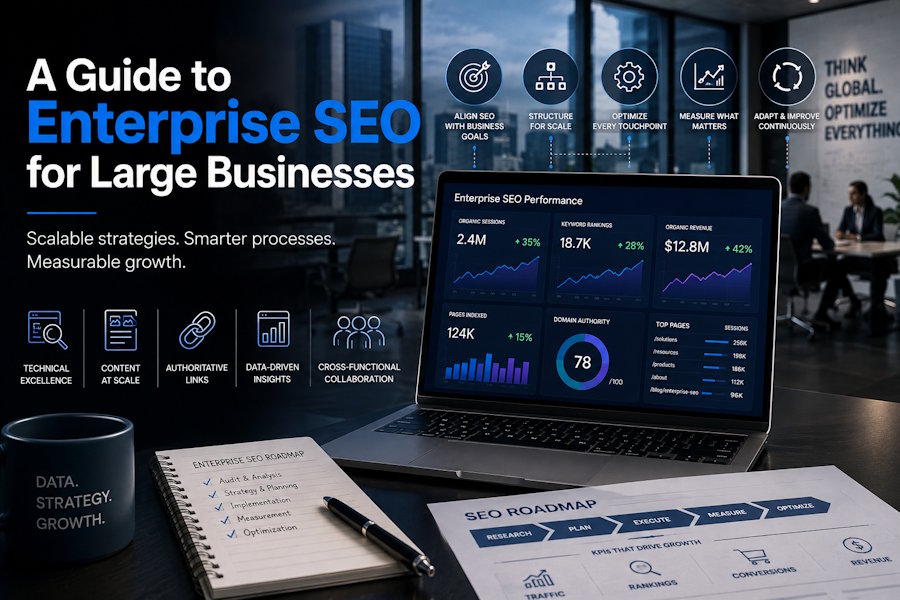
What Large Brands Should Expect from Enterprise SEO
Large brands rarely have simple websites. Multiple product categories, locations, markets, content teams, and technical systems can create an SEO environment where even small issues become difficult to manage. Working with an Enterprise SEO Company should therefore involve more than routine keyword optimisation. Large organisations need a structured approach that connects technical performance, content, governance, data, and business objectives while remaining flexible enough to support continued growth.
Key Takeaways
- Enterprise SEO should support wider business objectives.
- Large websites require scalable technical processes.
- SEO governance keeps multiple teams aligned.
- Content needs strategic management across thousands of pages.
- Data should lead to actionable decisions.
- Automation can improve efficiency when combined with human oversight.
- Reporting should connect search performance with business outcomes.
- Enterprise SEO requires continuous optimisation rather than one-time fixes.
A Strategy Built Around Business Priorities
Large brands often have several objectives at the same time. One market may be focused on customer acquisition, while another may prioritise product visibility or expansion into a new region.
From Business Goals to Search Opportunities
Objectives such as increasing revenue, entering new markets, generating qualified leads, or strengthening brand visibility can be translated into specific SEO opportunities. This helps teams prioritise work according to commercial importance.
A Strategy That Can Adapt
Enterprise strategies should not remain fixed for years. Changes in products, competitors, customer behaviour, technology, and search trends may require priorities to be reassessed regularly.
A Thorough Understanding of the Website
An enterprise website can contain thousands or even millions of URLs across different categories, products, locations, and content types. Understanding this environment requires more than reviewing a handful of important pages.
Mapping the Website Ecosystem
The assessment should consider the website architecture, CMS, templates, subdomains, product structures, location pages, and supporting content. This provides a clearer picture of how search engines and users navigate the site.
Finding Hidden Opportunities
Large websites may contain valuable pages that receive little organic visibility. Orphan pages, outdated resources, content gaps, weak internal links, and indexation problems can all represent opportunities for improvement.
| Website Area | What Should Be Examined |
|---|---|
| Architecture | Page hierarchy and navigation |
| Content | Quality and search intent |
| Technical layer | Crawling and indexation |
| Internal links | Page relationships |
| Templates | Repeated SEO elements |
Strong Technical SEO at Scale
Technical SEO becomes increasingly important as website size increases. A single problem affecting a template or CMS configuration can potentially appear across hundreds or thousands of pages.
Crawl and Indexation Control
Enterprise websites can generate unnecessary URLs through parameters, filters, duplicate versions, and faceted navigation. Managing these elements helps search engines focus their resources on important pages.
Website Performance
Technical reviews should also consider mobile performance, Core Web Vitals, redirects, JavaScript, structured data, and other elements that influence accessibility and search performance.
Key areas include:
- Crawlability
- Indexation
- Site architecture
- Core Web Vitals
- Redirect management
- Structured data
- Mobile performance
Clear SEO Governance Across Departments
When only one person manages a website, maintaining SEO consistency is relatively straightforward. Large brands often have developers, content writers, product teams, marketers, regional teams, and external partners making changes simultaneously.
Establish Consistent Standards
SEO guidelines can cover URLs, metadata, redirects, internal links, content templates, headings, and other recurring website elements. Standardisation makes optimisation easier to maintain across departments.
Assign Responsibility
Teams should understand who recommends changes, who approves them, who implements them, and who monitors their impact. Clear ownership reduces delays and prevents important SEO tasks from being overlooked.
A practical model is:
Define → Assign → Implement → Monitor → Improve
Content Management That Works Across Thousands of Pages
Large brands often have extensive content libraries built over many years. Some pages may remain valuable, while others become outdated, overlap with newer content, or no longer match user expectations.
Identify What Deserves Investment
Pages can be prioritised based on business importance, organic performance, search demand, conversion potential, and customer value. This allows teams to focus resources where improvements are most likely to matter.
Reduce Overlap and Cannibalisation
Similar pages can compete for the same search intent and make it harder for search engines to determine which URL should rank. Content audits can help identify opportunities to consolidate, differentiate, update, or redirect overlapping resources.
Important content priorities include:
- Search intent
- Originality
- Accuracy
- Expertise
- Content freshness
- Commercial relevance
Integration with Development and Marketing Teams
SEO cannot operate successfully in isolation on an enterprise website. Website migrations, redesigns, CMS changes, new templates, and marketing campaigns can all influence organic performance.
For brands operating across multiple locations, Local SEO can also support regional visibility while keeping local search efforts aligned with the wider enterprise strategy.
SEO Within Development Workflows
SEO professionals should be involved early in major technical projects. This can help teams address redirects, URL structures, indexation, site architecture, page performance, and other search considerations before launch.
Collaboration Across Marketing
SEO insights can also support paid search, content marketing, branding, and customer acquisition activities. Sharing search and audience insights can help different teams create more consistent digital experiences.
Advanced Data and Competitor Intelligence
Large brands generate substantial amounts of search data. The challenge is not collecting information but determining which findings deserve attention.
Identify Competitive Movements
Competitor analysis can reveal changes in search visibility, content coverage, market positioning, and emerging opportunities. Monitoring these movements can help businesses identify areas where their strategy needs adjustment.
Turn Data into Action
Data becomes useful when it leads to a clear recommendation. Teams should be able to understand what has changed, why it matters, what should happen next, and how the potential impact will be measured.
Automation with Strategic Human Oversight
Managing a large website manually can consume significant resources. Automation can make monitoring and analysis more efficient by processing large amounts of information and identifying recurring patterns.
However, automation should support strategic decision-making rather than replace it.
Automate Repetitive Processes
Businesses can use automation to monitor broken links, technical issues, metadata inconsistencies, indexation patterns, and changes in organic performance. This can reduce time spent on repetitive checks.
Keep Decisions Human
Not every automated alert represents a serious SEO problem. Experienced professionals need to assess context, business priorities, brand requirements, and potential risks before recommending action.
Reporting That Executives Can Understand
Enterprise SEO reporting should serve more than SEO specialists. Marketing leaders and senior management need to understand how organic search contributes to broader business performance.
Connect SEO with Business Outcomes
Useful measurements can include organic visibility, qualified traffic, leads, conversions, customer acquisition, and revenue. The most appropriate metrics depend on the organisation's objectives.
Provide Actionable Reporting
A useful report should explain what was completed, what changed, what is working, what needs attention, and what the next priorities will be.
| Metric | Business Question |
|---|---|
| Organic visibility | Are we reaching more searches? |
| Qualified traffic | Are we attracting the right audience? |
| Leads | Are visitors showing interest? |
| Conversions | Is SEO supporting growth? |
| Revenue | What commercial value is being generated? |
Continuous Optimisation, Not a One-Time Project
Enterprise SEO should not end when an initial audit has been completed. Search algorithms, competitors, customer expectations, website technology, and business priorities continue to change.
Test and Refine
SEO initiatives should be measured after implementation. Performance data can reveal which changes are producing value and where further improvements may be required.
Prepare for Future Growth
A scalable strategy should accommodate new products, locations, markets, website sections, and technological developments. Planning for these changes early can prevent unnecessary technical and content problems later.
A sustainable cycle is:
Analyse → Prioritise → Implement → Measure → Refine → Scale
Final Takeaway
Large brands should expect enterprise SEO to be strategic, scalable, collaborative, and measurable. It should address far more than keywords and rankings by bringing together technical SEO, content management, governance, data analysis, automation, and cross-team coordination.
SEOCompany.me helps businesses address complex SEO requirements with structured strategies focused on scalability, search visibility, and measurable business outcomes.
Explore Enterprise SEO Opportunities
Explore SEOCompany.me to discover how a structured enterprise SEO approach can help large brands manage website complexity, strengthen search visibility, and create scalable organic growth.
Frequently Asked Questions
1. What should large brands expect from enterprise SEO?
Large brands should expect strategic planning, technical optimisation, content management, governance, performance reporting, and continuous improvement. The approach should be designed to manage the complexity of large websites while supporting business objectives.
2. Why does enterprise SEO require a different approach?
Enterprise websites often contain thousands of pages and involve multiple teams, markets, technologies, and content systems. This scale makes governance, automation, technical management, and coordinated optimisation more important.
3. How does enterprise SEO support large websites?
Enterprise SEO creates scalable processes for managing technical performance, content, internal linking, indexation, and search visibility. It also helps teams prioritise improvements based on potential business impact.
4. What should enterprise SEO reporting include?
Reporting should cover relevant visibility and performance indicators such as organic traffic, qualified visitors, leads, conversions, and revenue. It should also explain completed work, challenges, opportunities, and upcoming priorities.
5. How long does enterprise SEO take to produce results?
The timeframe varies according to website condition, competition, industry, implementation speed, and the scale of required changes. Because enterprise SEO involves continuous optimisation, businesses should evaluate progress by tracking performance trends rather than expecting a single, fixed result.

