

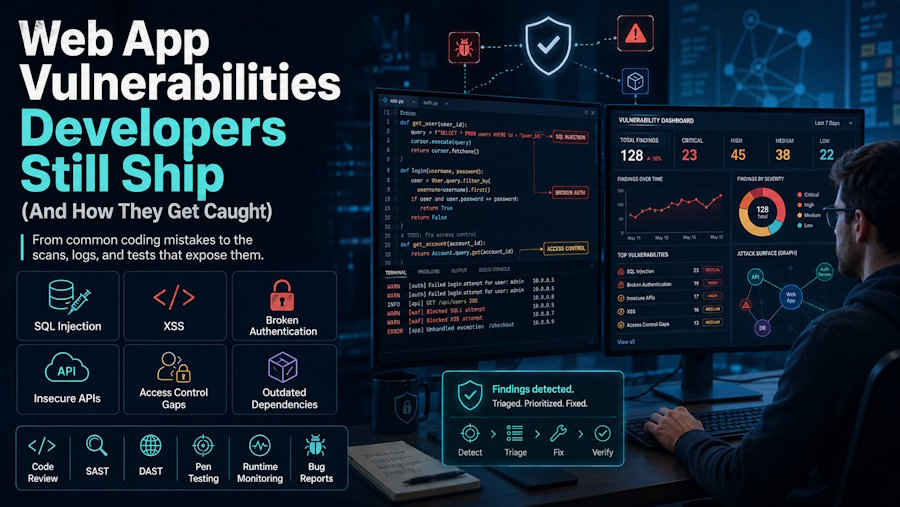
Software has never been better tested, yet exploitable bugs keep reaching production. Verizon's 2026 Data Breach Investigations Report found that 31% of breaches now begin with the exploitation of a software vulnerability, which for the first time overtook stolen credentials as the most common way in. The flaws behind those numbers are rarely exotic. Most are well-understood classes that mature teams still ship under deadline pressure.
Each of these vulnerabilities has a known shape, a known impact, and a known way to catch it. What follows is a tour of the ones still slipping through in 2026, and how disciplined teams find them first.
Why Mature Teams Still Ship Vulnerabilities
This is not a story about careless developers. Vulnerabilities survive because software is complex, deadlines are real, and security context often lives outside the code. A function can be perfectly written and still be insecure if it trusts the wrong input or assumes an earlier step already checked permissions. Frameworks hide risky defaults, third-party code arrives unread, and the rules a business cares about are seldom written down where an engineer can see them. The flaws below persist for structural reasons, not personal ones.
Broken Access Control, IDOR, and BOLA
Broken access control is the top category in the OWASP Top 10:2025, and it usually enters quietly. A developer builds a feature that loads a record by its identifier and assumes the user is only ever asking for their own. Change that identifier in the request and the server hands back someone else's data, a pattern known as insecure direct object reference (IDOR), or broken object level authorization (BOLA) in an API. An attacker gains other users' records, and at scale, entire databases. Automated scanners miss it because they cannot know which records a given user should see, so it is caught mainly through manual testing with multiple accounts and targeted code review of authorization logic. The fix is to enforce authorization on the server for every object, deny by default, and never trust an identifier supplied by the client.
Authentication and Session Management Failures
These failures creep in when teams build login flows by hand or bolt authentication onto an older system. Weak password handling, sessions that never expire, tokens that are easy to guess, and missing multi-factor authentication all open the door to account takeover. An attacker who succeeds can impersonate real users or administrators. Dynamic testing catches some cases, but logic gaps show up through manual review. Prevention means leaning on proven identity libraries and standards such as OAuth and OpenID Connect, enforcing multi-factor authentication, setting secure cookie flags, and keeping sessions short-lived.
Injection Is Still Not Dead
Injection, which covers SQL injection, command injection, and cross-site scripting, has been on every security list for two decades and still ships. It is introduced whenever untrusted input is mixed directly into a database query, a system command, or a page of markup. The payoff for an attacker ranges from reading and altering data to running commands or hijacking other users' browser sessions. Static analysis (SAST) and dynamic analysis (DAST) both catch many cases, backed by code review. The durable fixes are old but reliable: parameterized queries, output encoding, and strict allow-list validation of input.
Server-Side Request Forgery (SSRF)
SSRF, now folded into the broken access control category in the 2025 OWASP list, appears wherever a server fetches a URL that a user supplied. Import-from-link features and webhooks are classic sources. If the destination is not validated, an attacker can make the server reach internal systems or a cloud provider's metadata service, turning a harmless-looking feature into a pivot into the network. It is found through manual testing and review of any code that makes outbound requests. Prevention is to allow-list permitted destinations, block requests to internal address ranges, and lock down access to cloud metadata endpoints.
API Authorization Weaknesses
Modern applications are mostly APIs, and APIs expose objects and actions directly to clients. Broken object level authorization is the number one item on the OWASP API Security Top 10, and it enters when a service assumes clients will only ever send legitimate requests. An attacker enumerates identifiers and reaches other tenants' data, a serious problem in multi-customer platforms. Scanners struggle with multi-tenant context, so detection relies on manual testing with several roles and accounts. The prevention is unchanged: check authorization on the server for every request, and test each role against endpoints it should not reach.
Business-Logic and Workflow Abuse
Some of the most damaging flaws break no technical rule at all. The code runs exactly as written, but the workflow can be abused: applying a discount code repeatedly, skipping a payment step, or firing two requests at the same instant so a balance check passes twice, a race condition. Attackers turn these into free goods, drained accounts, or bypassed limits. Automated tools have no concept of the intended business rules, so these are found almost entirely through threat modeling and manual testing. Prevention means enforcing limits and state on the server, using locking or idempotency to handle simultaneous requests, and modeling abuse cases during design.
Exposed Secrets and Insecure Cloud Configurations
Secrets leak when an API key or password is committed to a repository, and cloud data is exposed when a storage bucket or database is left open or granted over-broad permissions. Attackers actively scan public code and cloud ranges for exactly this. The good news is that these are among the most automatable to catch, through secret scanning, software composition analysis, and cloud posture checks, reinforced by review of infrastructure-as-code. Prevention is to keep secrets in a dedicated manager, apply least privilege to every cloud role, and rotate any credential that may have been exposed.
Dependency and Software Supply-Chain Risk
Most applications are mostly other people's code. Software Supply Chain Failures rose to the number three slot in the OWASP Top 10:2025, reflecting how often risk arrives through a dependency, either a package with a known vulnerability or, occasionally, one that has been deliberately poisoned. An attacker exploits the known flaw or rides the compromised component straight into your build. Software composition analysis and a software bill of materials (SBOM) surface these. Prevention is to pin and verify versions, monitor advisories, and keep the dependency footprint as small as the product allows.
Why Automated Scanners Miss Contextual Vulnerabilities
Scanners are pattern matchers, and they are genuinely good at their job. They spot injection strings, outdated versions, and missing headers at a speed no human can match. What they cannot do is reason about intent. A scanner does not know that this user should not see that invoice, or that this three-step checkout can be short-circuited, because those rules exist only in the heads of the people who designed the product.
That blind spot is where human-led testing earns its place. Looking at what penetration testing services add beyond automated scans, chaining real weaknesses together, proving genuine business impact, and confirming that fixes hold, clarifies why serious teams pair tools with expert review instead of choosing one or the other. Tools give you breadth and speed; people give you judgment about context.
How the Testing Methods Fit Together
No single technique covers everything, which is why the strongest programs layer them. Each method answers a different question, and the gaps in one are covered by another.
- SAST reads source code for risky patterns early, before anything is deployed.
- DAST exercises the running application to find issues visible only in behavior.
- Software composition analysis surfaces vulnerable and outdated dependencies.
- Code review and threat modeling apply human reasoning to logic and design.
- Manual penetration testing chains weaknesses together and probes business logic.
Used together, these give both the breadth that automation is good at and the depth that only a person following an attacker's train of thought can provide.
How to Build Security In Without Blocking Releases
Security fails when it becomes a gate that stops shipping, so the goal is to make it a default instead. Fast automated checks such as static analysis, dependency scanning, and secret detection belong in the pipeline, where they run on every change and rarely slow anyone down. Slower, higher-value work is applied by risk: threat modeling for sensitive features, dynamic testing in staging, and periodic manual penetration tests before major releases.
When internal review needs an outside perspective, many teams schedule independent testing on a regular cadence. Comparing providers, including a shortlist of penetration testing services us, helps match expertise to your specific stack, though any such list is only a starting point for a real evaluation. Fix the critical findings, triage the rest by risk, and keep releases moving.
The Takeaway
The vulnerabilities reaching production in 2026 are mostly ones the industry has understood for years. They survive because they hide in context, in authorization decisions, business rules, and trusted dependencies that no scanner can fully reason about. Teams that pair automated coverage with human judgment, and treat security as part of how software ships, catch them first.
About The Author
Mohammed Khalil is a Cybersecurity Architect at DeepStrike, specializing in advanced penetration testing and offensive security operations. With certifications including CISSP, OSCP, and OSWE, he has led numerous red team engagements for Fortune 500 companies, focusing on cloud security, application vulnerabilities, and adversary emulation. His work involves dissecting complex attack chains and developing resilient defense strategies for clients in the finance, healthcare, and technology sectors.

