

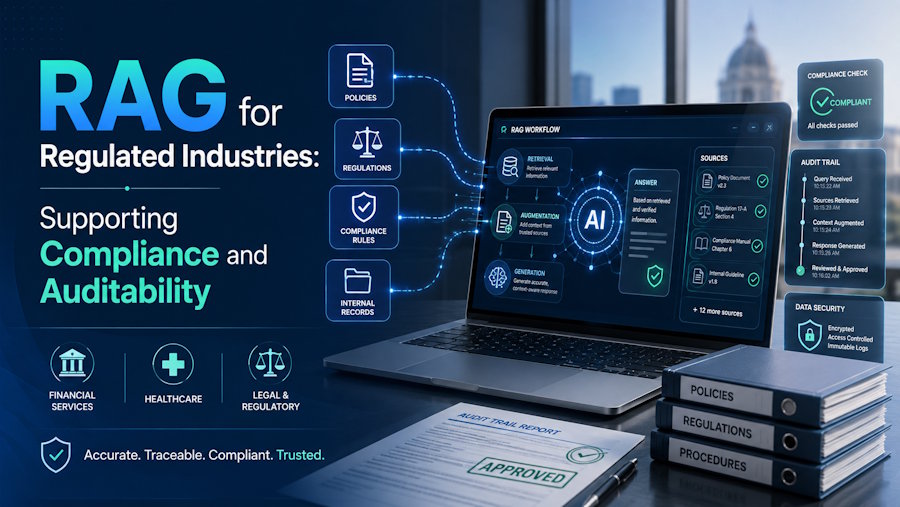
A compliance officer at a mid-size bank asks an AI assistant a question about a new lending disclosure rule. The answer sounds confident. It's also six months out of date, and nobody in the room can tell where it came from. That's the moment most regulated companies stop experimenting with generative AI and start asking a harder question: how do we get the speed of an LLM without losing the paper trail our auditors require?
Retrieval-augmented generation, or RAG, exists to answer exactly that question. Instead of relying on what a language model memorized during training, a RAG system looks up your actual policies, filings, or clinical guidelines at the moment someone asks, then generates an answer grounded in those retrieved documents, with a citation attached. According to a 2025 market analysis from MarketsandMarkets, BFSI (banking, financial services, and insurance) and healthcare are the two sectors leading enterprise RAG adoption, specifically to cut hallucinations, unlock siloed unstructured data, and automate high-stakes compliance auditing.
This guide walks through what RAG actually is, when it's the right fit for a regulated environment, what it costs, and how to run it well once it's live.
What Is RAG, and Why Does "Grounding" Matter for Compliance?
Retrieval-augmented generation (RAG) is an AI architecture that retrieves relevant source documents at query time and feeds them to a large language model (LLM) so its answer is grounded in your actual data instead of general training knowledge. The retrieval step is what separates it from a standard chatbot. Every answer can point back to the paragraph, policy version, or clinical note it came from.
What Exactly Happens Inside a RAG Pipeline
A RAG system has three moving parts. First, your documents get broken into chunks and converted into numerical representations (embeddings) stored in a vector database. Second, when a user asks a question, the system searches that database for the most relevant chunks. Third, an LLM reads those chunks alongside the question and writes an answer, ideally with a citation back to the source. Done well, this is the difference between "the model thinks this is probably true" and "here is the exact clause this answer is based on."
RAG vs. Fine-Tuning
Fine-tuning adjusts a model's internal weights using your data, baking knowledge into the model itself. It can produce a very fluent, on-brand assistant, but the knowledge is frozen at training time, and there's no built-in citation trail. If your compliance policy changes next Tuesday, a fine-tuned model won't know until you retrain it. RAG, by contrast, pulls from a live document store, so updating a policy PDF updates the system's answers immediately, and every response stays traceable to a source.
RAG vs. a Plain LLM Prompt
Pasting a policy document into a chat window and asking a question works for a one-off query. It does not scale, and it leaves no record of which version of the document was used, who asked what, or why the model answered the way it did. Regulated industries generally need that record. RAG systems are built to log retrieval events, so "what did the system know when it answered" becomes an answerable question rather than a guess.
When RAG Actually Makes Sense for a Regulated Organization
RAG isn't the right tool for every AI problem. Here's how to tell if it fits yours.
Your Source Material Changes Faster Than You Can Retrain a Model
If your policies, formularies, underwriting guidelines, or regulatory filings update monthly or more often, retraining or fine-tuning a model to keep pace is impractical. RAG systems stay current because they query live documents rather than frozen weights.
Auditors or Regulators Will Ask "Where Did This Answer Come From"
Financial regulators increasingly treat a missing decision trail as a books-and-records problem, not just a technical gap. If your use case involves lending decisions, clinical documentation, or claims adjudication, you need an answer that can show its work, not just produce one.
Your Knowledge Is Scattered Across Formats and Systems
Grand View Research estimates that unstructured data now makes up more than 80% of enterprise data, spread across PDFs, spreadsheets, scanned forms, and legacy portals. If your compliance knowledge lives in that kind of sprawl, retrieval grounding is often the fastest way to make it queryable without a multi-year data migration.
The Cost of a Wrong Answer Is High
Some AI use cases can tolerate an occasional wrong guess. Underwriting, clinical triage support, and regulatory reporting cannot. If a mistaken answer could trigger a fine, a patient safety event, or a restated filing, the added engineering effort of retrieval grounding pays for itself quickly.
You Already Have a Reasonably Organized Document Repository
RAG needs something to retrieve from. If your organization already maintains a policy library, a document management system, or a structured knowledge base, even an imperfect one, you have a real head start. If your knowledge exists mainly as institutional memory in people's heads, expect a heavier discovery phase before any AI system, retrieval-based or not, will be reliable.
What RAG Actually Buys You
Materially Fewer Hallucinations
Grounding an LLM's answers in retrieved source material typically cuts hallucination rates by 40% to 71% compared to an ungrounded model, according to industry benchmark data compiled in a 2026 review of AI hallucination costs, with some source-grounded summarization tasks dropping below 2%. That's a meaningful gap when the alternative is a model confidently inventing a clause that doesn't exist.
A Citation Trail That Doubles as an Audit Log
Every retrieval event, what was searched, what was returned, what the model used, can be logged. That log is what auditors, risk committees, and regulators increasingly expect to see, particularly as frameworks like the EU AI Act and existing rules such as SOX and HIPAA push organizations toward documented, traceable AI decision-making.
Faster Regulatory Reporting Cycles
AI-assisted reporting platforms have been shown to cut monthly regulatory submission preparation time by 35% to 45% for financial institutions, per EY research, largely by pulling verified source data automatically instead of manual cross-referencing.
Lower Exposure to Costly AI Errors
Healthcare has held the unwanted title of most expensive industry for data breaches for 14 consecutive years running, averaging $7.42 million per incident in 2025 according to IBM's Cost of a Data Breach Report. A well-grounded, access-controlled RAG deployment reduces the odds that an AI system becomes the next line item in that statistic.
Individual-Level Access Attribution
Compliance frameworks including HIPAA's unique user identification rule and GDPR's accountability principle require knowing which specific person triggered a given data access, not just which service account did. Properly architected RAG systems can log retrieval at the user level, closing a gap that generic API-key logging leaves wide open.
A Governance Story You Can Actually Tell
Only 43% of finance organizations currently have a formal AI governance framework in place, even though 92% have implemented or plan to implement AI within 12 months, according to a 2025 BDO survey of senior finance leaders. Standing up a RAG system with retrieval logging built in gives you something concrete to point to when governance questions come from the board or a regulator, rather than a policy document nobody has operationalized yet.
RAG Compared to the Alternatives
No single architecture wins every case. Here's an honest look at how RAG stacks up.
RAG vs. fine-tuned models. Fine-tuning can produce a more fluent, tightly styled output for narrow, stable tasks. Its real weakness in regulated settings is staleness and opacity: once trained, the model's knowledge is fixed until the next retraining cycle, and there's no native mechanism to show which source informed a given answer. RAG trades a bit of that polish for currency and traceability.
RAG vs. rules-based automation (RPA). Traditional robotic process automation is deterministic. Given the same input, it produces the same output every time, which auditors tend to love. Its weakness is brittleness. RPA struggles with unstructured input, ambiguous requests, or documents that don't match the expected template. RAG handles that variability far better, at the cost of some probabilistic uncertainty that rules-based systems don't have.
RAG vs. an ungrounded LLM. A plain LLM is cheaper to stand up and easier to prototype. It's also the option most likely to hallucinate a plausible-sounding but false answer, with no way to check it short of manual verification. For low-stakes, non-regulated tasks that tradeoff might be fine. For anything touching compliance, it usually isn't.
Who Actually Builds and Runs This
Custom RAG development for a regulated environment is rarely a single developer's project. The teams that get this right typically involve:
- A compliance or risk lead who defines what "acceptable answer" means for the domain and signs off on retrieval sources.
- Data engineers who build the ingestion pipelines that clean, chunk, and version source documents.
- ML/AI engineers who design the retrieval architecture, choose embedding models, and tune relevance ranking.
- A security engineer who implements access controls so the system only retrieves what a given user is authorized to see.
- Subject-matter reviewers (underwriters, clinicians, legal counsel) who validate outputs during testing and spot-check production answers on an ongoing basis.
- A project or program owner who keeps the cross-functional group moving and owns the relationship with whichever AI agent development or engineering partner is building the system.
That combination matters because a technically sound retrieval pipeline built without compliance input tends to retrieve the wrong things confidently, and a policy-perfect system built without engineering rigor tends not to work reliably at all.
How to Actually Build It: A Phased Approach
Phase 1: Discovery and Data Audit
Start by mapping what source material actually exists, where it lives, how current it is, and who's authorized to see it. This phase usually surfaces uncomfortable truths: duplicate policy versions, undocumented access rules, documents nobody remembers approving. Better to find that now than after launch.
Phase 2: Architecture and Retrieval Design
Design the chunking strategy, choose an embedding model, and build the retrieval and ranking logic. This is also where access controls get wired in, so the system never retrieves a document a given user isn't cleared to see. For regulated deployments, this phase should also define what gets logged and for how long.
Phase 3: Pilot, Validation, and Adversarial Testing
Run the system against a curated set of real questions with known correct answers, then have subject-matter reviewers grade the outputs. Deliberately test edge cases, ambiguous questions, and attempts to elicit an answer outside the approved source set. This is where most of the trust-building work happens before anyone in production sees the system.
Phase 4: Deployment and Continuous Monitoring
Roll out with logging active from day one, and set a cadence for reviewing retrieval accuracy, flagged answers, and any drift in source document quality. A 2026 Gartner survey found that 67% of enterprises running production RAG systems still logged at least one hallucination incident in the past year, which underscores that launch is the beginning of the governance work, not the end of it.
What This Actually Costs
Pricing for a custom RAG deployment depends on a handful of variables that matter more than the sticker price alone.
Data complexity and volume drive most of the cost. A system pulling from a few hundred well-structured PDFs is a very different project from one ingesting scanned handwritten intake forms, legacy database exports, and email threads.
Integration depth matters too. A standalone knowledge assistant is cheaper to build than a system embedded into an existing EHR, loan origination platform, or claims system with its own authentication and workflow requirements.
Compliance and access-control requirements add engineering time upfront but reduce risk (and often rework) later. Field-level access rules, audit logging, and retention policies aren't optional extras in a regulated build; they're core scope.
Geography of the development team affects hourly rates significantly, though the honest caveat here matters: a lower hourly rate doesn't automatically mean lower quality, and a higher one doesn't guarantee better governance. What tends to correlate with outcomes is process maturity, specifically whether the vendor has actually shipped compliance-grade systems before, not where their office sits.
Ongoing monitoring and maintenance is easy to underestimate in an initial budget. Document sources drift, regulations change, and retrieval quality needs periodic tuning. Budgeting for this as an ongoing line item, not a one-time cost, avoids an unpleasant surprise six months post-launch.
Making It Work Long-Term
Build a Retrieval Audit Cadence, Not a One-Time Review
A system that passed validation at launch can drift as source documents change, get archived, or go stale. Schedule recurring reviews, quarterly at minimum for high-stakes domains, where a sample of real production answers gets checked against current source material.
Keep the Knowledge Base Actively Maintained
RAG is only as good as what it retrieves from. Assign clear ownership for updating policy documents, flagging outdated ones, and retiring superseded versions. A retrieval system pulling confidently from a two-year-old policy is arguably worse than no AI system at all, because it looks authoritative.
Keep Humans in the Loop Where the Stakes Are Highest
Automation should reduce workload, not remove judgment from decisions that carry real consequences. For underwriting, clinical documentation, or anything feeding a regulatory filing, keep a human review step in the loop, and use the system's citation trail to make that review faster rather than eliminating it.
The Bottom Line
RAG doesn't make AI infallible, and no honest vendor will tell you otherwise. What it does is turn "trust me" into "check the source," which is precisely the shift regulated industries need. For a bank, hospital system, or insurer weighing generative AI, the real question isn't whether an LLM can generate a plausible-sounding answer. It's whether that answer can survive an audit. Retrieval grounding is the architecture built to answer yes.
Frequently Asked Questions
Does RAG completely eliminate AI hallucinations? No, and any vendor claiming otherwise should raise a flag. Grounding reduces hallucination rates substantially, often by 40 to 71% versus an ungrounded model, but retrieval quality, document freshness, and edge-case handling all still matter. Ongoing monitoring is part of the deal, not an optional add-on.
Is RAG considered HIPAA or GDPR compliant out of the box? Neither RAG nor any AI architecture is inherently compliant. Compliance comes from how the system is built: access controls, individual-level audit logging, data retention policies, and retrieval scoping all have to be designed to meet the specific framework governing your data. RAG makes that design achievable; it doesn't make it automatic.
How is RAG different from just using ChatGPT or a similar tool with our documents attached? Pasting documents into a chat session works for a single query but doesn't scale, doesn't log access at a user level, and typically doesn't survive an audit. A production RAG system indexes your full document set, applies access controls per user, and logs every retrieval event so you can reconstruct exactly what the system knew when it answered.
Can a RAG system work with data we can't move to the cloud? Yes, RAG architectures can be deployed on-premises or in a private cloud environment specifically to satisfy data residency or sovereignty requirements common in banking and healthcare. It typically adds infrastructure cost and complexity compared to a fully managed cloud deployment.
How long does a typical regulated-industry RAG implementation take? Timelines vary with document complexity and integration scope, but a focused pilot for a well-defined use case often runs 8 to 12 weeks from discovery through validation, with full production rollout and monitoring infrastructure extending that further depending on the compliance requirements involved.
What happens when the underlying regulation or policy changes? Because RAG retrieves from live documents rather than model weights, updating a policy document typically updates system answers on the next retrieval cycle, without retraining. The discipline required is making sure someone actually owns updating the source documents promptly.
Do we need our own data science team to maintain this after launch? Not necessarily at the outset, though someone needs to own document freshness, access control changes, and periodic retrieval audits. Many organizations start with an external partner handling build and initial monitoring, then bring maintenance in-house once the system has stabilized and internal capacity catches up.

