

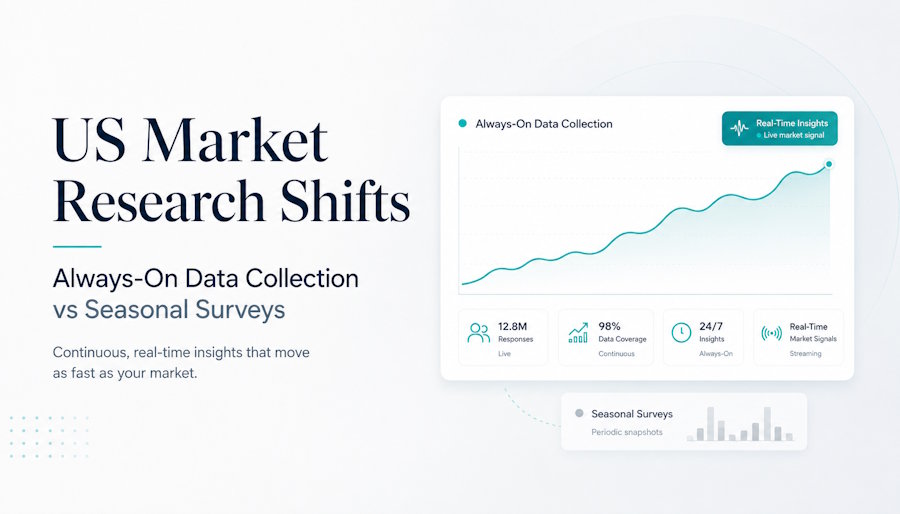
US enterprise organizations are replacing slow, episodic annual survey research with always-on data collection frameworks that deliver continuous customer sentiment signals integrated directly into CRM and marketing automation systems. This shift enables agile, sprint-based decision-making but introduces data quality challenges including bot response contamination and authenticity verification complexity. This article explains why the transition is accelerating, how research teams structure continuous insight streams, and what verification protocols maintain true data quality in automated collection environments.
McKinsey's 2025 Enterprise Decision-Making Report Documents That Organizations Operating With Real-Time Customer Sentiment Data Make Strategic Pivots 4.3 Times Faster Than Competitors Relying on Annual Research Cycles and Those Faster Decisions Produce 19% Higher Revenue Growth Rates on Average
The annual survey model was not abandoned because it produced bad data. It was abandoned because it produced accurate data about conditions that had already changed by the time the analysis was complete. A consumer sentiment survey conducted in Q1, analyzed through Q2, presented to leadership in Q3, and incorporated into Q4 planning reflects market conditions from nine to twelve months prior. In market environments where competitive dynamics, consumer confidence, and product category perception shift quarterly, that research cadence is structurally misaligned with the decision speed that enterprise leadership now requires.
Why Enterprise Leaders Are Replacing Annual Surveys With Continuous Insight Streams
Real-time customer sentiment data streams integrated with CRM systems allow enterprise organizations to monitor net promoter trends, product satisfaction signals, purchase intent indicators, and competitive perception shifts on a rolling basis rather than at defined annual intervals. The data sources feeding these continuous streams include: in-product behavioral analytics capturing feature engagement and abandonment patterns; post-interaction survey micro-pulses sent within 24 hours of a customer touchpoint; social listening pipelines monitoring brand and category sentiment across indexed platforms; and review platform monitoring tracking rating distribution shifts and qualitative feedback themes in near real time.
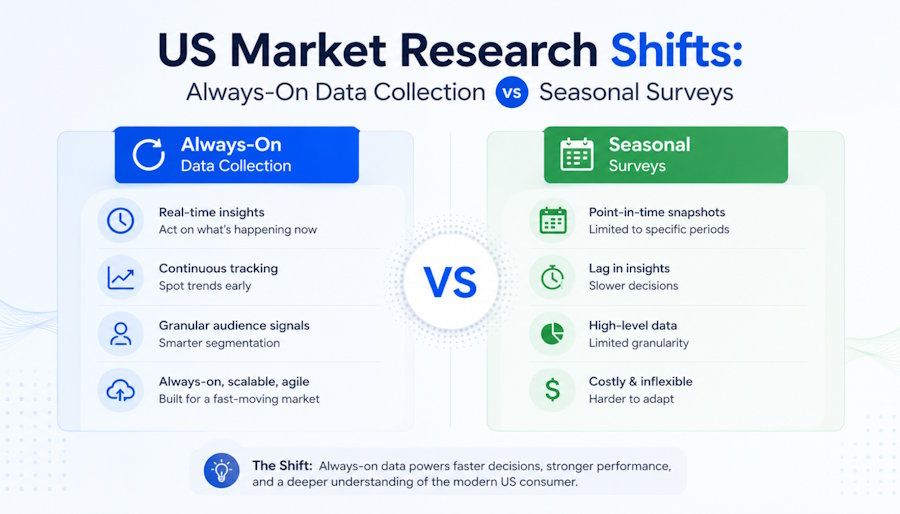
The operational difference between annual survey research and always-on collection is not just cadence. It is integration architecture. Annual survey data produces a static report that enters a distribution and review process before influencing any decision. Agile sprint-based market research metrics feed directly into CRM workflow triggers, marketing automation personalization logic, and product development backlog prioritization. The data influences decisions at the moment it becomes available rather than after it has traversed a reporting infrastructure designed for periodic consumption.
According to Qualtrics' 2025 State of Experience Management Report, enterprises operating continuous experience measurement programs identify product satisfaction issues an average of 67 days earlier than enterprises conducting equivalent annual surveys, and resolve them an average of 43 days faster due to the compressed interval between signal detection and organizational response.
How Research Teams Verify Response Authenticity in Automated Collection Environments
Participant response authenticity verification is the data quality challenge that always-on collection introduces at a scale that episodic survey research, with its smaller sample sizes and controlled distribution lists, never encountered at equivalent severity. Continuous data collection pipelines operating at high volume attract automated bot responses, incentive-farming behavior from survey panels, and synthetic response patterns generated by individuals providing random or patterned answers to complete collection requirements without genuine engagement.
The verification protocols that maintain true data quality in real-time sentiment streams operate across three detection layers. Behavioral validation analyzes response timing patterns: human respondents demonstrate natural variation in time-per-question; bot responses exhibit either unnaturally uniform timing or implausibly fast completion patterns. Semantic coherence analysis evaluates whether open-text responses demonstrate genuine topic engagement; large language model-based semantic classifiers identify responses with high keyword relevance but low contextual coherence as synthetic generation artifacts.
Statistical anomaly detection monitors response distribution shifts that indicate panel contamination: sudden increases in identical response patterns across distinct respondent profiles, geographic clustering inconsistent with target population distribution, or rating scale distribution spikes that deviate from established baseline patterns.
The digital research infrastructure underlying continuous data collection requires the same technical rigor applied to any marketing data pipeline; the agency ecosystem structuring enterprise market research and digital marketing integration for US brands is documented in this analysis of top digital marketing agencies and their research service capabilities. The full framework for continuous market research integrated with digital marketing performance measurement is detailed in c3digitus's market research services methodology.
The Agency Consensus
Research teams presenting annual survey findings to enterprise leadership in 2026 are delivering the equivalent of last year's weather report to an organization deciding whether to carry an umbrella today. The data is accurate. The conditions it describes no longer exist.
Building the Always-On Research Infrastructure That Compounds Strategic Advantage
Forrester's 2025 Customer Intelligence Enterprise Survey documents that organizations with mature always-on research programs reinvest insight generation capacity into strategic decision-making at 2.7 times the rate of organizations managing equivalent research budgets through annual program structures. The compounding effect is not just speed; it is the organizational learning curve that continuous data exposure accelerates. Teams that review customer sentiment weekly develop pattern recognition capabilities that teams reviewing annual survey decks annually never acquire.
The always-on research infrastructure is not a data collection upgrade. It is an organizational intelligence development system whose returns compound with every sprint cycle that produces an insight, tests a response, and measures the outcome within the same quarter the signal was first detected.

