

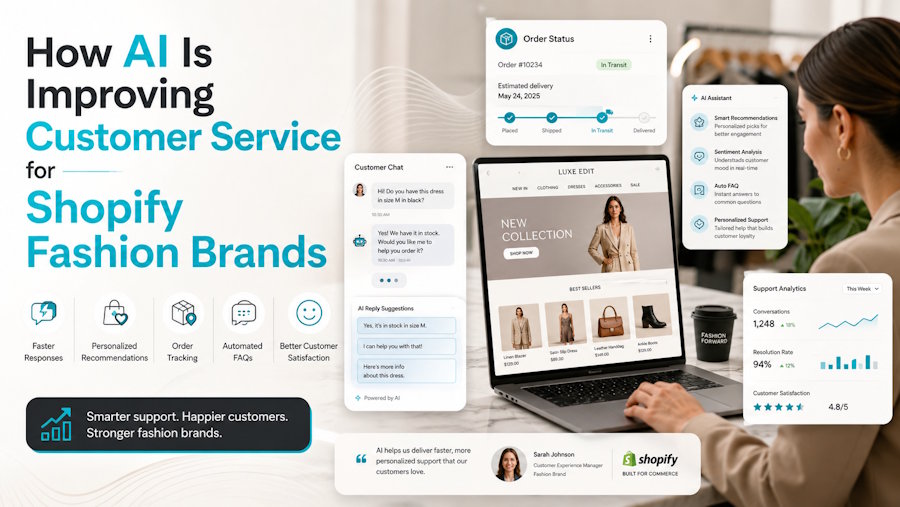
Customer expectations in ecommerce have changed rapidly. Shoppers now expect fast answers, accurate product information, and support at almost any time of day. For Shopify fashion brands, this creates a challenge: how do you deliver better customer service without dramatically increasing staffing costs?
Artificial intelligence is increasingly becoming part of the answer.
AI-powered customer service tools can connect with Shopify stores to answer common questions automatically. Instead of customers waiting for a team member to respond to questions about delivery, returns, sizing, or stock availability, AI can provide useful information within seconds.
This is particularly valuable for fashion retailers, where customers frequently need help before making a purchase. Questions such as “What size should I order?”, “Is this suit available in another colour?” or “Can this arrive before my wedding?” can directly influence whether someone completes their order.
AI can also use information already stored within a Shopify store. Through integrations and APIs, customer service systems can access relevant product, order, and inventory data. This allows businesses to provide more personalised answers rather than relying on generic chatbot responses.
For example, a customer could ask where their order is and receive an update based on their actual order information. Another shopper could ask whether a particular three-piece suit is available in their size and receive an immediate response based on current stock.
The benefit is not simply reduced workload.
Better customer service can have a direct impact on conversion rates. If a potential customer has a question while considering a purchase, removing uncertainty quickly can prevent them from abandoning the website and buying elsewhere.
AI can also identify conversations that genuinely require human assistance. Rather than replacing customer service teams, the technology can filter repetitive enquiries while allowing staff to focus on more complex or valuable customer interactions.
Fashion retailers such as Paul Andrew operate in a market where purchasing decisions often involve questions around fit, occasion, delivery, and product choice. Using technology to answer those questions more efficiently can create a smoother buying experience while helping customers feel more confident before ordering.
The next stage of ecommerce customer service is therefore likely to be a combination of automation and human support.
Shopify provides the infrastructure, APIs allow systems to communicate with one another, and AI provides an increasingly intelligent layer between the customer and the retailer.
For ecommerce brands, the opportunity is not simply to automate customer service. It is to use technology to make the buying experience faster, easier, and more helpful.

